QUESTION IMAGE
Question
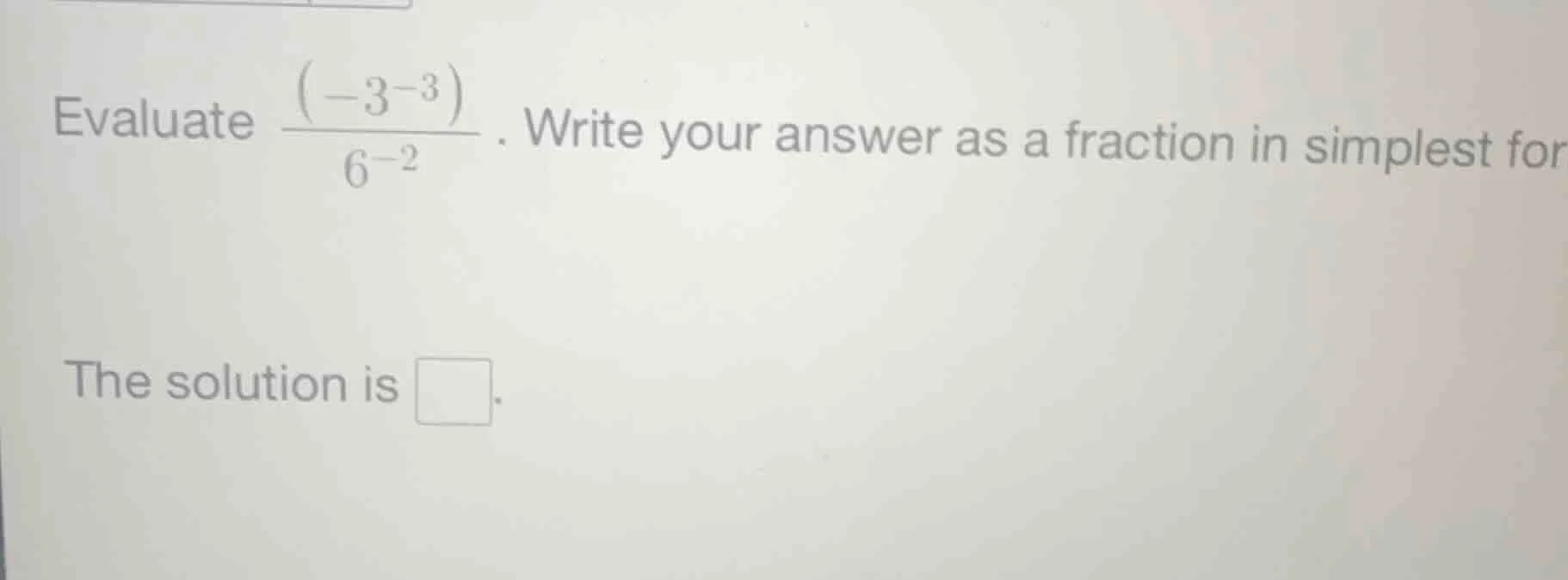
evaluate \\(\frac{(-3^{-3})}{6^{-2}}\\). write your answer as a fraction in simplest for the solution is \\(\square\\).
Step1: Simplify negative exponents
Recall that \( a^{-n} = \frac{1}{a^n} \). So, \( -3^{-3} = -\frac{1}{3^3} = -\frac{1}{27} \) and \( 6^{-2} = \frac{1}{6^2} = \frac{1}{36} \). The expression becomes \( \frac{-\frac{1}{27}}{\frac{1}{36}} \).
Step2: Divide by a fraction (multiply by reciprocal)
Dividing by a fraction is the same as multiplying by its reciprocal. So, \( \frac{-\frac{1}{27}}{\frac{1}{36}} = -\frac{1}{27} \times 36 \).
Step3: Simplify the multiplication
Simplify \( -\frac{1}{27} \times 36 \). We can reduce \( \frac{36}{27} \) by dividing numerator and denominator by 9: \( \frac{36 \div 9}{27 \div 9} = \frac{4}{3} \). So, \( -\frac{1}{27} \times 36 = -\frac{4}{3} \)? Wait, no, wait. Wait, \( 36 \div 27 = \frac{4}{3} \), but with the negative sign, it's \( -\frac{36}{27} = -\frac{4}{3} \)? Wait, no, let's check again. Wait, \( -3^{-3} \) is \( - (3^3)^{-1} = - \frac{1}{3^3} = - \frac{1}{27} \). Then the denominator is \( 6^{-2} = \frac{1}{6^2} = \frac{1}{36} \). So the expression is \( (- \frac{1}{27}) \div (\frac{1}{36}) = (- \frac{1}{27}) \times 36 = - \frac{36}{27} = - \frac{4}{3} \)? Wait, no, that can't be right. Wait, maybe I messed up the sign. Wait, \( -3^{-3} \): is it \( (-3)^{-3} \) or \( - (3^{-3}) \)? The original expression is \( (-3^{-3}) \), so it's \( - (3^{-3}) \), which is \( - \frac{1}{3^3} = - \frac{1}{27} \). Then the denominator is \( 6^{-2} = \frac{1}{36} \). So dividing \( - \frac{1}{27} \) by \( \frac{1}{36} \) is \( - \frac{1}{27} \times 36 = - \frac{36}{27} = - \frac{4}{3} \)? Wait, but let's check again. Wait, \( 36 \) and \( 27 \) have a common factor of 9. \( 36 \div 9 = 4 \), \( 27 \div 9 = 3 \). So \( - \frac{36}{27} = - \frac{4}{3} \). Wait, but that seems off. Wait, maybe I made a mistake in the sign. Wait, is \( -3^{-3} \) equal to \( (-3)^{-3} \)? Let's clarify: \( -3^{-3} = - (3^3)^{-1} = - \frac{1}{27} \), while \( (-3)^{-3} = \frac{1}{(-3)^3} = - \frac{1}{27} \). Oh, so in this case, \( -3^{-3} \) is the same as \( (-3)^{-3} \), which is \( - \frac{1}{27} \). So then the calculation is correct. Wait, but let's re-express the original expression:
\( \frac{ -3^{-3} }{ 6^{-2} } = \frac{ - \frac{1}{3^3} }{ \frac{1}{6^2} } = \frac{ - \frac{1}{27} }{ \frac{1}{36} } = - \frac{1}{27} \times 36 = - \frac{36}{27} = - \frac{4}{3} \). Wait, but that seems negative. Let me check the exponent rules again. \( a^{-n} = \frac{1}{a^n} \), so \( 3^{-3} = \frac{1}{27} \), so \( -3^{-3} = - \frac{1}{27} \). Then \( 6^{-2} = \frac{1}{36} \), so dividing by \( \frac{1}{36} \) is multiplying by 36. So \( - \frac{1}{27} \times 36 = - \frac{36}{27} = - \frac{4}{3} \). Yes, that's correct.

Snap & solve any problem in the app
Get step-by-step solutions on Sovi AI
Photo-based solutions with guided steps
Explore more problems and detailed explanations
\( -\frac{4}{3} \)