QUESTION IMAGE
Question
evaluation video
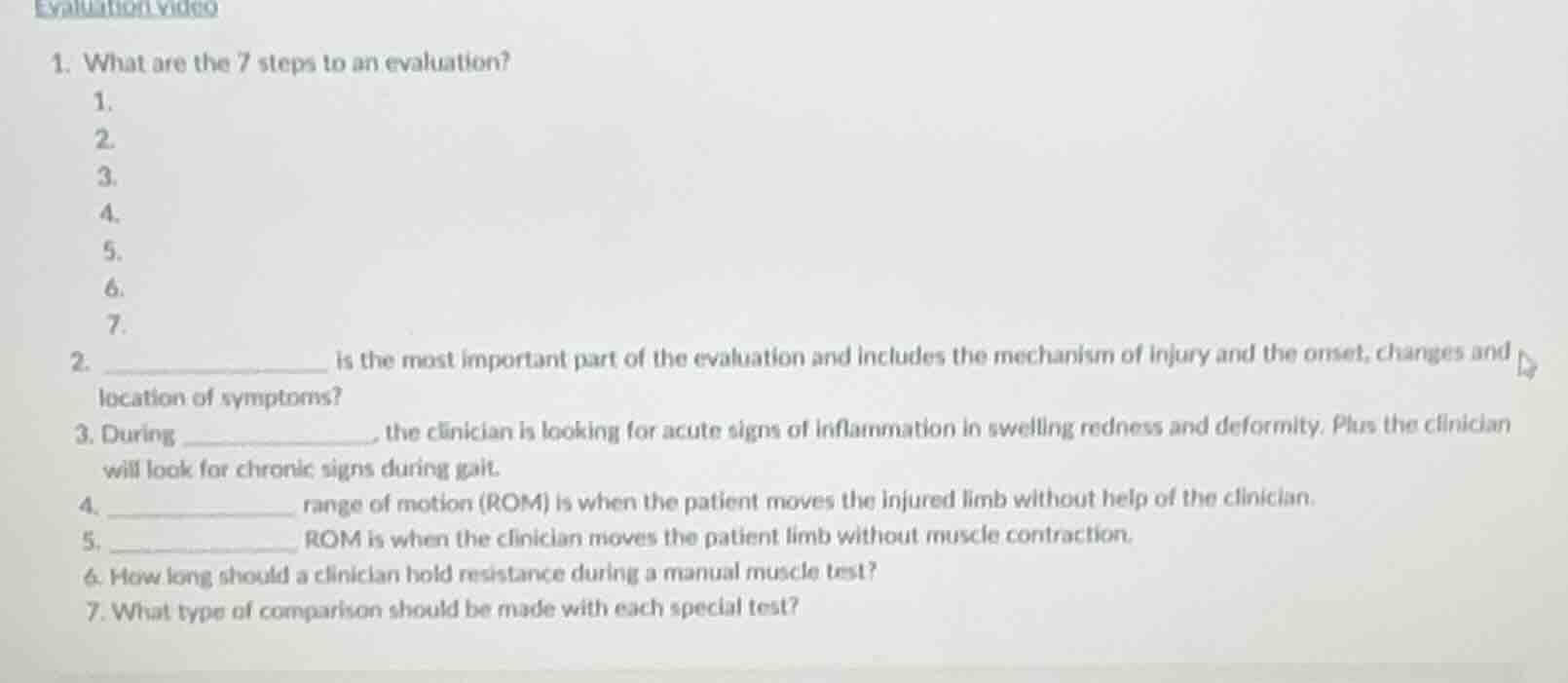
- what are the 7 steps to an evaluation?
1.
2.
3.
4.
5.
6.
7.
- ____________ is the most important part of the evaluation and includes the mechanism of injury and the onset, changes and location of symptoms?
- during ____________, the clinician is looking for acute signs of inflammation in swelling redness and deformity. plus the clinician will look for chronic signs during gait.
- ____________ range of motion (rom) is when the patient moves the injured limb without help of the clinician.
- ____________ rom is when the clinician moves the patient limb without muscle contraction.
- how long should a clinician hold resistance during a manual muscle test?
- what type of comparison should be made with each special test?
Question 1
The 7 steps of a typical evaluation (e.g., in sports medicine or physical therapy) are: 1. History (taking patient's history), 2. Observation (visual assessment), 3. Palpation (touching to assess), 4. Active Range of Motion (AROM), 5. Passive Range of Motion (PROM), 6. Manual Muscle Testing (MMT), 7. Special Tests (specific diagnostic tests).
The "History" (or "Patient History") is crucial as it captures mechanism of injury, symptom onset, changes, and location. It’s the first step to understand the problem.
"Observation" is the phase where clinicians visually check for acute (swelling, redness, deformity) and chronic (gait - related) signs. It’s the visual assessment step.

Snap & solve any problem in the app
Get step-by-step solutions on Sovi AI
Photo-based solutions with guided steps
Explore more problems and detailed explanations
- History
- Observation
- Palpation
- Active Range of Motion (AROM)
- Passive Range of Motion (PROM)
- Manual Muscle Testing (MMT)
- Special Tests