QUESTION IMAGE
Question
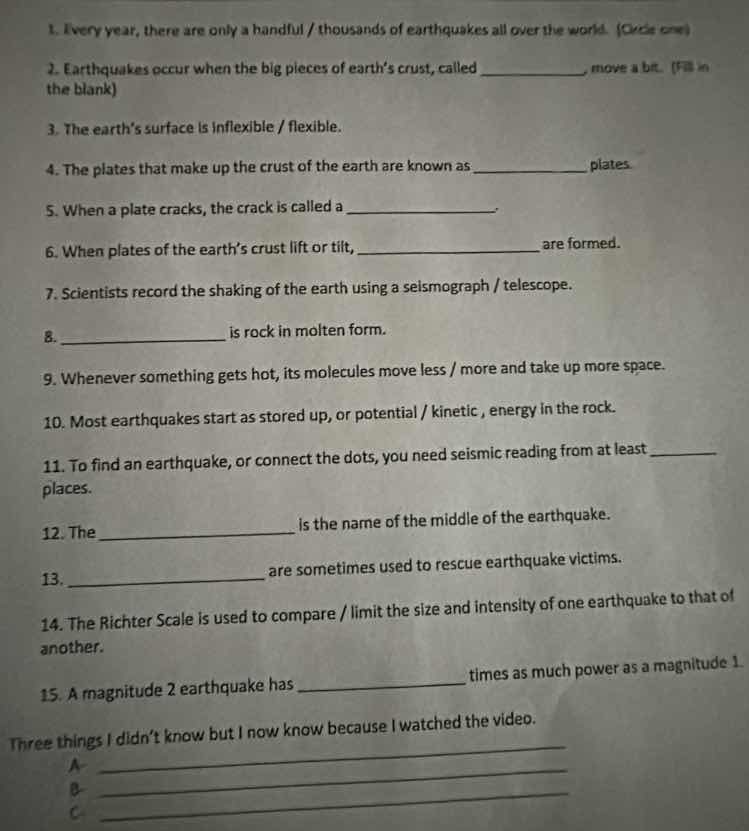
- every year, there are only a handful / thousands of earthquakes all over the world. (circle one)2. earthquakes occur when the big pieces of earths crust, called __________, move a bit. (fill in the blank)3. the earths surface is inflexible / flexible.4. the plates that make up the crust of the earth are known as ________ plates.5. when a plate cracks, the crack is called a ________.6. when plates of the earths crust lift or tilt, ________ are formed.7. scientists record the shaking of the earth using a seismograph / telescope.8. ________ is rock in molten form.9. whenever something gets hot, its molecules move less / more and take up more space.10. most earthquakes start as stored up, or potential / kinetic, energy in the rock.11. to find an earthquake, or connect the dots, you need seismic reading from at least ________ places.12. the ________ is the name of the middle of the earthquake.13. ________ are sometimes used to rescue earthquake victims.14. the richter scale is used to compare / limit the size and intensity of one earthquake to that of another.15. a magnitude 2 earthquake has ________ times as much power as a magnitude 1.three things i didnt know but i now know because i watched the video.a- ________b- ________c- __________
Brief Explanations
These are fill-in-the-blank and multiple-choice questions focused on basic earthquake and earth science concepts, with answers based on standard geology knowledge.

Snap & solve any problem in the app
Get step-by-step solutions on Sovi AI
Photo-based solutions with guided steps
Explore more problems and detailed explanations
- thousands
- tectonic plates
- inflexible
- tectonic
- fault
- mountains
- seismograph
- Magma
- more
- potential
- 3
- epicenter
- Search and rescue dogs (or heavy machinery)
- compare
- 32
A- (Example: Most earthquakes originate from tectonic plate movement, not random crust shifts)
B- (Example: The Richter Scale is logarithmic, so each magnitude increase is 32x stronger)
C- (Example: Seismographs use seismic waves to pinpoint earthquake locations)