QUESTION IMAGE
Question
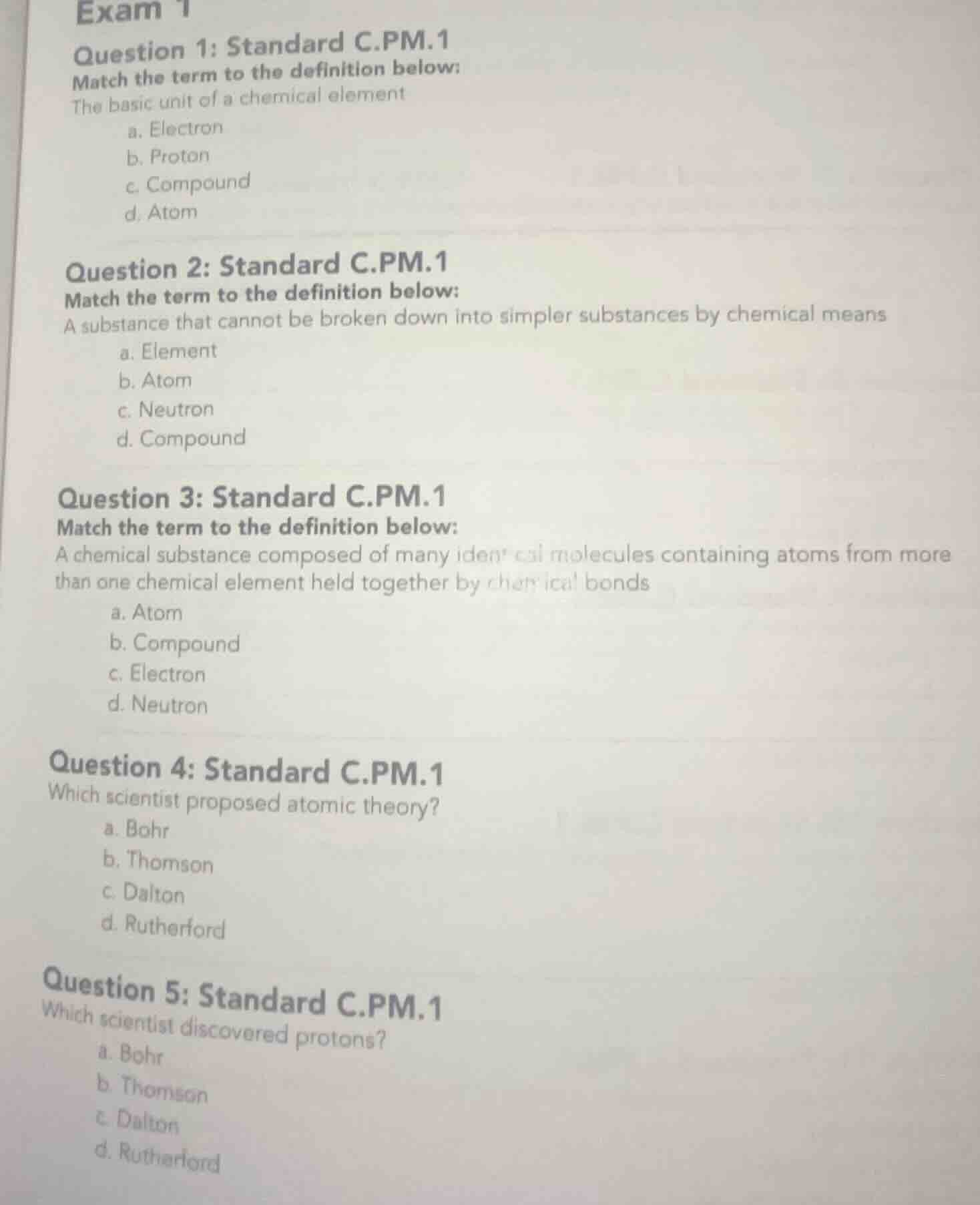
exam 1
question 1: standard c.pm.1
match the term to the definition below:
the basic unit of a chemical element
a. electron
b. proton
c. compound
d. atom
question 2: standard c.pm.1
match the term to the definition below:
a substance that cannot be broken down into simpler substances by chemical means
a. element
b. atom
c. neutron
d. compound
question 3: standard c.pm.1
match the term to the definition below:
a chemical substance composed of many identical molecules containing atoms from more than one chemical element held together by chemical bonds
a. atom
b. compound
c. electron
d. neutron
question 4: standard c.pm.1
which scientist proposed atomic theory?
a. bohr
b. thomson
c. dalton
d. rutherford
question 5: standard c.pm.1
which scientist discovered protons?
a. bohr
b. thomson
c. dalton
d. rutherford
- The basic unit of a chemical element is an atom; electrons and protons are subatomic particles, and a compound is made of multiple elements.
- An element is a pure substance that cannot be chemically broken down into simpler substances; atoms are its units, neutrons are subatomic, and compounds are combinations of elements.
- A compound is a substance made of molecules with atoms from multiple elements bonded together; the other options are subatomic particles or single element units.
- John Dalton proposed the modern atomic theory; Bohr, Thomson, and Rutherford expanded or modified atomic models later.
- Ernest Rutherford discovered protons through his gold foil experiment and related research; the other scientists focused on other atomic structure discoveries or models.

Snap & solve any problem in the app
Get step-by-step solutions on Sovi AI
Photo-based solutions with guided steps
Explore more problems and detailed explanations
- d. Atom
- a. Element
- b. Compound
- c. Dalton
- d. Rutherford