QUESTION IMAGE
Question
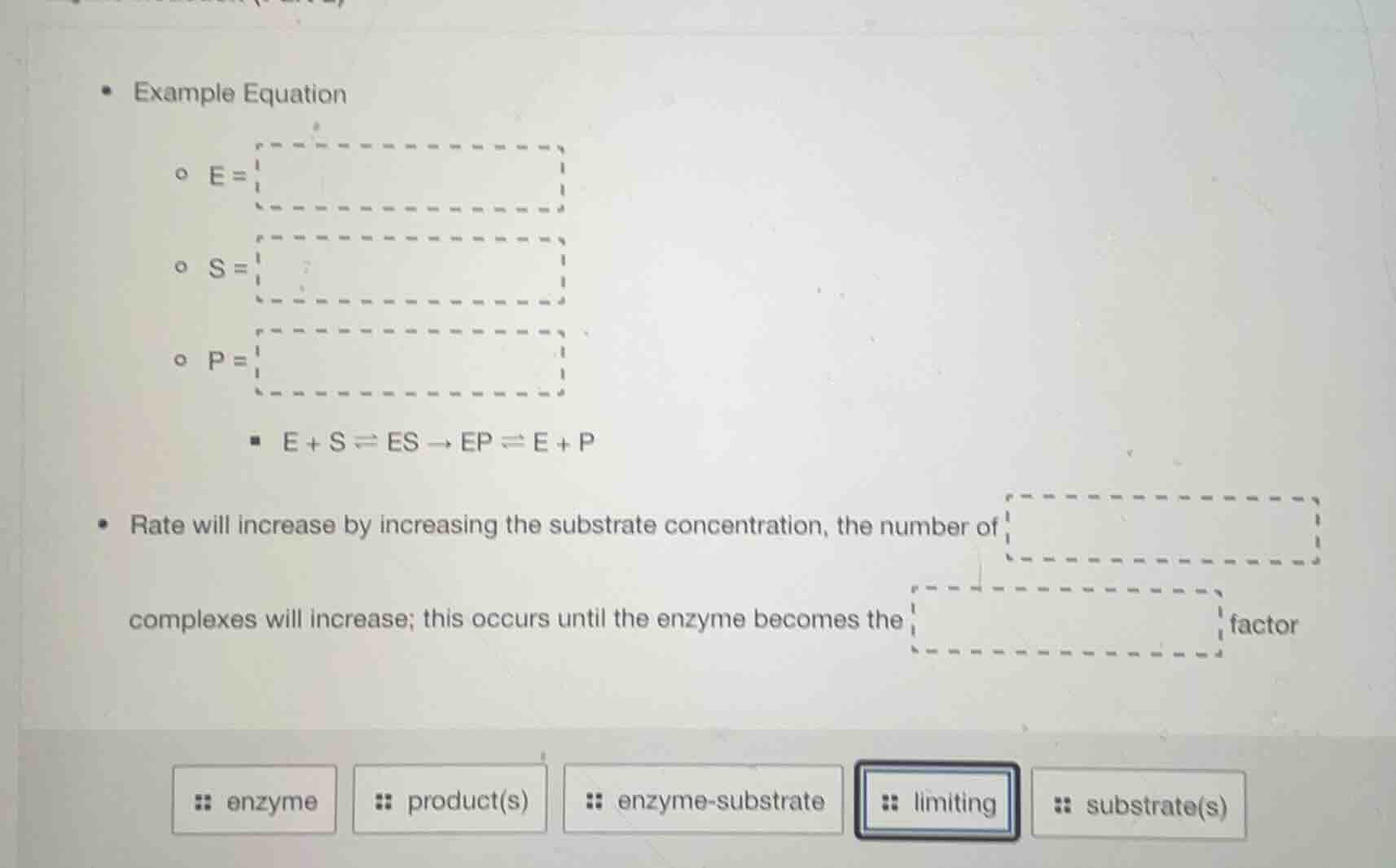
- example equation
◦ e= dashed box
◦ s= dashed box
◦ p= dashed box
▪ e + s ⇌ es → ep ⇌ e + p
- rate will increase by increasing the substrate concentration, the number of dashed box
complexes will increase; this occurs until the enzyme becomes the dashed box factor
buttons: enzyme, product(s), enzyme - substrate, limiting, substrate(s)
Response
To solve this fill - in - the - blank problem related to enzyme - substrate reactions, we analyze each blank based on the knowledge of enzyme kinetics:
For the first set of blanks (E, S, P):
- In the context of enzyme - catalyzed reactions, \(E\) stands for enzyme, \(S\) stands for substrate, and \(P\) stands for product. So:
- \(E=\) enzyme
- \(S=\) substrate(s)
- \(P=\) product(s)
For the sentence about the rate and complexes:
- When we increase the substrate concentration, the number of enzyme - substrate (\(ES\)) complexes will increase. So the first blank in the sentence “Rate will increase by increasing the substrate concentration, the number of \(\underline{\quad}\) complexes will increase” is filled with enzyme - substrate.
- As we keep increasing the substrate concentration, after a certain point, the enzyme becomes the limiting factor because all the enzyme active sites are occupied and further increase in substrate concentration does not increase the reaction rate. So the second blank in “this occurs until the enzyme becomes the \(\underline{\quad}\) factor” is filled with limiting.
Final Answers:
- \(E=\) enzyme
- \(S=\) substrate(s)
- \(P=\) product(s)
- “Rate will increase by increasing the substrate concentration, the number of \(\boldsymbol{\text{enzyme - substrate}}\) complexes will increase; this occurs until the enzyme becomes the \(\boldsymbol{\text{limiting}}\) factor”

Snap & solve any problem in the app
Get step-by-step solutions on Sovi AI
Photo-based solutions with guided steps
Explore more problems and detailed explanations
To solve this fill - in - the - blank problem related to enzyme - substrate reactions, we analyze each blank based on the knowledge of enzyme kinetics:
For the first set of blanks (E, S, P):
- In the context of enzyme - catalyzed reactions, \(E\) stands for enzyme, \(S\) stands for substrate, and \(P\) stands for product. So:
- \(E=\) enzyme
- \(S=\) substrate(s)
- \(P=\) product(s)
For the sentence about the rate and complexes:
- When we increase the substrate concentration, the number of enzyme - substrate (\(ES\)) complexes will increase. So the first blank in the sentence “Rate will increase by increasing the substrate concentration, the number of \(\underline{\quad}\) complexes will increase” is filled with enzyme - substrate.
- As we keep increasing the substrate concentration, after a certain point, the enzyme becomes the limiting factor because all the enzyme active sites are occupied and further increase in substrate concentration does not increase the reaction rate. So the second blank in “this occurs until the enzyme becomes the \(\underline{\quad}\) factor” is filled with limiting.
Final Answers:
- \(E=\) enzyme
- \(S=\) substrate(s)
- \(P=\) product(s)
- “Rate will increase by increasing the substrate concentration, the number of \(\boldsymbol{\text{enzyme - substrate}}\) complexes will increase; this occurs until the enzyme becomes the \(\boldsymbol{\text{limiting}}\) factor”