QUESTION IMAGE
Question
example 3
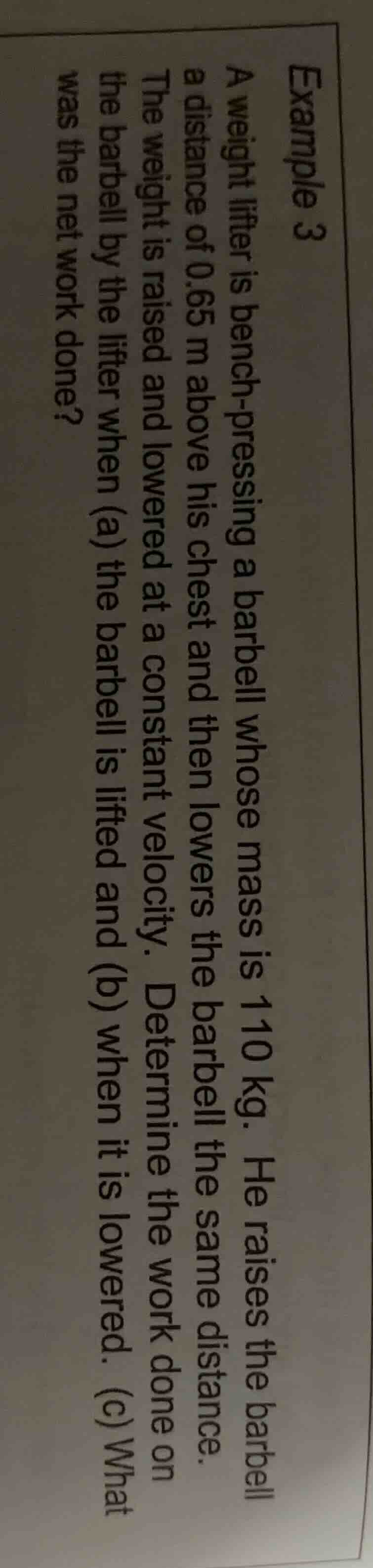
a weight lifter is bench - pressing a barbell whose mass is 110 kg. he raises the barbell a distance of 0.65 m above his chest and then lowers the barbell the same distance. the weight is raised and lowered at a constant velocity. determine the work done on the barbell by the lifter when (a) the barbell is lifted and (b) when it is lowered. (c) what was the net work done?
Step1: Calculate barbell weight
First, find the weight (force due to gravity) of the barbell using $F = mg$. Take $g = 9.8\ \text{m/s}^2$.
$F = 110\ \text{kg} \times 9.8\ \text{m/s}^2 = 1078\ \text{N}$
Step2: Work done lifting barbell
Work is force times distance, with force and displacement in the same direction.
$W_{\text{lift}} = F \times d = 1078\ \text{N} \times 0.65\ \text{m} = 700.7\ \text{J}$
Step3: Work done lowering barbell
Force opposes displacement, so work is negative.
$W_{\text{lower}} = -F \times d = -1078\ \text{N} \times 0.65\ \text{m} = -700.7\ \text{J}$
Step4: Calculate net work
Sum work from lift and lower.
$W_{\text{net}} = W_{\text{lift}} + W_{\text{lower}} = 700.7\ \text{J} + (-700.7\ \text{J}) = 0\ \text{J}$

Snap & solve any problem in the app
Get step-by-step solutions on Sovi AI
Photo-based solutions with guided steps
Explore more problems and detailed explanations
(a) $700.7\ \text{J}$
(b) $-700.7\ \text{J}$
(c) $0\ \text{J}$