QUESTION IMAGE
Question
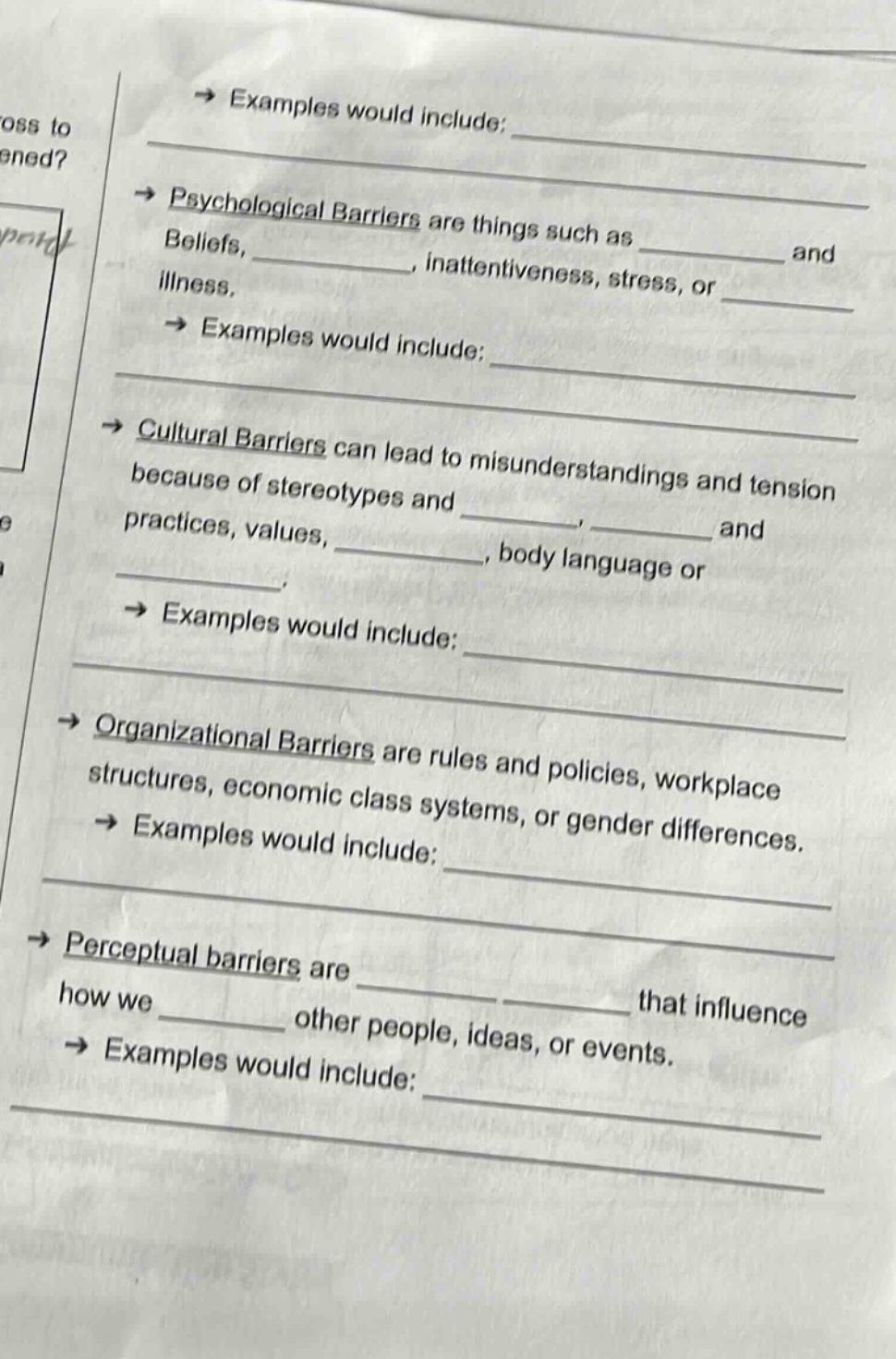
→ examples would include:
→ psychological barriers are things such as and beliefs, , inattentiveness, stress, or illness.
→ examples would include:
→ cultural barriers can lead to misunderstandings and tension because of stereotypes and , and practices, values, , body language or .
→ examples would include:
→ organizational barriers are rules and policies, workplace structures, economic class systems, or gender differences.
→ examples would include:
→ perceptual barriers are that influence how we other people, ideas, or events.
→ examples would include:
Response
Psychological Barriers
- Fill - ins: Attitudes, Prejudices, Fatigue
- Examples Explanation: Psychological barriers relate to mental and emotional factors. Attitudes shape how we approach communication, prejudices can cloud judgment, and fatigue affects our mental capacity. For example, a person with a negative attitude towards a new policy may misinterpret communication about it; someone with prejudice against a group may not listen to their ideas; and fatigue can make a student unable to focus on a teacher's lecture.
- Examples: A manager with a negative attitude towards remote work misinterpreting communication about remote work policies; a person with prejudice against a certain race not listening to a colleague from that race; a tired employee not being able to focus on a team - meeting discussion.
Cultural Barriers
- Fill - ins: Biases, Norms, Language, Gestures
- Examples Explanation: Cultural barriers stem from differences in cultural elements. Biases and norms vary across cultures, language is a key cultural marker, and gestures (part of body language) have different meanings in different cultures. For example, in some cultures, direct eye contact is a sign of respect, while in others it's seen as rude (norms/gestures); a company with employees from different language backgrounds may face miscommunication due to language differences; and biases about other cultures' work ethics can lead to tension.
- Examples: A business deal failing because a Western - style direct communication was seen as rude in an Asian culture (norms); a team miscommunicating because one member speaks English and another speaks only Spanish (language); a manager having a bias that Asian employees are overly submissive (biases).
Organizational Barriers
- Examples Explanation: Organizational barriers are related to the structure and policies of an organization. For example, a company with a very hierarchical structure may have slow communication as ideas have to go through many levels; an economic class system in a company (where employees from lower economic backgrounds are not given equal opportunities to communicate) can be a barrier; and gender differences in a male - dominated workplace where female employees' ideas are overlooked.
- Examples: A large corporation where a junior employee's idea has to go through 5 levels of management before being considered (workplace structure); a company where employees from lower economic backgrounds are not invited to high - level strategy meetings (economic class systems); a tech startup where female developers' suggestions are ignored because of gender biases in the workplace (gender differences).
Perceptual Barriers
- Fill - ins: Mental Filters, Perceive
- Examples Explanation: Perceptual barriers are about how our mental processes filter and interpret information. Mental filters are the biases, experiences, and beliefs that shape our perception. They influence how we perceive others, ideas, or events. For example, a person who has had a bad experience with a certain type of marketing (mental filter) may misperceive a new marketing idea as bad; a manager who has a filter of "young employees are inexperienced" may misperceive a young employee's innovative idea.
- Examples: A teacher who believes "all athletes are not good at academics" (mental filter) misperceiving a student - athlete's academic potential; a consumer who had a bad experience with a brand (mental filter) misperceiving a new product from that brand as low - quality.

Snap & solve any problem in the app
Get step-by-step solutions on Sovi AI
Photo-based solutions with guided steps
Explore more problems and detailed explanations
Psychological Barriers
- Fill - ins: Attitudes, Prejudices, Fatigue
- Examples Explanation: Psychological barriers relate to mental and emotional factors. Attitudes shape how we approach communication, prejudices can cloud judgment, and fatigue affects our mental capacity. For example, a person with a negative attitude towards a new policy may misinterpret communication about it; someone with prejudice against a group may not listen to their ideas; and fatigue can make a student unable to focus on a teacher's lecture.
- Examples: A manager with a negative attitude towards remote work misinterpreting communication about remote work policies; a person with prejudice against a certain race not listening to a colleague from that race; a tired employee not being able to focus on a team - meeting discussion.
Cultural Barriers
- Fill - ins: Biases, Norms, Language, Gestures
- Examples Explanation: Cultural barriers stem from differences in cultural elements. Biases and norms vary across cultures, language is a key cultural marker, and gestures (part of body language) have different meanings in different cultures. For example, in some cultures, direct eye contact is a sign of respect, while in others it's seen as rude (norms/gestures); a company with employees from different language backgrounds may face miscommunication due to language differences; and biases about other cultures' work ethics can lead to tension.
- Examples: A business deal failing because a Western - style direct communication was seen as rude in an Asian culture (norms); a team miscommunicating because one member speaks English and another speaks only Spanish (language); a manager having a bias that Asian employees are overly submissive (biases).
Organizational Barriers
- Examples Explanation: Organizational barriers are related to the structure and policies of an organization. For example, a company with a very hierarchical structure may have slow communication as ideas have to go through many levels; an economic class system in a company (where employees from lower economic backgrounds are not given equal opportunities to communicate) can be a barrier; and gender differences in a male - dominated workplace where female employees' ideas are overlooked.
- Examples: A large corporation where a junior employee's idea has to go through 5 levels of management before being considered (workplace structure); a company where employees from lower economic backgrounds are not invited to high - level strategy meetings (economic class systems); a tech startup where female developers' suggestions are ignored because of gender biases in the workplace (gender differences).
Perceptual Barriers
- Fill - ins: Mental Filters, Perceive
- Examples Explanation: Perceptual barriers are about how our mental processes filter and interpret information. Mental filters are the biases, experiences, and beliefs that shape our perception. They influence how we perceive others, ideas, or events. For example, a person who has had a bad experience with a certain type of marketing (mental filter) may misperceive a new marketing idea as bad; a manager who has a filter of "young employees are inexperienced" may misperceive a young employee's innovative idea.
- Examples: A teacher who believes "all athletes are not good at academics" (mental filter) misperceiving a student - athlete's academic potential; a consumer who had a bad experience with a brand (mental filter) misperceiving a new product from that brand as low - quality.