QUESTION IMAGE
Question
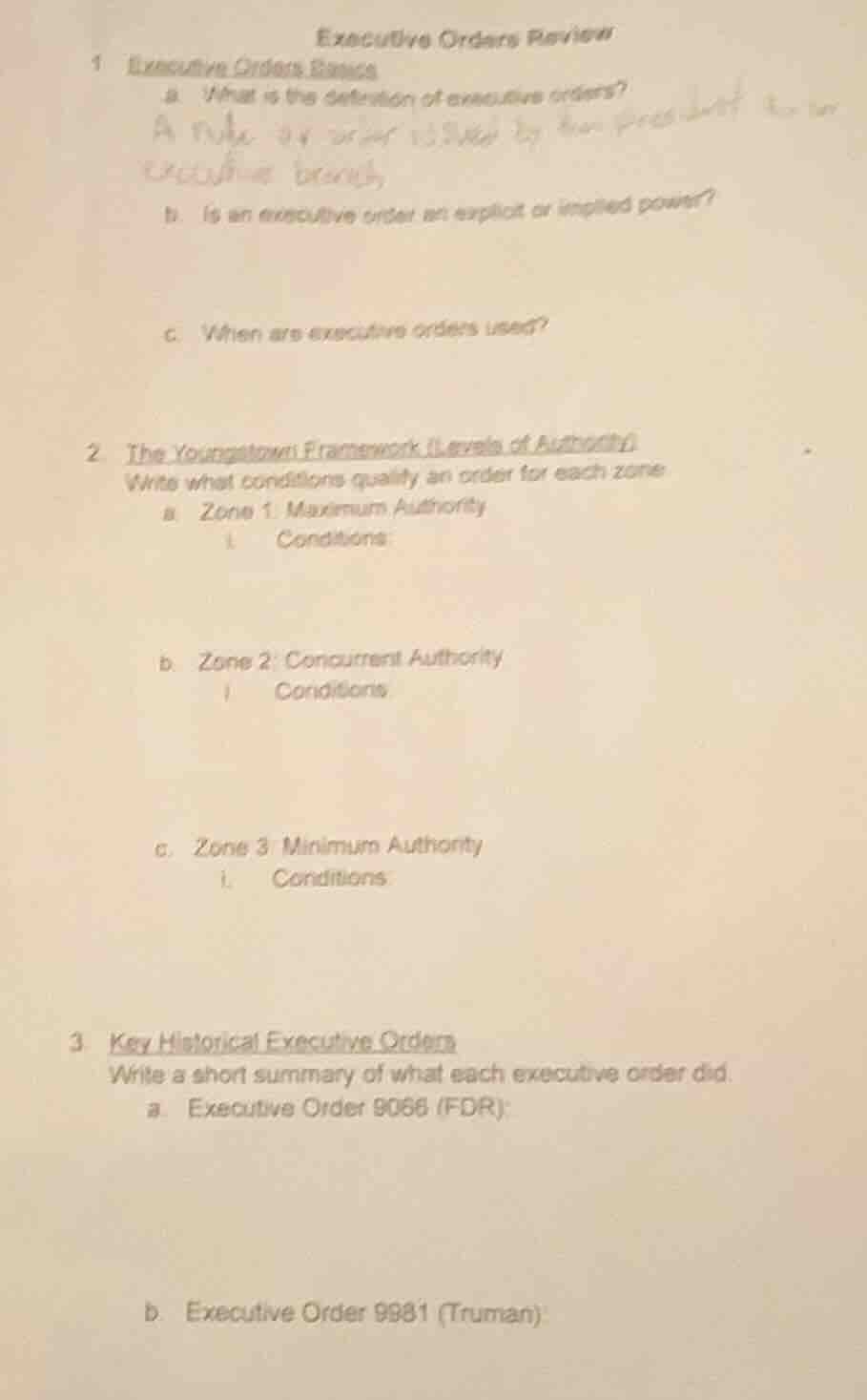
executive orders review
1 executive orders basics
a. what is the definition of executive orders?
b. is an executive order an explicit or implied power?
c. when are executive orders used?
2 the youngstown framework (levels of authority)
write what conditions qualify an order for each zone
a zone 1: maximum authority
i. conditions
b. zone 2: concurrent authority
i. conditions
c. zone 3: minimum authority
i. conditions
3 key historical executive orders
write a short summary of what each executive order did.
a. executive order 9066 (fdr):
b. executive order 9981 (truman):
- Executive Orders Basics
a. Defined as directives from the U.S. President that manage operations of the federal executive branch, having the force of law.
b. Executive orders stem from implied powers of the President, derived from constitutional roles and congressional delegations, not explicit constitutional text.
c. Used to direct federal agencies, implement laws, respond to emergencies, or clarify executive branch procedures when Congress has not acted or delegated authority.
- Youngstown Framework (Levels of Authority)
a. Zone 1 (Maximum Authority): Occurs when the President acts with explicit or implicit congressional approval, giving the strongest legal standing to the executive order.
b. Zone 2 (Concurrent Authority): Happens when congressional intent is unclear; the President's action is permissible unless Congress later contradicts it.
c. Zone 3 (Minimum Authority): Takes place when the President acts against explicit congressional will, making the order most vulnerable to judicial invalidation.
- Key Historical Executive Orders
a. Executive Order 9066 (FDR): Authorized the forced removal and internment of over 120,000 Japanese Americans, Japanese nationals, and some German/Italian Americans during World War II, citing military necessity.
b. Executive Order 9981 (Truman): Abolished racial segregation and discrimination in the United States Armed Forces, requiring equal treatment and opportunity for all service members regardless of race, color, religion, or national origin.

Snap & solve any problem in the app
Get step-by-step solutions on Sovi AI
Photo-based solutions with guided steps
Explore more problems and detailed explanations
- Executive Orders Basics
a. A directive from the U.S. President that manages federal executive branch operations and carries the force of law.
b. Implied power
c. To direct federal agencies, implement legislation, address emergencies, or formalize executive branch processes when Congress has not specified rules or has delegated authority.
- Youngstown Framework (Levels of Authority)
a. Zone 1: President acts with congressional approval (explicit/implicit)
b. Zone 2: Congressional intent is unclear; President acts without clear opposition
c. Zone 3: President acts against explicit congressional will
- Key Historical Executive Orders
a. Executive Order 9066 (FDR): Authorized the forced relocation and internment of Japanese Americans, Japanese nationals, and select German/Italian Americans during WWII.
b. Executive Order 9981 (Truman): Ended racial segregation and discrimination in the U.S. military, mandating equal treatment for all service members.