QUESTION IMAGE
Question
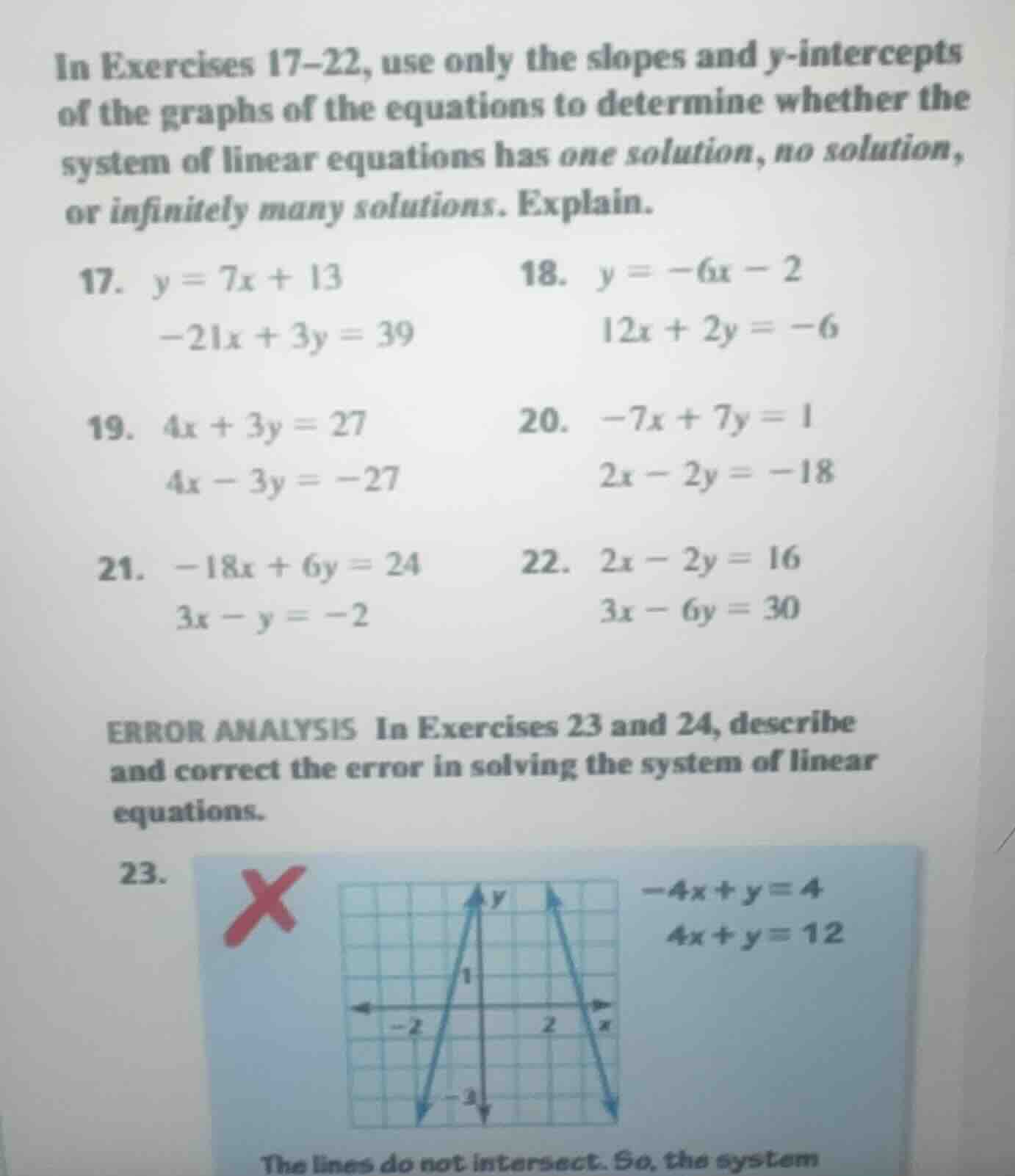
in exercises 17–22, use only the slopes and y-intercepts of the graphs of the equations to determine whether the system of linear equations has one solution, no solution, or infinitely many solutions. explain. 17. $y = 7x + 13$ $-21x + 3y = 39$ 18. $y = -6x - 2$ $12x + 2y = -6$ 19. $4x + 3y = 27$ $4x - 3y = -27$ 20. $-7x + 7y = 1$ $2x - 2y = -18$ 21. $-18x + 6y = 24$ $3x - y = -2$ 22. $2x - 2y = 16$ $3x - 6y = 30$ error analysis in exercises 23 and 24, describe and correct the error in solving the system of linear equations. 23. $-4x + y = 4$ $4x + y = 12$ the lines do not intersect. so, the system
Exercise 17
Step1: Rewrite to slope-intercept form
First equation: $y = 7x + 13$ (slope $m_1=7$, y-intercept $b_1=13$)
Second equation: $-21x + 3y = 39 \implies y = 7x + 13$ (slope $m_2=7$, y-intercept $b_2=13$)
Step2: Compare slopes and intercepts
$m_1=m_2$ and $b_1=b_2$, so lines coincide.
Exercise 18
Step1: Rewrite to slope-intercept form
First equation: $y = -6x - 2$ (slope $m_1=-6$, y-intercept $b_1=-2$)
Second equation: $12x + 2y = -6 \implies y = -6x - 3$ (slope $m_2=-6$, y-intercept $b_2=-3$)
Step2: Compare slopes and intercepts
$m_1=m_2$ but $b_1
eq b_2$, so lines are parallel.
Exercise 19
Step1: Rewrite to slope-intercept form
First equation: $4x + 3y = 27 \implies y = -\frac{4}{3}x + 9$ (slope $m_1=-\frac{4}{3}$)
Second equation: $4x - 3y = -27 \implies y = \frac{4}{3}x + 9$ (slope $m_2=\frac{4}{3}$)
Step2: Compare slopes
$m_1
eq m_2$, so lines intersect once.
Exercise 20
Step1: Rewrite to slope-intercept form
First equation: $-7x + 7y = 1 \implies y = x + \frac{1}{7}$ (slope $m_1=1$, y-intercept $b_1=\frac{1}{7}$)
Second equation: $2x - 2y = -18 \implies y = x + 9$ (slope $m_2=1$, y-intercept $b_2=9$)
Step2: Compare slopes and intercepts
$m_1=m_2$ but $b_1
eq b_2$, so lines are parallel.
Exercise 21
Step1: Rewrite to slope-intercept form
First equation: $-18x + 6y = 24 \implies y = 3x + 4$ (slope $m_1=3$, y-intercept $b_1=4$)
Second equation: $3x - y = -2 \implies y = 3x + 2$ (slope $m_2=3$, y-intercept $b_2=2$)
Step2: Compare slopes and intercepts
$m_1=m_2$ but $b_1
eq b_2$, so lines are parallel.
Exercise 22
Step1: Rewrite to slope-intercept form
First equation: $2x - 2y = 16 \implies y = x - 8$ (slope $m_1=1$)
Second equation: $3x - 6y = 30 \implies y = \frac{1}{2}x - 5$ (slope $m_2=\frac{1}{2}$)
Step2: Compare slopes
$m_1
eq m_2$, so lines intersect once.
Exercise 23
Step1: Rewrite to slope-intercept form
First equation: $-4x + y = 4 \implies y = 4x + 4$
Second equation: $4x + y = 12 \implies y = -4x + 12$
Step2: Analyze error and correct
The graph is incorrect: the slopes are $4$ and $-4$ (not equal, so lines intersect). Solve
:
$4x+4=-4x+12 \implies 8x=8 \implies x=1$, then $y=8$.

Snap & solve any problem in the app
Get step-by-step solutions on Sovi AI
Photo-based solutions with guided steps
Explore more problems and detailed explanations
- Infinitely many solutions; the two equations represent the same line (equal slopes and equal y-intercepts).
- No solution; the lines are parallel (equal slopes, different y-intercepts).
- One solution; the lines have different slopes, so they intersect at exactly one point.
- No solution; the lines are parallel (equal slopes, different y-intercepts).
- No solution; the lines are parallel (equal slopes, different y-intercepts).
- One solution; the lines have different slopes, so they intersect at exactly one point.
- Error: The graph incorrectly shows parallel lines, but the lines have slopes $4$ and $-4$ (not equal, so they intersect). Correct solution: The system has one solution $(1, 8)$.