QUESTION IMAGE
Question
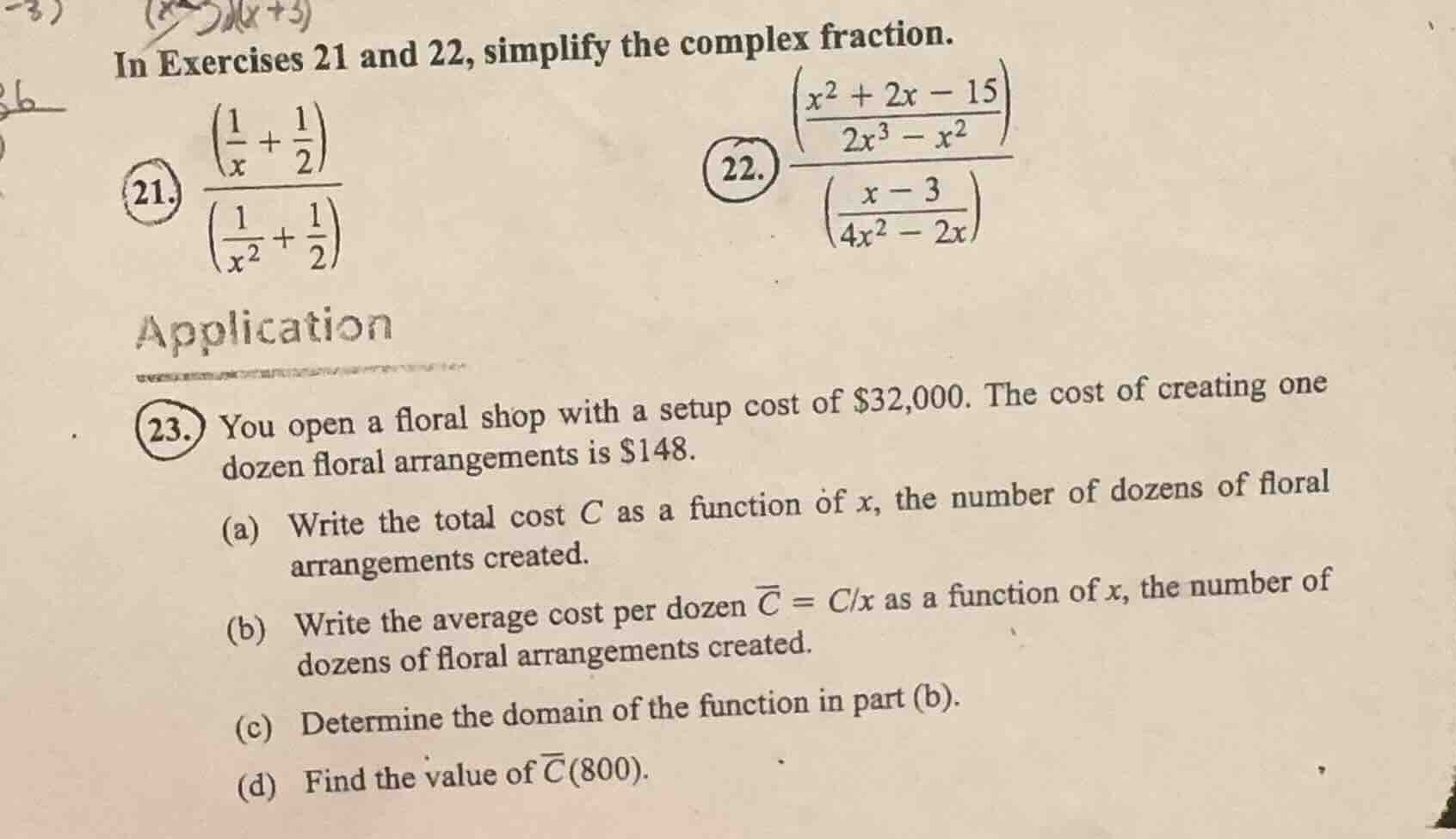
in exercises 21 and 22, simplify the complex fraction.
- \\(\dfrac{\left(\dfrac{1}{x} + \dfrac{1}{2}\
ight)}{\left(\dfrac{1}{x^2} + \dfrac{1}{2}\
ight)}
- \\(\dfrac{\left(\dfrac{x^2 + 2x - 15}{2x^3 - x^2}\
ight)}{\left(\dfrac{x - 3}{4x^2 - 2x}\
ight)}
application
- you open a floral shop with a setup cost of $32,000. the cost of creating one dozen floral arrangements is $148.
(a) write the total cost \\(c\\) as a function of \\(x\\), the number of dozens of floral arrangements created.
(b) write the average cost per dozen \\(\overline{c} = c/x\\) as a function of \\(x\\), the number of dozens of floral arrangements created.
(c) determine the domain of the function in part (b).
(d) find the value of \\(\overline{c}(800)\\).
Exercise 21: Simplify the Complex Fraction
Step 1: Simplify the numerator and denominator separately.
- Numerator: $\frac{1}{x} + \frac{1}{2} = \frac{2 + x}{2x}$ (Find a common denominator, which is $2x$, then add the fractions: $\frac{2}{2x} + \frac{x}{2x} = \frac{2 + x}{2x}$)
- Denominator: $\frac{1}{x^2} + \frac{1}{2} = \frac{2 + x^2}{2x^2}$ (Find a common denominator, which is $2x^2$, then add the fractions: $\frac{2}{2x^2} + \frac{x^2}{2x^2} = \frac{2 + x^2}{2x^2}$)
Step 2: Divide the simplified numerator by the simplified denominator.
Dividing by a fraction is the same as multiplying by its reciprocal:
$\frac{\frac{2 + x}{2x}}{\frac{2 + x^2}{2x^2}} = \frac{2 + x}{2x} \times \frac{2x^2}{2 + x^2}$
Step 3: Simplify the expression.
Cancel out the common factors:
The $2$ in the numerator and denominator cancels. One $x$ from $2x^2$ cancels with $2x$, leaving $x$ in the numerator.
So we get $\frac{(x + 2) \times x}{2 + x^2} = \frac{x(x + 2)}{x^2 + 2}$
Step 1: Factor all the polynomials.
- Numerator of the main fraction: $\frac{x^2 + 2x - 15}{2x^3 - x^2}$
- Factor the numerator: $x^2 + 2x - 15 = (x + 5)(x - 3)$ (since $5 \times (-3) = -15$ and $5 + (-3) = 2$)
- Factor the denominator: $2x^3 - x^2 = x^2(2x - 1)$ (factor out $x^2$)
- So the numerator of the main fraction becomes $\frac{(x + 5)(x - 3)}{x^2(2x - 1)}$
- Denominator of the main fraction: $\frac{x - 3}{4x^2 - 2x}$
- Factor the denominator: $4x^2 - 2x = 2x(2x - 1)$ (factor out $2x$)
- So the denominator of the main fraction becomes $\frac{x - 3}{2x(2x - 1)}$
Step 2: Divide the simplified numerator by the simplified denominator.
Dividing by a fraction is the same as multiplying by its reciprocal:
$\frac{\frac{(x + 5)(x - 3)}{x^2(2x - 1)}}{\frac{x - 3}{2x(2x - 1)}} = \frac{(x + 5)(x - 3)}{x^2(2x - 1)} \times \frac{2x(2x - 1)}{x - 3}$
Step 3: Simplify the expression.
Cancel out the common factors:
- $(x - 3)$ in the numerator and denominator cancels.
- $(2x - 1)$ in the numerator and denominator cancels.
- $2x$ in the numerator and $x^2$ in the denominator: one $x$ cancels, leaving $x$ in the denominator and $2$ in the numerator.
- So we have $\frac{(x + 5) \times 2}{x} = \frac{2(x + 5)}{x}$ (or $\frac{2x + 10}{x}$)
The total cost $C$ is the sum of the fixed setup cost and the variable cost. The setup cost is $\$32,000$, and the variable cost is $\$148$ per dozen floral arrangements. If $x$ is the number of dozens, then the variable cost is $148x$. So the total cost function is $C(x) = 32000 + 148x$.

Snap & solve any problem in the app
Get step-by-step solutions on Sovi AI
Photo-based solutions with guided steps
Explore more problems and detailed explanations
$\frac{x(x + 2)}{x^2 + 2}$ (or $\frac{x^2 + 2x}{x^2 + 2}$)