QUESTION IMAGE
Question
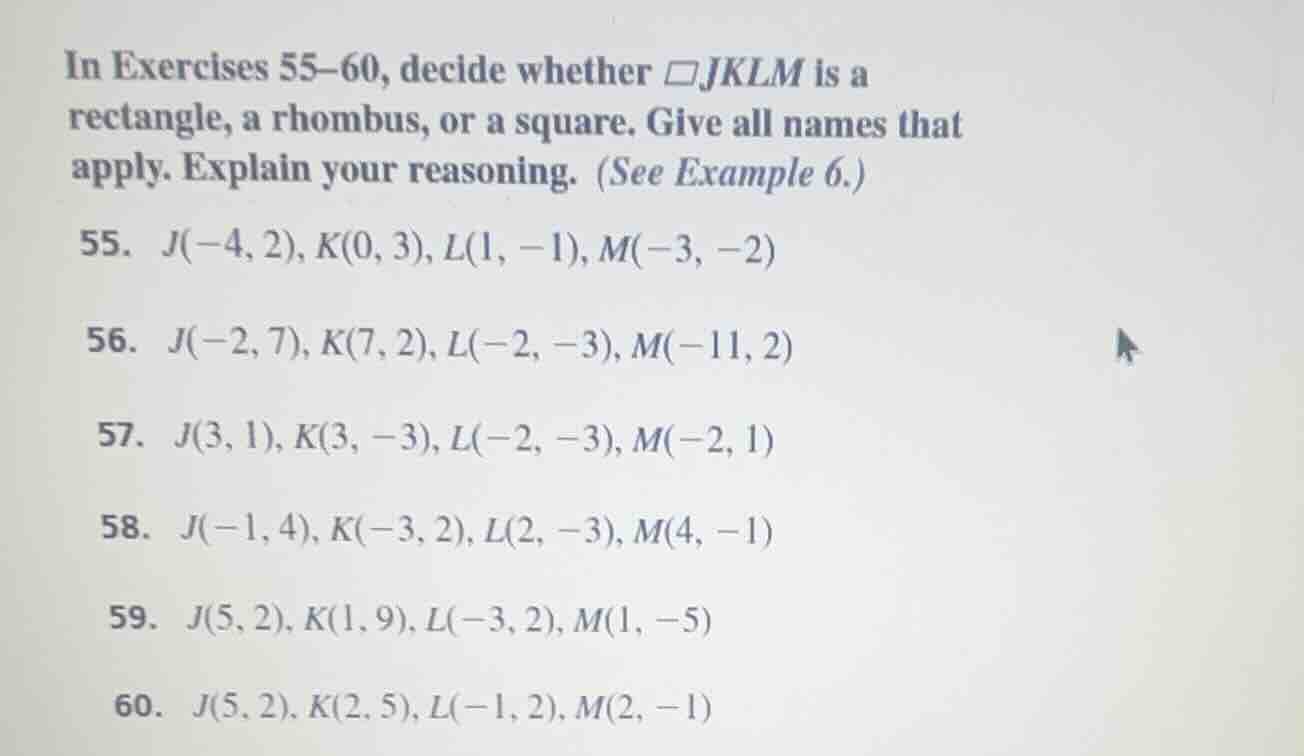
in exercises 55–60, decide whether $\square j k l m$ is a rectangle, a rhombus, or a square. give all names that apply. explain your reasoning. (see example 6.)
- $j(-4, 2), k(0, 3), l(1, -1), m(-3, -2)$
- $j(-2, 7), k(7, 2), l(-2, -3), m(-11, 2)$
- $j(3, 1), k(3, -3), l(-2, -3), m(-2, 1)$
- $j(-1, 4), k(-3, 2), l(2, -3), m(4, -1)$
- $j(5, 2), k(1, 9), l(-3, 2), m(1, -5)$
- $j(5, 2), k(2, 5), l(-1, 2), m(2, -1)$
Let's solve problem 57: \( J(3, 1), K(3, -3), L(-2, -3), M(-2, 1) \)
Step 1: Recall the properties of parallelograms, rectangles, rhombuses, and squares
- A rectangle is a parallelogram with four right angles (so the adjacent sides are perpendicular, i.e., the product of their slopes is -1).
- A rhombus is a parallelogram with four equal - length sides.
- A square is a parallelogram that is both a rectangle and a rhombus (four right angles and four equal - length sides).
First, we can find the lengths of the sides and the slopes of the sides.
Step 2: Find the lengths of the sides
The distance formula between two points \((x_1,y_1)\) and \((x_2,y_2)\) is \(d = \sqrt{(x_2 - x_1)^2+(y_2 - y_1)^2}\)
- Length of \(JK\):
For \(J(3,1)\) and \(K(3, - 3)\), \(x_1 = 3,y_1 = 1,x_2 = 3,y_2=-3\)
\(JK=\sqrt{(3 - 3)^2+(-3 - 1)^2}=\sqrt{0 + (-4)^2}=\sqrt{16}=4\)
- Length of \(KL\):
For \(K(3,-3)\) and \(L(-2,-3)\), \(x_1 = 3,y_1=-3,x_2=-2,y_2=-3\)
\(KL=\sqrt{(-2 - 3)^2+(-3+3)^2}=\sqrt{(-5)^2+0}=\sqrt{25}=5\)
- Length of \(LM\):
For \(L(-2,-3)\) and \(M(-2,1)\), \(x_1=-2,y_1=-3,x_2=-2,y_2 = 1\)
\(LM=\sqrt{(-2+2)^2+(1 + 3)^2}=\sqrt{0+16}=4\)
- Length of \(MJ\):
For \(M(-2,1)\) and \(J(3,1)\), \(x_1=-2,y_1 = 1,x_2 = 3,y_2 = 1\)
\(MJ=\sqrt{(3 + 2)^2+(1 - 1)^2}=\sqrt{25+0}=5\)
Step 3: Find the slopes of the sides
The slope formula between two points \((x_1,y_1)\) and \((x_2,y_2)\) is \(m=\frac{y_2 - y_1}{x_2 - x_1}\)
- Slope of \(JK\):
For \(J(3,1)\) and \(K(3,-3)\), \(m_{JK}=\frac{-3 - 1}{3 - 3}=\frac{-4}{0}\) (undefined, vertical line)
- Slope of \(KL\):
For \(K(3,-3)\) and \(L(-2,-3)\), \(m_{KL}=\frac{-3+3}{-2 - 3}=\frac{0}{-5}=0\) (horizontal line)
- Slope of \(LM\):
For \(L(-2,-3)\) and \(M(-2,1)\), \(m_{LM}=\frac{1 + 3}{-2+2}=\frac{4}{0}\) (undefined, vertical line)
- Slope of \(MJ\):
For \(M(-2,1)\) and \(J(3,1)\), \(m_{MJ}=\frac{1 - 1}{3 + 2}=\frac{0}{5}=0\) (horizontal line)
Step 4: Analyze the properties
- Parallelogram check: Opposite sides are equal (\(JK = LM = 4\) and \(KL = MJ = 5\)) and opposite sides are parallel (vertical lines are parallel to each other, horizontal lines are parallel to each other), so \(JKLM\) is a parallelogram.
- Rectangle check: The slope of \(JK\) is undefined (vertical line) and the slope of \(KL\) is \(0\) (horizontal line). The product of the slope of a vertical line and a horizontal line is undefined \(\times0\), but we know that a vertical line and a horizontal line are perpendicular (they form a right angle). Since adjacent sides are perpendicular, all angles are right angles. So \(JKLM\) is a rectangle.
- Rhombus check: The lengths of the sides are \(4,5,4,5\). Since not all sides are equal (\(4
eq5\)), \(JKLM\) is not a rhombus.
- Square check: Since it is not a rhombus (not all sides equal), it cannot be a square.
So, \(JKLM\) is a rectangle.

Snap & solve any problem in the app
Get step-by-step solutions on Sovi AI
Photo-based solutions with guided steps
Explore more problems and detailed explanations
\(\parallelogram J K L M\) is a rectangle. Because \(JKLM\) is a parallelogram (opposite sides are equal and parallel), and adjacent sides are perpendicular (vertical and horizontal lines are perpendicular), so it has four right angles, satisfying the definition of a rectangle. It is not a rhombus (sides \(JK = 4\), \(KL = 5\), \(JK
eq KL\)) and thus not a square.