QUESTION IMAGE
Question
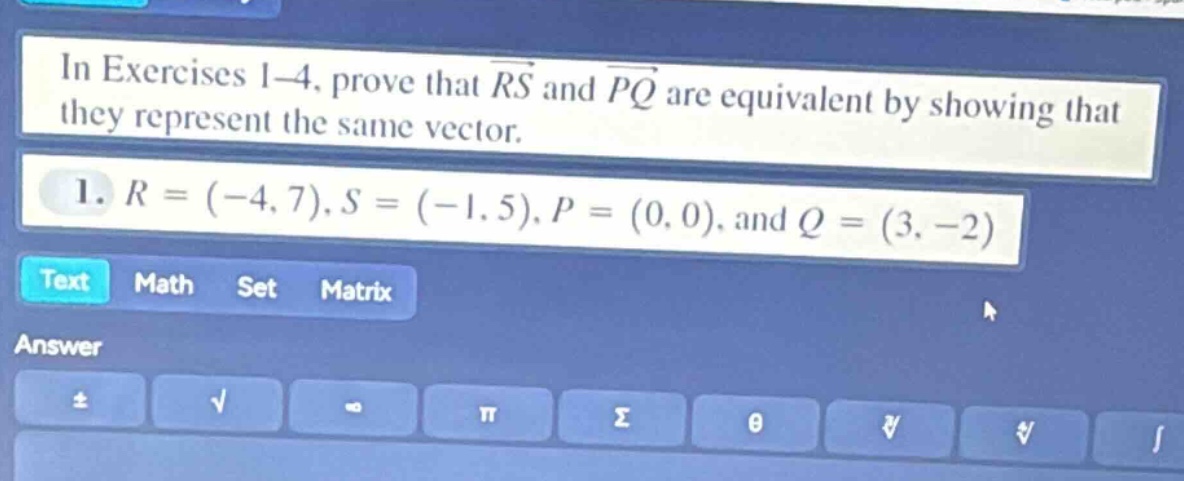
in exercises 1–4, prove that \\(\overrightarrow{rs}\\) and \\(\overrightarrow{pq}\\) are equivalent by showing that they represent the same vector.
- \\( r = (-4, 7) \\), \\( s = (-1, 5) \\), \\( p = (0, 0) \\), and \\( q = (3, -2) \\)
Step1: Recall vector component formula
For a vector with initial point \((x_1, y_1)\) and terminal point \((x_2, y_2)\), the component form is \(\langle x_2 - x_1, y_2 - y_1
angle\).
Step2: Find components of \(\overrightarrow{RS}\)
Given \(R = (-4, 7)\) and \(S = (-1, 5)\), substitute into the formula:
\(x\)-component: \(-1 - (-4) = -1 + 4 = 3\)
\(y\)-component: \(5 - 7 = -2\)
So, \(\overrightarrow{RS} = \langle 3, -2
angle\)
Step3: Find components of \(\overrightarrow{PQ}\)
Given \(P = (0, 0)\) and \(Q = (3, -2)\), substitute into the formula:
\(x\)-component: \(3 - 0 = 3\)
\(y\)-component: \(-2 - 0 = -2\)
So, \(\overrightarrow{PQ} = \langle 3, -2
angle\)
Step4: Compare the two vectors
Since \(\overrightarrow{RS} = \langle 3, -2
angle\) and \(\overrightarrow{PQ} = \langle 3, -2
angle\), they have the same component form.

Snap & solve any problem in the app
Get step-by-step solutions on Sovi AI
Photo-based solutions with guided steps
Explore more problems and detailed explanations
\(\overrightarrow{RS}\) and \(\overrightarrow{PQ}\) are equivalent because \(\overrightarrow{RS}=\langle 3, -2
angle\) and \(\overrightarrow{PQ}=\langle 3, -2
angle\), so they represent the same vector.