QUESTION IMAGE
Question
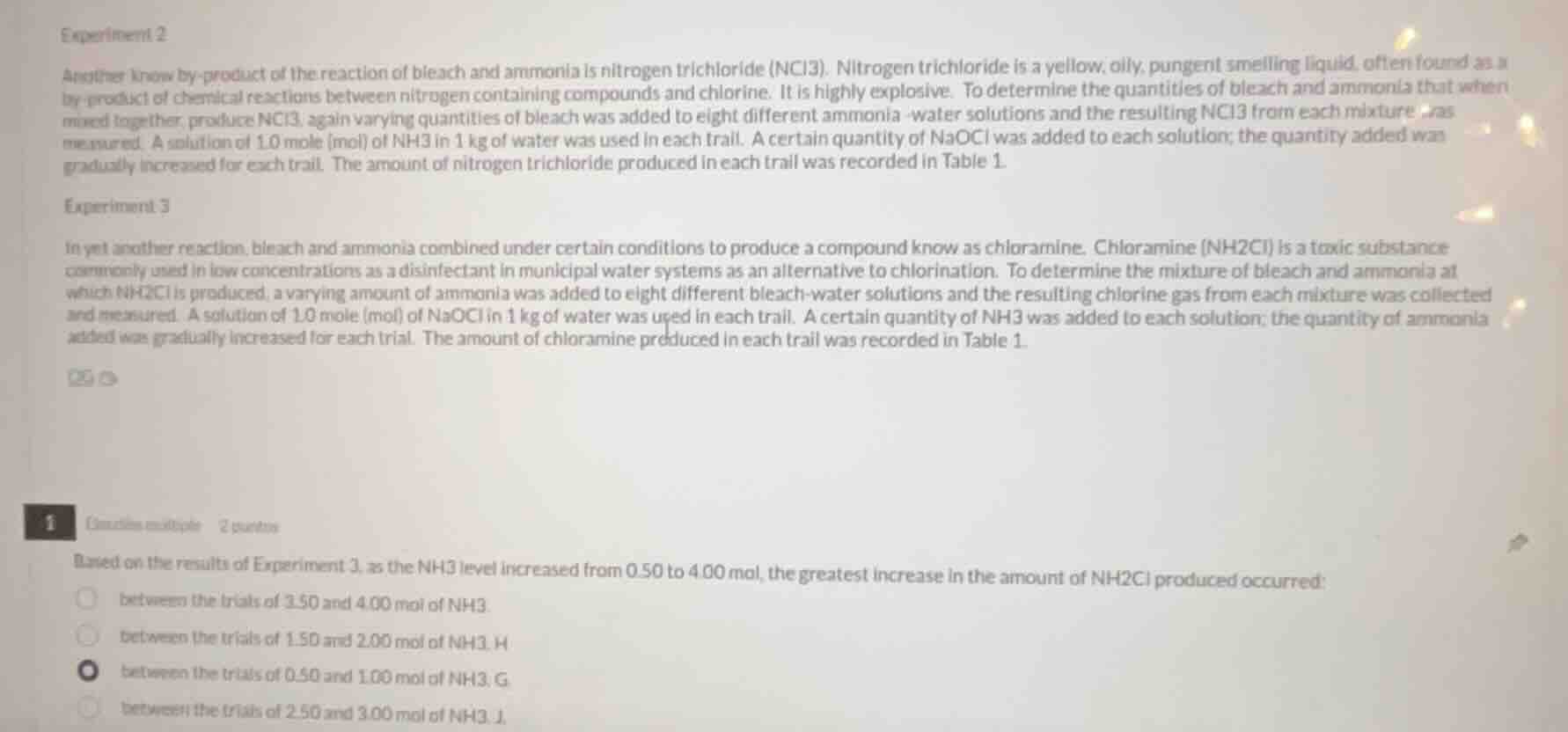
experiment 2
another know by - product of the reaction of bleach and ammonia is nitrogen trichloride (ncl3). nitrogen trichloride is a yellow, oily, pungent smelling liquid, often found as a by - product of chemical reactions between nitrogen containing compounds and chlorine. it is highly explosive. to determine the quantities of bleach and ammonia that when mixed together produce ncl3, again varying quantities of bleach was added to eight different ammonia - water solutions and the resulting ncl3 from each mixture was measured. a solution of 1.0 mole (mol) of nh3 in 1 kg of water was used in each trail. a certain quantity of naocl was added to each solution; the quantity added was gradually increased for each trail. the amount of nitrogen trichloride produced in each trail was recorded in table 1.
experiment 3
in yet another reaction, bleach and ammonia combined under certain conditions to produce a compound know as chloramine. chloramine (nh2cl) is a toxic substance commonly used in low concentrations as a disinfectant in municipal water systems as an alternative to chlorination. to determine the mixture of bleach and ammonia at which nh2cl is produced, a varying amount of ammonia was added to eight different bleach - water solutions and the resulting chlorine gas from each mixture was collected and measured. a solution of 1.0 mole (mol) of naocl in 1 kg of water was used in each trail. a certain quantity of nh3 was added to each solution; the quantity of ammonia added was gradually increased for each trail. the amount of chloramine produced in each trail was recorded in table 1.
1
(select multiple 2 points)
based on the results of experiment 3, as the nh3 level increased from 0.50 to 4.00 mol, the greatest increase in the amount of nh2cl produced occurred:
- between the trials of 3.50 and 4.00 mol of nh3.
- between the trials of 1.50 and 2.00 mol of nh3. h
- between the trials of 0.50 and 1.00 mol of nh3. g
- between the trials of 2.50 and 3.00 mol of nh3. j.
To determine the greatest increase in NH₂Cl production as NH₃ increases from 0.50 to 4.00 mol, we analyze the rate of change (increase in NH₂Cl per mol increase in NH₃) for each interval. The interval between 0.50 and 1.00 mol of NH₃ likely has the steepest increase (highest rate of NH₂Cl production per mol NH₃ added) compared to other intervals (e.g., 1.50–2.00, 2.50–3.00, 3.50–4.00 would show smaller or more gradual increases, typical in reaction kinetics where initial reactant addition has a larger impact).

Snap & solve any problem in the app
Get step-by-step solutions on Sovi AI
Photo-based solutions with guided steps
Explore more problems and detailed explanations
between the trials of 0.50 and 1.00 mol of NH3. G