QUESTION IMAGE
Question
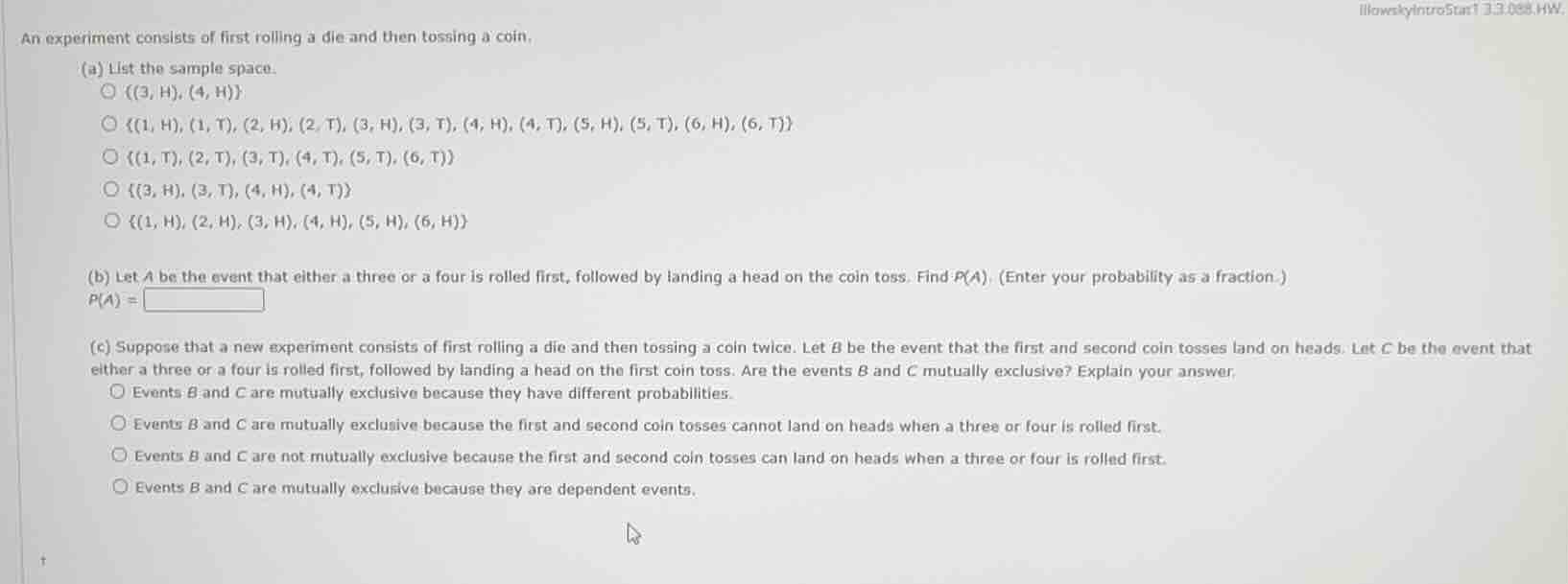
an experiment consists of first rolling a die and then tossing a coin.
(a) list the sample space.
\bigcirc \\{\\(3, h\\), \\(4, h\\)\\}
\bigcirc \\{\\(1, h\\), \\(1, t\\), \\(2, h\\), \\(2, t\\), \\(3, h\\), \\(3, t\\), \\(4, h\\), \\(4, t\\), \\(5, h\\), \\(5, t\\), \\(6, h\\), \\(6, t\\)\\}
\bigcirc \\{\\(1, t\\), \\(2, t\\), \\(3, t\\), \\(4, t\\), \\(5, t\\), \\(6, t\\)\\}
\bigcirc \\{\\(3, h\\), \\(3, t\\), \\(4, h\\), \\(4, t\\)\\}
\bigcirc \\{\\(1, h\\), \\(2, h\\), \\(3, h\\), \\(4, h\\), \\(5, h\\), \\(6, h\\)\\}
(b) let ( a ) be the event that either a three or a four is rolled first, followed by landing a head on the coin toss. find ( p(a) ). (enter your probability as a fraction.)
( p(a) = )
(c) suppose that a new experiment consists of first rolling a die and then tossing a coin twice. let ( b ) be the event that the first and second coin tosses land on heads. let ( c ) be the event that either a three or a four is rolled first, followed by landing a head on the first coin toss. are the events ( b ) and ( c ) mutually exclusive? explain your answer.
\bigcirc events ( b ) and ( c ) are mutually exclusive because they have different probabilities.
\bigcirc events ( b ) and ( c ) are mutually exclusive because the first and second coin tosses cannot land on heads when a three or four is rolled first.
\bigcirc events ( b ) and ( c ) are not mutually exclusive because the first and second coin tosses can land on heads when a three or four is rolled first.
\bigcirc events ( b ) and ( c ) are mutually exclusive because they are dependent events.
Part (a)
The experiment is rolling a die (outcomes 1 - 6) then tossing a coin (outcomes H, T). The sample space should include all combinations of die rolls and coin tosses. So for each die roll (1 - 6), we pair with H and T. The correct sample space is \(\{(1, H), (1, T), (2, H), (2, T), (3, H), (3, T), (4, H), (4, T), (5, H), (5, T), (6, H), (6, T)\}\).
Step1: Find total outcomes
From part (a), total outcomes in sample space \(n(S)=12\).
Step2: Find favorable outcomes for event A
Event A: roll 3 or 4, then head. Favorable outcomes: \((3, H), (4, H)\), so \(n(A) = 2\).
Step3: Calculate probability
Probability \(P(A)=\frac{n(A)}{n(S)}=\frac{2}{12}=\frac{1}{6}\).
Mutually exclusive events cannot occur at the same time. Event B: first and second coin tosses are heads (e.g., (1, H, H), (2, H, H), (3, H, H), (4, H, H), (5, H, H), (6, H, H)). Event C: roll 3 or 4, then first coin toss is head (e.g., (3, H, T), (3, H, H), (4, H, T), (4, H, H)). The outcome (3, H, H) and (4, H, H) are in both B and C, so they can occur together. Thus, B and C are not mutually exclusive because the first and second coin tosses can land on heads when a three or four is rolled first.

Snap & solve any problem in the app
Get step-by-step solutions on Sovi AI
Photo-based solutions with guided steps
Explore more problems and detailed explanations
B. \(\{(1, H), (1, T), (2, H), (2, T), (3, H), (3, T), (4, H), (4, T), (5, H), (5, T), (6, H), (6, T)\}\)