QUESTION IMAGE
Question
experiment 6 ions in solution: electrolyte strength and electrical conductivity
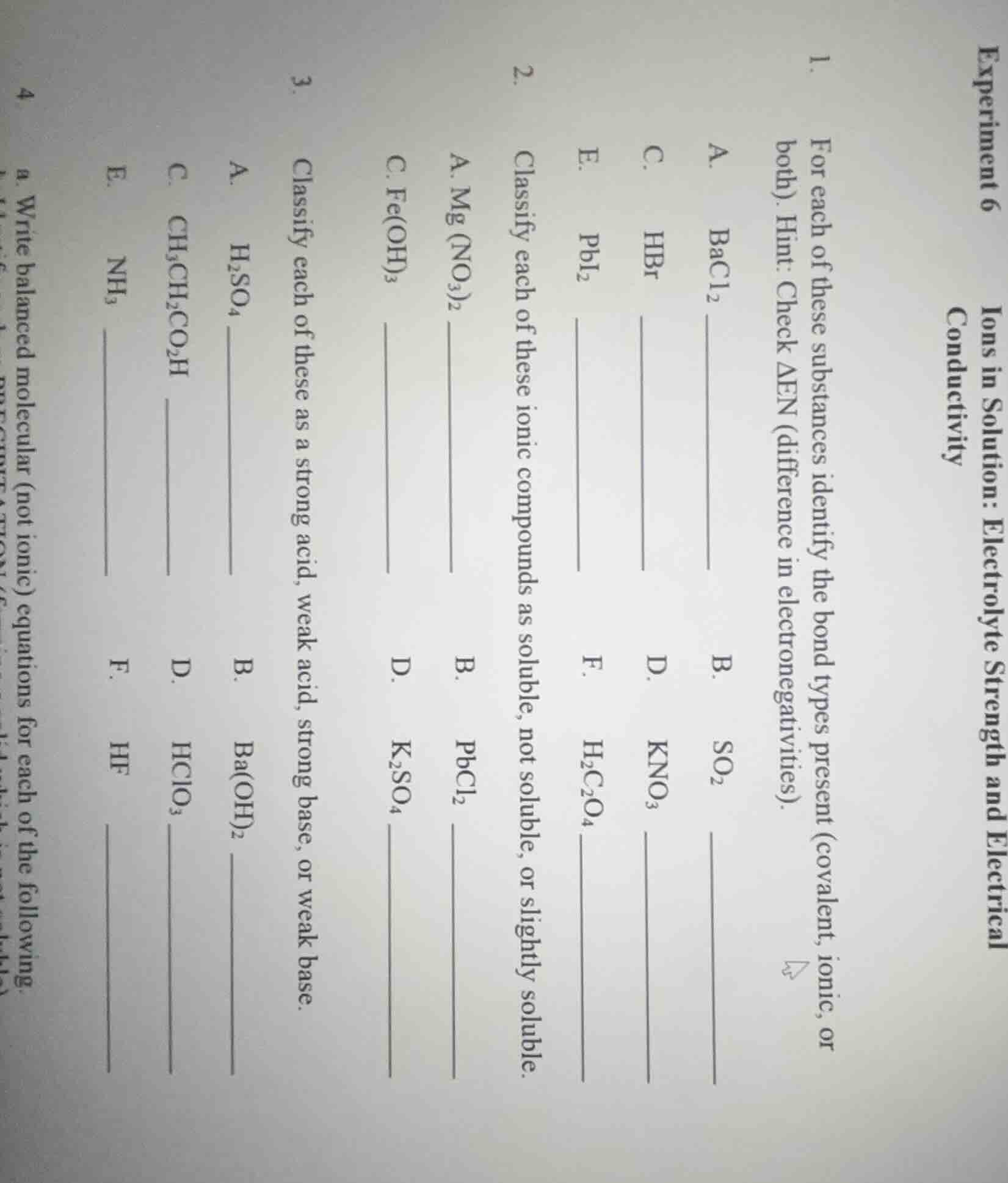
- for each of these substances identify the bond types present (covalent, ionic, or both). hint: check $delta$en (difference in electronegativities).
a. $\text{bacl}_2$ ________
b. $\text{so}_2$ ________
c. $\text{hbr}$ ________
d. $\text{kno}_3$ ________
e. $\text{pbi}_2$ ________
f. $\text{h}_2\text{c}_2\text{o}_4$ ________
- classify each of these ionic compounds as soluble, not soluble, or slightly soluble.
a. $\text{mg (no}_3\text{)}_2$ ________
b. $\text{pbcl}_2$ ________
c. $\text{fe(oh)}_3$ ________
d. $\text{k}_2\text{so}_4$ ________
- classify each of these as a strong acid, weak acid, strong base, or weak base.
a. $\text{h}_2\text{so}_4$ ________
b. $\text{ba(oh)}_2$ ________
c. $\text{ch}_3\text{ch}_2\text{co}_2\text{h}$ ________
d. $\text{hclo}_3$ ________
e. $\text{nh}_3$ ________
f. $\text{hf}$ ________
- a. write balanced molecular (not ionic) equations for each of the following.
Step1: Identify bond types (Q1)
Use ΔEN: Ionic if ΔEN>1.7, polar covalent if 0.4<ΔEN<1.7, nonpolar covalent if ΔEN<0.4.
- A. $\text{BaCl}_2$: ΔEN(Cl-Ba)=3.16-0.89=2.27 >1.7 → Ionic
- B. $\text{SO}_2$: ΔEN(O-S)=3.44-2.58=0.86 (0.4-1.7) → Covalent (polar)
- C. $\text{HBr}$: ΔEN(Br-H)=2.96-2.20=0.76 (0.4-1.7) → Covalent (polar)
- D. $\text{KNO}_3$: ΔEN(O-K)=3.44-0.82=2.62 >1.7; ΔEN(O-N)=3.44-3.04=0.4 → Ionic (cation-anion) + Covalent (within nitrate)
- E. $\text{PbI}_2$: ΔEN(I-Pb)=2.66-1.87=0.79 (0.4-1.7) → Covalent (polar)
- F. $\text{H}_2\text{C}_2\text{O}_4$: ΔEN(O-H)=3.44-2.20=1.24; ΔEN(O-C)=3.44-2.55=0.89; ΔEN(C-H)=2.55-2.20=0.35 → Covalent (polar/nonpolar)
Step2: Classify solubility (Q2)
Use solubility rules for ionic compounds:
- A. $\text{Mg(NO}_3\text{)}_2$: All nitrates are soluble → Soluble
- B. $\text{PbCl}_2$: Chlorides are soluble except $\text{Pb}^{2+}$, $\text{Ag}^+$, $\text{Hg}_2^{2+}$; $\text{PbCl}_2$ dissolves slightly → Slightly soluble
- C. $\text{Fe(OH)}_3$: Hydroxides of transition metals are insoluble → Not soluble
- D. $\text{K}_2\text{SO}_4$: All group 1 salts are soluble → Soluble
Step3: Classify acids/bases (Q3)
Strong acids: $\text{H}_2\text{SO}_4$, $\text{HClO}_3$; Weak acids: $\text{CH}_3\text{CH}_2\text{CO}_2\text{H}$, $\text{HF}$; Strong base: $\text{Ba(OH)}_2$; Weak base: $\text{NH}_3$
- A. $\text{H}_2\text{SO}_4$ → Strong acid
- B. $\text{Ba(OH)}_2$ → Strong base
- C. $\text{CH}_3\text{CH}_2\text{CO}_2\text{H}$ → Weak acid
- D. $\text{HClO}_3$ → Strong acid
- E. $\text{NH}_3$ → Weak base
- F. $\text{HF}$ → Weak acid

Snap & solve any problem in the app
Get step-by-step solutions on Sovi AI
Photo-based solutions with guided steps
Explore more problems and detailed explanations
1.
A. $\text{BaCl}_2$: Ionic
B. $\text{SO}_2$: Covalent
C. $\text{HBr}$: Covalent
D. $\text{KNO}_3$: Ionic and Covalent
E. $\text{PbI}_2$: Covalent
F. $\text{H}_2\text{C}_2\text{O}_4$: Covalent
2.
A. $\text{Mg(NO}_3\text{)}_2$: Soluble
B. $\text{PbCl}_2$: Slightly soluble
C. $\text{Fe(OH)}_3$: Not soluble
D. $\text{K}_2\text{SO}_4$: Soluble
3.
A. $\text{H}_2\text{SO}_4$: Strong acid
B. $\text{Ba(OH)}_2$: Strong base
C. $\text{CH}_3\text{CH}_2\text{CO}_2\text{H}$: Weak acid
D. $\text{HClO}_3$: Strong acid
E. $\text{NH}_3$: Weak base
F. $\text{HF}$: Weak acid
(Note: Question 4 is incomplete, so no answer provided for it.)