QUESTION IMAGE
Question
experiment: part 3
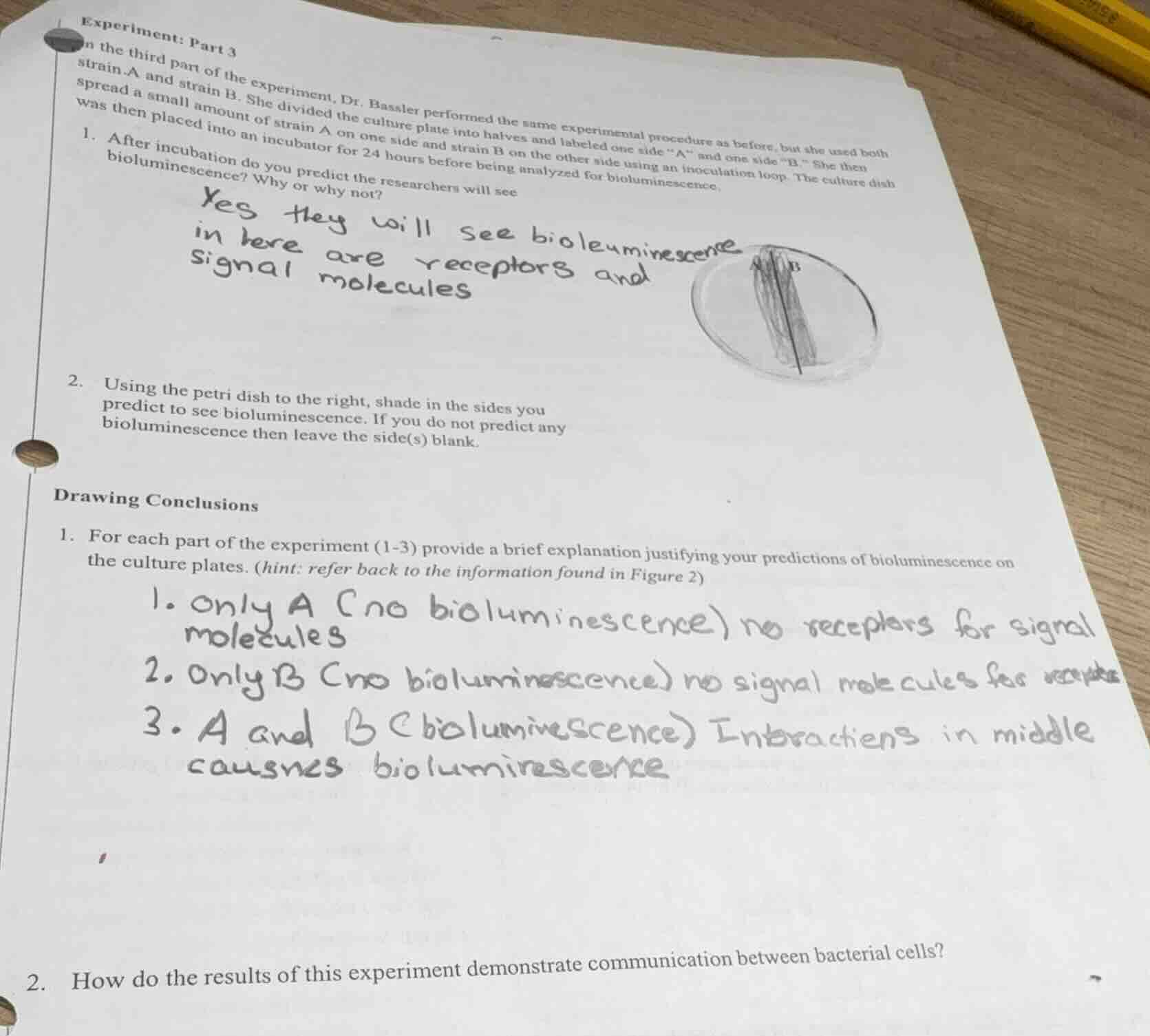
in the third part of the experiment, dr. bassler performed the same experimental procedure as before, but she used both strain a and strain b. she divided the culture plate into halves and labeled one side \a\ and one side \b.\ she then spread a small amount of strain a on one side and strain b on the other side using an inoculation loop. the culture dish was then placed into an incubator for 24 hours before being analyzed for bioluminescence.
- after incubation do you predict the researchers will see bioluminescence? why or why not?
yes they will see bioluminescence in here are receptors and signal molecules
- using the petri dish to the right, shade in the sides you predict to see bioluminescence. if you do not predict any bioluminescence then leave the side(s) blank.
drawing conclusions
- for each part of the experiment (1-3) provide a brief explanation justifying your predictions of bioluminescence on the culture plates. (hint: refer back to the information found in figure 2)
- only a (no bioluminescence) no receptors for signal molecules
- only b (no bioluminescence) no signal molecules for receptors
- a and b (bioluminescence) interactions in middle causes bioluminescence
- how do the results of this experiment demonstrate communication between bacterial cells?
For Question 1 (Prediction of Bioluminescence):
This experiment involves bacterial quorum sensing, where strain A produces signal molecules and strain B has receptors for those signals. When both are present, the signal molecules from A bind to B's receptors, triggering bioluminescence.
For Question 2 (Shading the Petri Dish):
Bioluminescence occurs where the two strains interact, so the middle region between sides A and B should be shaded, along with adjacent areas of A and B where signal-receptor binding happens.
For Drawing Conclusions 1:
- Only strain A: No receptors to detect signals, so no bioluminescence.
- Only strain B: No signal molecules to activate receptors, so no bioluminescence.
- Strains A and B: Signal molecules from A bind to receptors on B, triggering the bioluminescent response in the overlapping/interacting region.
For Drawing Conclusions 2:
The results show that bioluminescence only occurs when both strains are present. Strain A sends chemical signals, and strain A receives/responds to them, proving bacterial cells communicate via chemical signal molecules to trigger a collective response (bioluminescence).

Snap & solve any problem in the app
Get step-by-step solutions on Sovi AI
Photo-based solutions with guided steps
Explore more problems and detailed explanations
- Yes, they will see bioluminescence. Strain A produces signal molecules, strain B has matching receptors; their interaction triggers the response.
- (Shade the middle overlapping region of the petri dish between side A and side B, plus the inner edges of A and B adjacent to this middle area)
Drawing Conclusions 1:
- Only A: No bioluminescence, no receptors for signals.
- Only B: No bioluminescence, no signal molecules.
- A and B: Bioluminescence, signal-receptor interaction triggers it.
Drawing Conclusions 2:
Bioluminescence only occurs when both strains are combined, showing strain A releases chemical signals that strain B detects and responds to, demonstrating bacterial intercellular communication via chemical signaling.