QUESTION IMAGE
Question
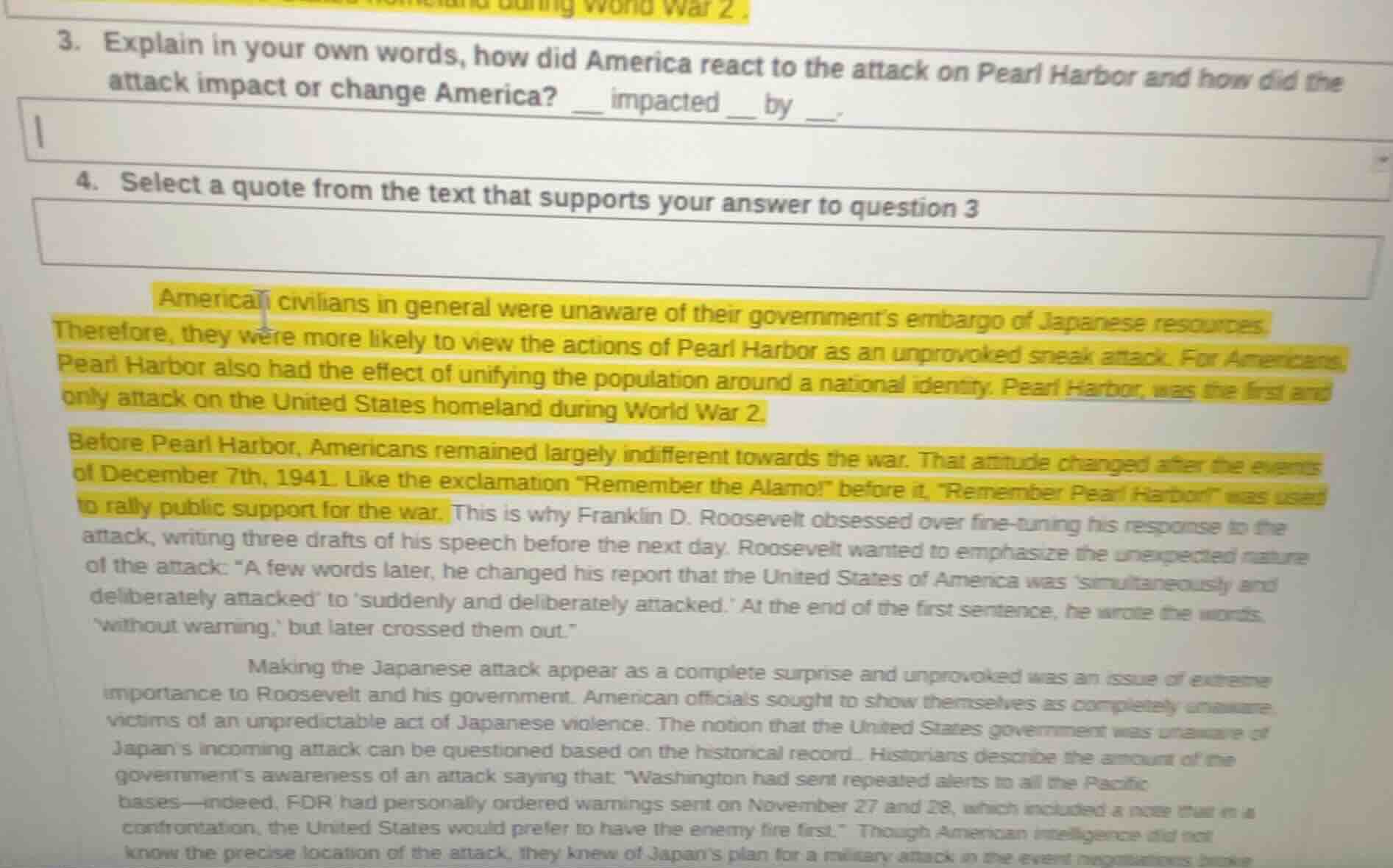
- explain in your own words, how did america react to the attack on pearl harbor and how did the attack impact or change america? impacted by __. 4. select a quote from the text that supports your answer to question 3 america civilians in general were unaware of their government’s embargo of japanese resources. therefore, they were more likely to view the actions of pearl harbor as an unprovoked sneak attack. for americans, pearl harbor also had the effect of unifying the population around a national identity. pearl harbor, was the first and only attack on the united states homeland during world war 2. before pearl harbor, americans remained largely indifferent towards the war. that attitude changed after the events of december 7th, 1941. like the exclamation “remember the alamo!” before it, “remember pearl harbor!” was used to rally public support for the war. this is why franklin d. roosevelt obsessed over fine - tuning his response to the attack, writing three drafts of his speech before the next day. roosevelt wanted to emphasize the unexpected nature of the attack: “a few words later, he changed his report that the united states of america was ‘simultaneously and deliberately attacked’ to ‘suddenly and deliberately attacked.’ at the end of the first sentence, he wrote the words, ‘without warning,’ but later crossed them out.” making the japanese attack appear as a complete surprise and unprovoked was an issue of extreme importance to roosevelt and his government. american officials sought to show themselves as completely unknown victims of an unpredictable act of japanese violence. the notion that the united states government was unaware of japan’s incoming attack can be questioned based on the historical record. historians describe the amount of the government’s awareness of an attack saying that: “washington had sent repeated alerts to all the pacific bases—indeed, fdr had personally ordered warnings sent on november 27 and 29, which included a note that in a confrontation, the united states would prefer to have the enemy fire first.” though american intelligence did not know the precise location of the attack, they knew of japan’s plan for a military attack in the event negotiations broke
Brief Explanations
- For question 3: Most American civilians, unaware of the U.S. resource embargo on Japan, saw the Pearl Harbor attack as an unprovoked sneak attack. This event ended widespread U.S. indifference to WWII, unified the population around a national identity, and rallied public support for the U.S. to enter the war, with the slogan "Remember Pearl Harbor!" used to galvanize people.
- For question 4: The selected quote directly supports the reaction and impact described, linking the attack to the shift in public attitude and unification.

Snap & solve any problem in the app
Get step-by-step solutions on Sovi AI
Photo-based solutions with guided steps
Explore more problems and detailed explanations
- Most American civilians, who did not know about the U.S. government's embargo on Japanese resources, viewed the Pearl Harbor attack as an unprovoked sneak attack. Before the attack, most Americans were indifferent to World War 2, but the attack unified the U.S. population around a national identity, ended that indifference, and rallied widespread public support for the U.S. to join the war, with the rallying cry "Remember Pearl Harbor!" used to mobilize people.
- "Before Pearl Harbor, Americans remained largely indifferent towards the war. That attitude changed after the events of December 7th, 1941. Like the exclamation 'Remember the Alamo!' before it, 'Remember Pearl Harbor!' was used to rally public support for the war."