QUESTION IMAGE
Question
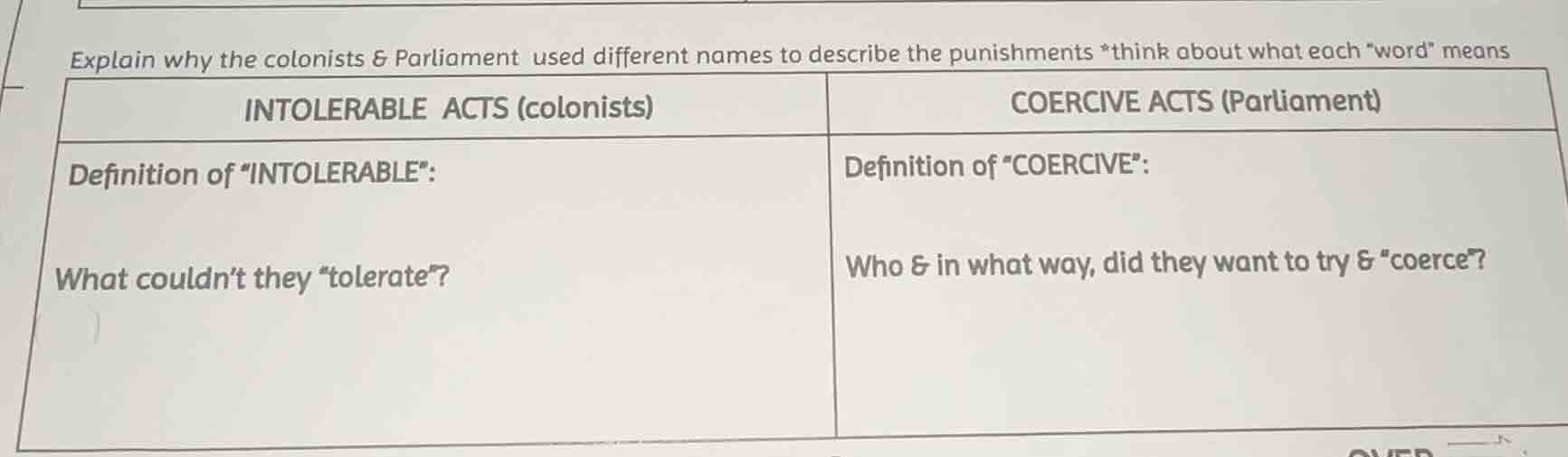
explain why the colonists & parliament used different names to describe the punishments *think about what each \word\ means
intolerable acts (colonists) | coercive acts (parliament)
definition of \intolerable\:
what couldn’t they \tolerate\? | definition of \coercive\:
who & in what way, did they want to try & \coerce\?
Brief Explanations
- Intolerable (Colonists): "Intolerable" means unbearable, unacceptable. Colonists couldn’t tolerate the loss of rights (e.g., self - governance, trial by jury), economic harm (like port closures in Boston), and perceived British tyranny (such as quartering troops, restrictive laws). These acts violated their sense of liberty and self - rule, so they saw them as intolerable.
- Coercive (Parliament): "Coercive" means using force to persuade or control. Parliament wanted to coerce the colonists (specifically Massachusetts after the Boston Tea Party) to comply with British rule. They aimed to force the colonists to pay for the tea, respect British authority, and stop acts of rebellion through restrictive laws (closing Boston port, altering Massachusetts’ government, etc.). The different names reflect their opposing perspectives: colonists emphasized the unjust, unbearable nature of the acts, while Parliament focused on using the acts to enforce compliance.

Snap & solve any problem in the app
Get step-by-step solutions on Sovi AI
Photo-based solutions with guided steps
Explore more problems and detailed explanations
- Definition of “INTOLERABLE”: Unbearable, not able to be endured.
- What couldn’t they “tolerate”: The colonists couldn’t tolerate the loss of their rights (e.g., self - government, trial by jury), economic hardships (like Boston Port closure), and British attempts to impose tyranny (e.g., quartering troops, restrictive governance changes).
- Definition of “COERCIVE”: Relating to the use of force or pressure to make someone do something.
- Who & in what way, did they want to try & “coerce”: Parliament wanted to coerce the colonists (especially Massachusetts) to comply with British rule. They used the acts to force colonists to pay for the Boston Tea Party damages, respect British authority, and end rebellion—through measures like closing Boston’s port, altering Massachusetts’ government, and imposing stricter control.
- Why different names: Colonists saw the acts as unjust and unbearable (“intolerable”) due to violated rights/freedoms. Parliament viewed the acts as a means to enforce compliance (“coercive”) to maintain British authority over the colonies. Their perspectives (oppressed vs. enforcer) led to different naming.