QUESTION IMAGE
Question
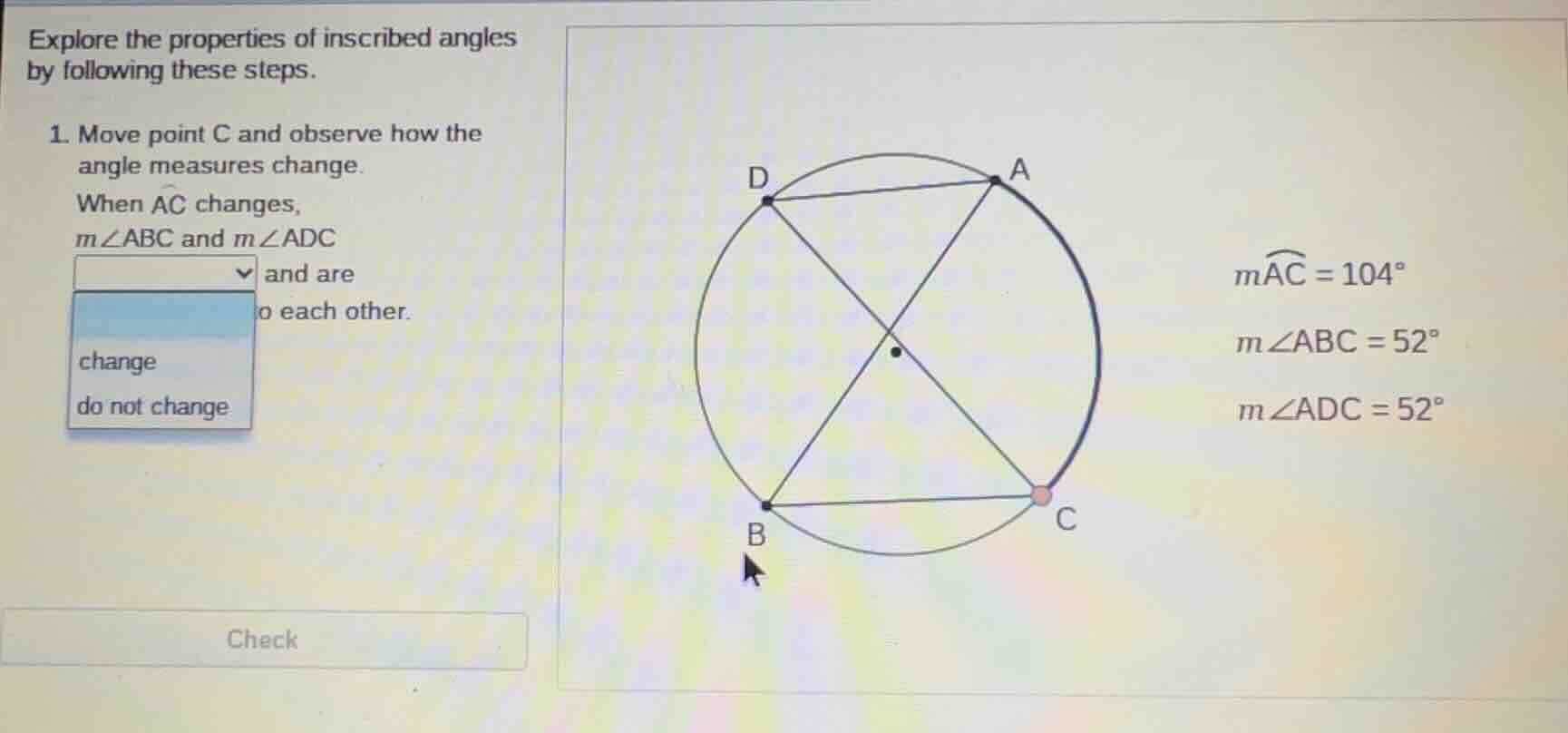
explore the properties of inscribed angles by following these steps. 1. move point c and observe how the angle measures change. when ac changes, m∠abc and m∠adc dropdown with options change, do not change and are text cut off to each other. (image shows a circle with points a, b, c, d on the circumference, intersecting chords, and measurements: m⌢ac = 104°, m∠abc = 52°, m∠adc = 52°)
Step1: Recall inscribed angle theorem
The measure of an inscribed angle is half the measure of its intercepted arc. For \(\angle ABC\) and \(\angle ADC\), they both intercept arc \(AC\). The measure of arc \(AC\) is \(104^\circ\), so the measure of each inscribed angle should be \(\frac{1}{2} \times 104^\circ= 52^\circ\).
Step2: Analyze the effect of moving point \(C\)
When we move point \(C\) on the circle, the arc \(AC\) (the intercepted arc for both \(\angle ABC\) and \(\angle ADC\)) does not change its measure (because the arc is defined by points \(A\) and \(C\) on the circle, and moving \(C\) along the circle doesn't change the arc between \(A\) and \(C\) in terms of the central angle's relation to the inscribed angle? Wait, actually, the key is that as long as \(A\) and \(C\) are fixed (or moving along the circle such that the arc \(AC\) remains the same? No, when you move \(C\), the arc \(AC\) can change? Wait, no, in the diagram, if we move \(C\) along the circumference, the arc \(AC\) will change? Wait, no, maybe the problem is considering that \(\angle ABC\) and \(\angle ADC\) are inscribed angles subtended by the same arc \(AC\). Wait, the theorem says that inscribed angles subtended by the same arc are equal. So regardless of where \(B\) and \(D\) are (as long as they are on the circumference and on the same side of arc \(AC\) or opposite? Wait, in this case, \(\angle ABC\) and \(\angle ADC\) are subtended by arc \(AC\). So their measures depend only on the measure of arc \(AC\). So if we move point \(C\), does arc \(AC\) change? Wait, maybe in the context of this problem, when we move point \(C\), the arc \(AC\) is kept such that the inscribed angle theorem still holds. Wait, the given values: \(m\widehat{AC} = 104^\circ\), \(m\angle ABC=52^\circ\), \(m\angle ADC = 52^\circ\). So when we move \(C\), the arc \(AC\) (the intercepted arc) will have a measure, and the inscribed angles \(\angle ABC\) and \(\angle ADC\) will always be half of that arc. But the question is about when \(AC\) changes? Wait, maybe the problem has a typo, or maybe "when \(AC\) changes" is a misstatement, and it's when we move \(C\). But according to the inscribed angle theorem, as long as the intercepted arc is the same, the inscribed angles are equal. And if we move \(C\), the intercepted arc \(AC\) (if \(A\) is fixed) - wait, no, if \(A\) and \(C\) are two points on the circle, moving \(C\) along the circle will change the arc \(AC\). But in the problem, the initial values show that \(m\angle ABC\) and \(m\angle ADC\) are both \(52^\circ\) when \(m\widehat{AC}=104^\circ\). So if we move \(C\), will \(m\angle ABC\) and \(m\angle ADC\) change? Wait, no, because the measure of an inscribed angle is half the measure of its intercepted arc. So if the intercepted arc \(AC\) changes, then the inscribed angles will change. But the problem's dropdown has "change" and "do not change". Wait, maybe I misread. Wait, the question is "When \(AC\) changes, \(m\angle ABC\) and \(m\angle ADC\) [dropdown] and are [something] to each other." Wait, maybe the first part: when \(AC\) (the arc) changes, do \(m\angle ABC\) and \(m\angle ADC\) change? But according to the theorem, \(m\angle ABC=\frac{1}{2}m\widehat{AC}\) and \(m\angle ADC=\frac{1}{2}m\widehat{AC}\). So if \(m\widehat{AC}\) changes, then \(m\angle ABC\) and \(m\angle ADC\) will change. But in the given example, \(m\widehat{AC} = 104^\circ\), so \(m\angle ABC = m\angle ADC=52^\circ\). But if we move \(C\), making \(m\widehat{AC}\) different, then \(m\angle ABC\) and \(m\angle ADC\) will change. But t…

Snap & solve any problem in the app
Get step-by-step solutions on Sovi AI
Photo-based solutions with guided steps
Explore more problems and detailed explanations
do not change