QUESTION IMAGE
Question
explore properties of transformations
study the example problem showing how to analyze a figure and
its image after a transformation. then solve problems 1–6.
example
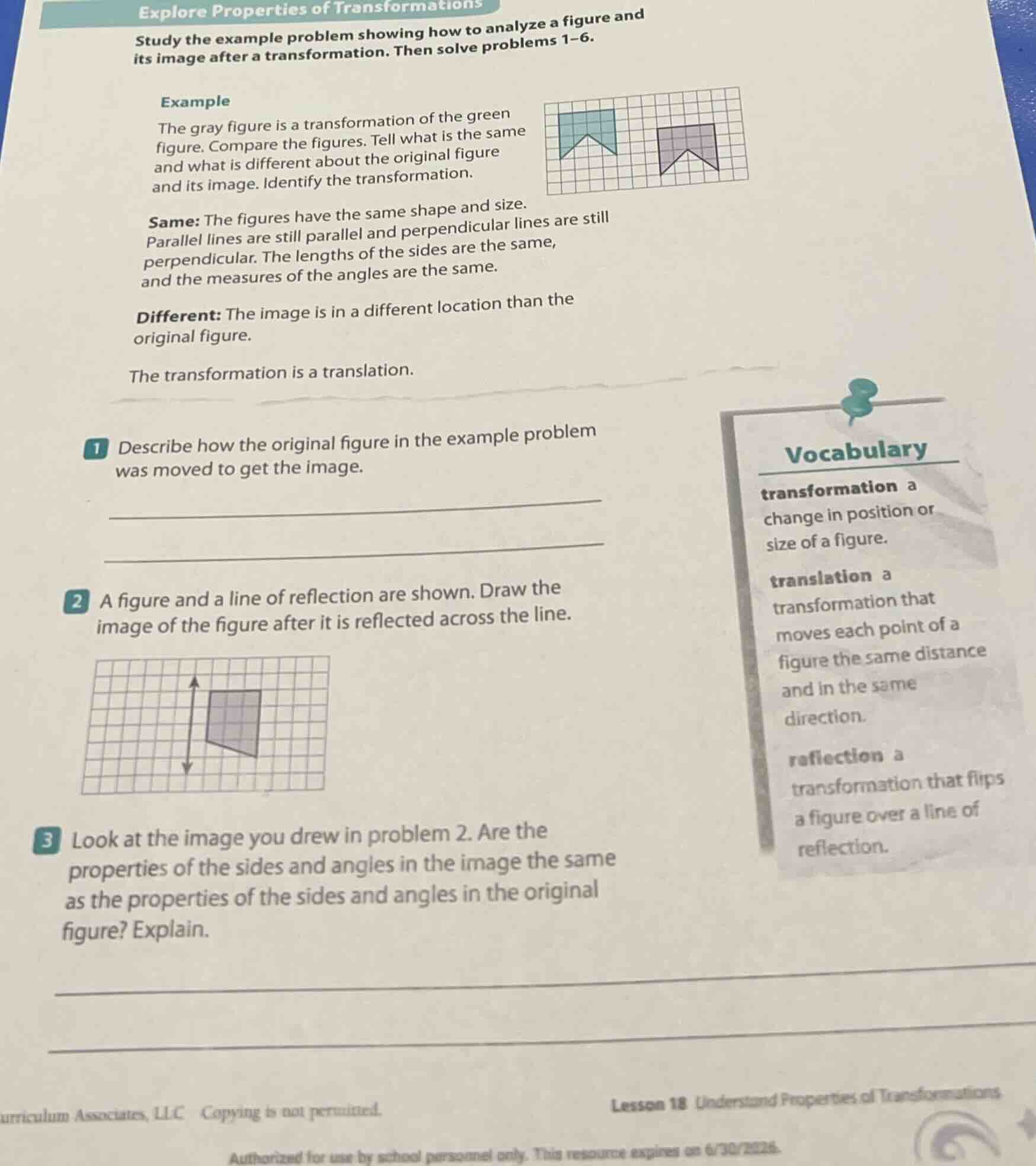
the gray figure is a transformation of the green
figure. compare the figures. tell what is the same
and what is different about the original figure
and its image. identify the transformation.
same: the figures have the same shape and size.
parallel lines are still parallel and perpendicular lines are still
perpendicular. the lengths of the sides are the same,
and the measures of the angles are the same.
different: the image is in a different location than the
original figure.
the transformation is a translation.
1 describe how the original figure in the example problem
was moved to get the image.
2 a figure and a line of reflection are shown. draw the
image of the figure after it is reflected across the line.
3 look at the image you drew in problem 2. are the
properties of the sides and angles in the image the same
as the properties of the sides and angles in the original
figure? explain.
vocabulary
transformation a
change in position or
size of a figure.
translation a
transformation that
moves each point of a
figure the same distance
and in the same
direction.
reflection a
transformation that flips
a figure over a line of
reflection.
Problem 1
Step1: Count horizontal grid movement
Count the horizontal distance between corresponding points of the green (original) and gray (image) figures. The original figure is shifted 6 units to the right.
Step2: Count vertical grid movement
Count the vertical distance between corresponding points. The original figure is shifted 1 unit down.
Reflection is a rigid transformation, which preserves all side lengths, angle measures, parallelism, and perpendicularity of the original figure. Rigid transformations only change the position/orientation of a figure, not its size or shape properties.

Snap & solve any problem in the app
Get step-by-step solutions on Sovi AI
Photo-based solutions with guided steps
Explore more problems and detailed explanations
(Problem 1):
The original figure was moved 6 units to the right and 1 unit down to get the image.
---
Problem 2
Step1: Identify key figure points
Label the 4 vertices of the trapezoid: let them be $(x_1,y_1)$, $(x_2,y_2)$, $(x_3,y_3)$, $(x_4,y_4)$ relative to the vertical reflection line.
Step2: Reflect each point across the line
For each point, calculate its mirror point across the vertical line: if a point is $d$ units left of the line, its reflection is $d$ units right of the line, and vice versa.
Step3: Connect reflected points
Draw line segments between the reflected vertices to form the reflected trapezoid.