QUESTION IMAGE
Question
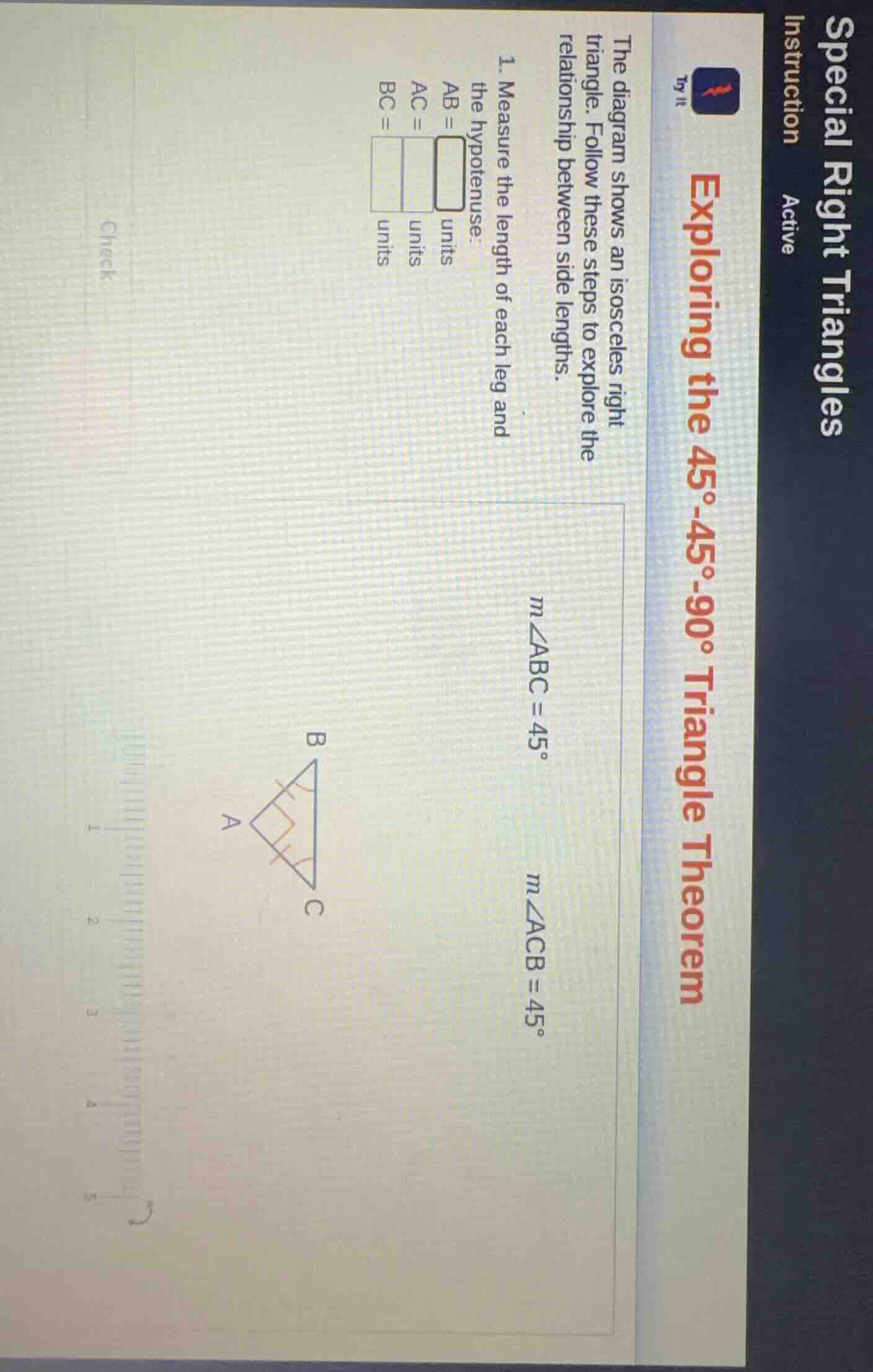
exploring the 45°-45°-90° triangle theorem the diagram shows an isosceles right triangle. follow these steps to explore the relationship between side lengths. 1. measure the length of each leg and the hypotenuse: ab = \boxed{} units ac = \boxed{} units bc = \boxed{} units m∠abc = 45° m∠acb = 45°
Step1: Identify the triangle type
The triangle is an isosceles right triangle (∠A = 90°, ∠B = ∠C = 45°), so legs \( AB \) and \( AC \) are equal. Assume we measure \( AB \) and \( AC \) first. Let's say using the ruler (from the diagram's scale), if we consider the grid or the ruler provided, suppose \( AB = 2 \) units and \( AC = 2 \) units (since it's isosceles right, legs are equal).
Step2: Calculate the hypotenuse \( BC \)
For a right triangle, use the Pythagorean theorem: \( BC^2 = AB^2 + AC^2 \). Substituting \( AB = 2 \), \( AC = 2 \): \( BC^2 = 2^2 + 2^2 = 4 + 4 = 8 \), so \( BC = \sqrt{8} = 2\sqrt{2} \approx 2.83 \) units. But if we measure directly (assuming the diagram's scale where each unit is, say, 1 unit for legs), let's confirm: if \( AB = 2 \), \( AC = 2 \), then \( BC \approx 2.83 \) (or if legs are 1 unit, \( BC = \sqrt{2} \approx 1.41 \)). But typically, in such diagrams, if the legs are 2 units (from the ruler's scale, looking at the left ruler, maybe each major tick is 1 unit, and the triangle's legs span 2 units). So:
- \( AB = 2 \) units (measure leg)
- \( AC = 2 \) units (measure leg, equal to \( AB \) as isosceles)
- \( BC = \sqrt{2^2 + 2^2} = \sqrt{8} = 2\sqrt{2} \approx 2.83 \) units (or measure directly, which should match the calculation).
(Note: Actual measurement depends on the diagram's scale. If the ruler on the left has ticks, say from 1 to 5, and the triangle's legs are from, e.g., 1 to 3 (2 units), then the above applies. For a standard 45-45-90 triangle, legs \( l \), hypotenuse \( l\sqrt{2} \).)

Snap & solve any problem in the app
Get step-by-step solutions on Sovi AI
Photo-based solutions with guided steps
Explore more problems and detailed explanations
\( AB = 2 \) units, \( AC = 2 \) units, \( BC = 2\sqrt{2} \approx 2.83 \) units (or based on actual diagram measurement, e.g., if legs are 1 unit, \( AB = 1 \), \( AC = 1 \), \( BC = \sqrt{2} \approx 1.41 \)). (Adjust based on the specific diagram's scale; the key is legs are equal, hypotenuse is leg \( \times \sqrt{2} \).)