QUESTION IMAGE
Question
exploring properties of parallelograms
name
1)
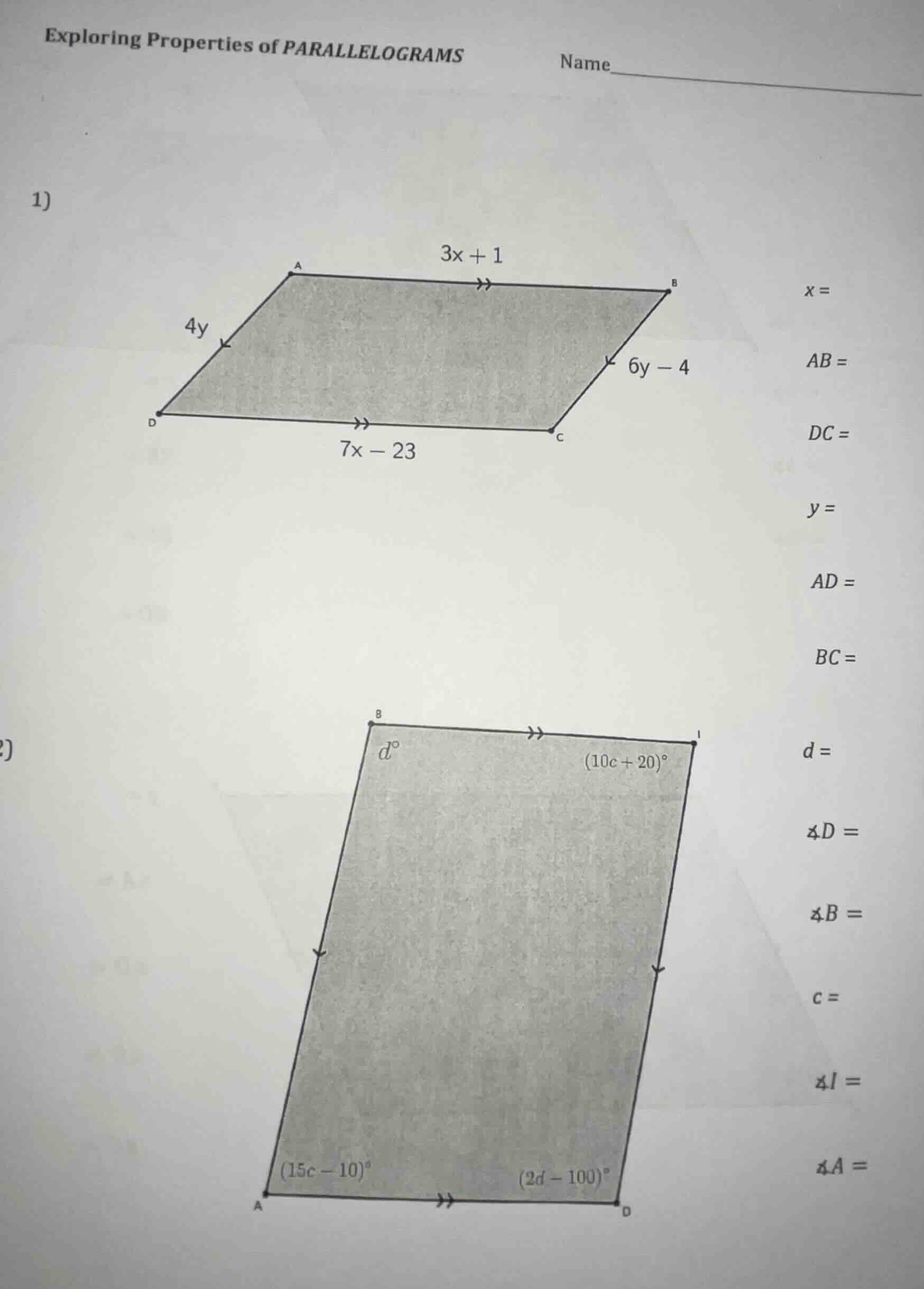
(figure of a parallelogram abcd with ab = 3x + 1, dc = 7x - 23, ad = 4y, bc = 6y - 4)
x =
ab =
dc =
y =
ad =
bc =
2)
(figure of a parallelogram with angles: angle b = d°, angle i = (10c + 20)°, angle a = (15c - 10)°, angle d = (2d - 100)°)
d =
∠d =
∠b =
c =
∠i =
∠a =
Step1: Solve for x (opposite sides equal)
$3x + 1 = 7x - 23$
$1 + 23 = 7x - 3x$
$24 = 4x$
$x = \frac{24}{4} = 6$
Step2: Calculate AB and DC
$AB = 3x + 1 = 3(6) + 1 = 19$
$DC = AB = 19$ (opposite sides of parallelogram are equal)
Step3: Solve for y (opposite sides equal)
$4y = 6y - 4$
$4 = 6y - 4y$
$4 = 2y$
$y = \frac{4}{2} = 2$
Step4: Calculate AD and BC
$AD = 4y = 4(2) = 8$
$BC = AD = 8$ (opposite sides of parallelogram are equal)
Step5: Solve for c (opposite angles equal)
$15c - 10 = 10c + 20$
$15c - 10c = 20 + 10$
$5c = 30$
$c = \frac{30}{5} = 6$
Step6: Calculate ∠I and ∠A
$\angle I = 10c + 20 = 10(6) + 20 = 80^\circ$
$\angle A = \angle I = 80^\circ$ (opposite angles of parallelogram are equal)
Step7: Solve for d (consecutive angles supplementary)
$d + (15c - 10) = 180$
Substitute $c=6$: $d + (15(6)-10) = 180$
$d + 80 = 180$
$d = 180 - 80 = 100$
Step8: Calculate ∠B and ∠D
$\angle B = d = 100^\circ$
$\angle D = \angle B = 100^\circ$ (opposite angles of parallelogram are equal)

Snap & solve any problem in the app
Get step-by-step solutions on Sovi AI
Photo-based solutions with guided steps
Explore more problems and detailed explanations
For Figure 1:
$x = 6$
$AB = 19$
$DC = 19$
$y = 2$
$AD = 8$
$BC = 8$
For Figure 2:
$d = 100$
$\angle D = 100^\circ$
$\angle B = 100^\circ$
$c = 6$
$\angle I = 80^\circ$
$\angle A = 80^\circ$