QUESTION IMAGE
Question
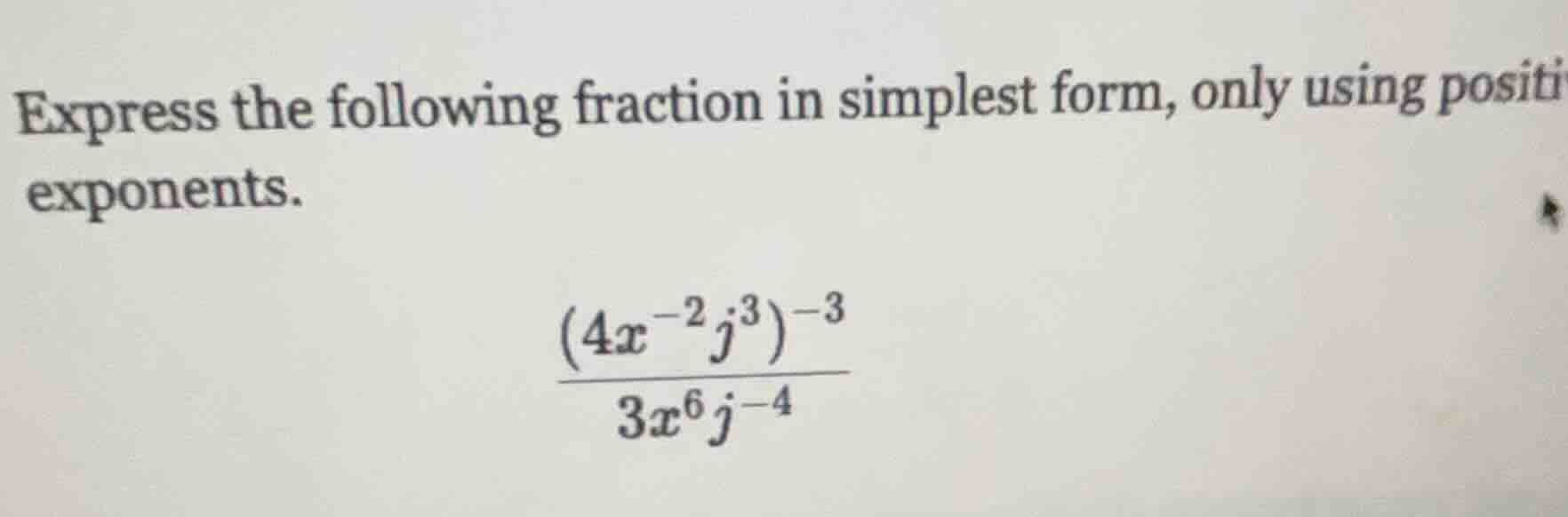
express the following fraction in simplest form, only using positi exponents. \\(dfrac{(4x^{-2}j^{3})^{-3}}{3x^{6}j^{-4}}\\)
Step1: Apply the power of a product rule to the numerator
The power of a product rule states that \((ab)^n = a^n b^n\). So for \((4x^{-2}j^{3})^{-3}\), we have:
\(4^{-3}(x^{-2})^{-3}(j^{3})^{-3}\)
Using the power of a power rule \((a^m)^n=a^{mn}\), we get:
\(4^{-3}x^{(-2)\times(-3)}j^{3\times(-3)} = 4^{-3}x^{6}j^{-9}\)
So the numerator becomes \(4^{-3}x^{6}j^{-9}\) and the denominator is \(3x^{6}j^{-4}\). The expression is now \(\frac{4^{-3}x^{6}j^{-9}}{3x^{6}j^{-4}}\)
Step2: Simplify the coefficients and variables separately
For the coefficients:
We have \(\frac{4^{-3}}{3}\). Recall that \(a^{-n}=\frac{1}{a^{n}}\), so \(4^{-3}=\frac{1}{4^{3}}=\frac{1}{64}\). Thus, the coefficient part is \(\frac{1}{64\times3}=\frac{1}{192}\)
For the \(x\) terms:
We have \(\frac{x^{6}}{x^{6}}\). Using the quotient rule \(\frac{a^{m}}{a^{n}} = a^{m - n}\), we get \(x^{6-6}=x^{0}\). And \(x^{0} = 1\) (for \(x
eq0\))
For the \(j\) terms:
We have \(\frac{j^{-9}}{j^{-4}}\). Using the quotient rule \(\frac{a^{m}}{a^{n}}=a^{m - n}\), we get \(j^{-9-(-4)}=j^{-9 + 4}=j^{-5}\). Again, using \(a^{-n}=\frac{1}{a^{n}}\), we have \(j^{-5}=\frac{1}{j^{5}}\)
Step3: Combine the simplified parts
Multiply the coefficient, \(x\) term, and \(j\) term together:
\(\frac{1}{192}\times1\times\frac{1}{j^{5}}=\frac{1}{192j^{5}}\)

Snap & solve any problem in the app
Get step-by-step solutions on Sovi AI
Photo-based solutions with guided steps
Explore more problems and detailed explanations
\(\frac{1}{192j^{5}}\)