QUESTION IMAGE
Question
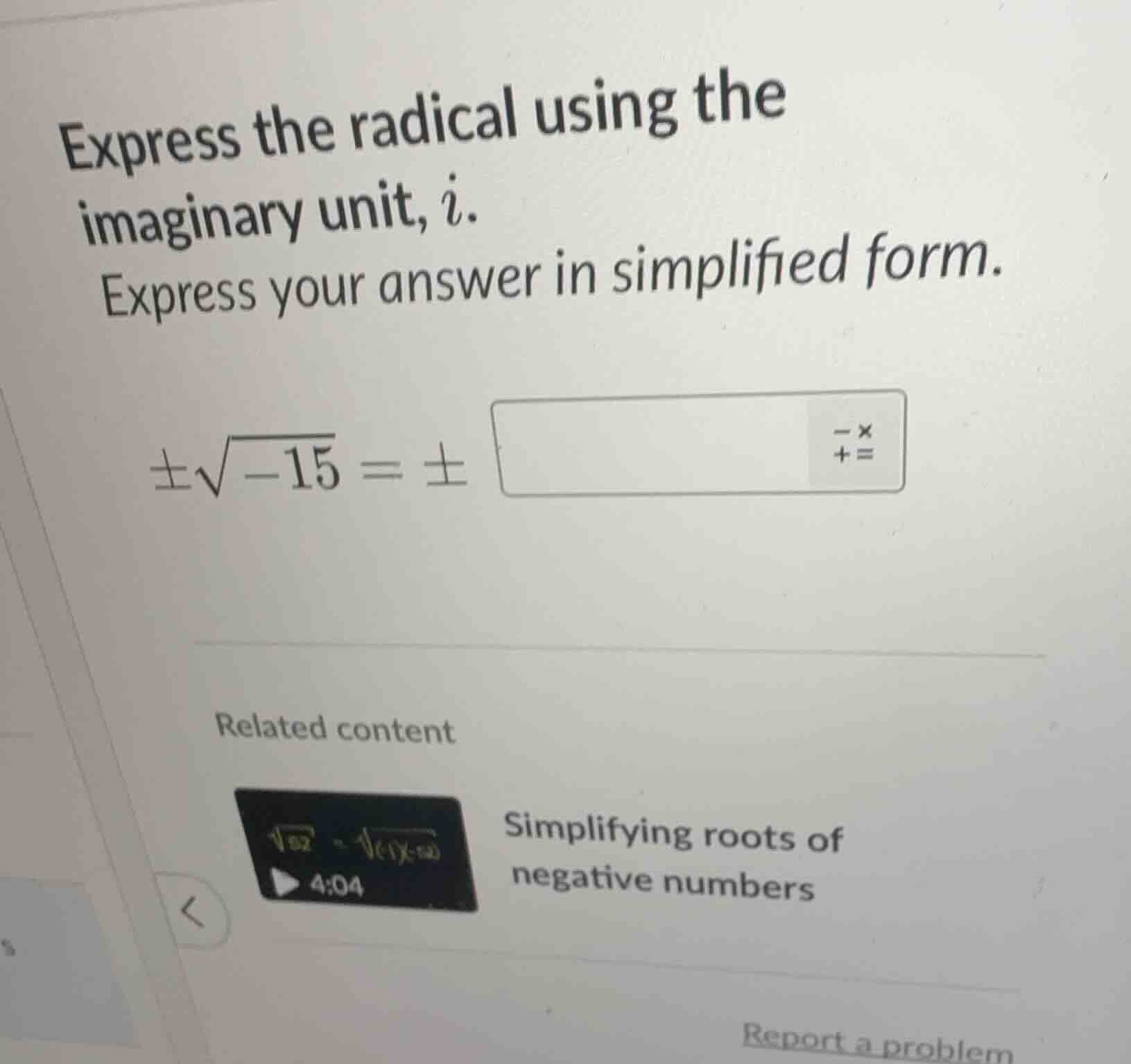
express the radical using the imaginary unit, i. express your answer in simplified form. ±√(-15) = ±
Step1: Recall the definition of imaginary unit
The imaginary unit \( i \) is defined as \( i = \sqrt{-1} \), so we can rewrite \( \sqrt{-a} \) (where \( a>0 \)) as \( \sqrt{a}\cdot\sqrt{-1} \).
For \( \pm\sqrt{-15} \), we can split the square root: \( \pm\sqrt{15\times(-1)} \)
Step2: Apply the property of square roots
Using the property \( \sqrt{ab}=\sqrt{a}\cdot\sqrt{b} \) (for \( a\geq0, b\geq0 \); here we extend it to complex numbers where \( b = - 1\)), we get \( \pm\sqrt{15}\cdot\sqrt{-1} \)
Step3: Substitute \( i=\sqrt{-1} \)
Substitute \( \sqrt{-1} \) with \( i \), so \( \pm\sqrt{15}\cdot i=\pm i\sqrt{15} \)

Snap & solve any problem in the app
Get step-by-step solutions on Sovi AI
Photo-based solutions with guided steps
Explore more problems and detailed explanations
\( i\sqrt{15} \) (Note: The \( \pm \) is already accounted for in the original problem's left - hand side, and the simplified form of the radical part is \( i\sqrt{15} \))