QUESTION IMAGE
Question
extension questions
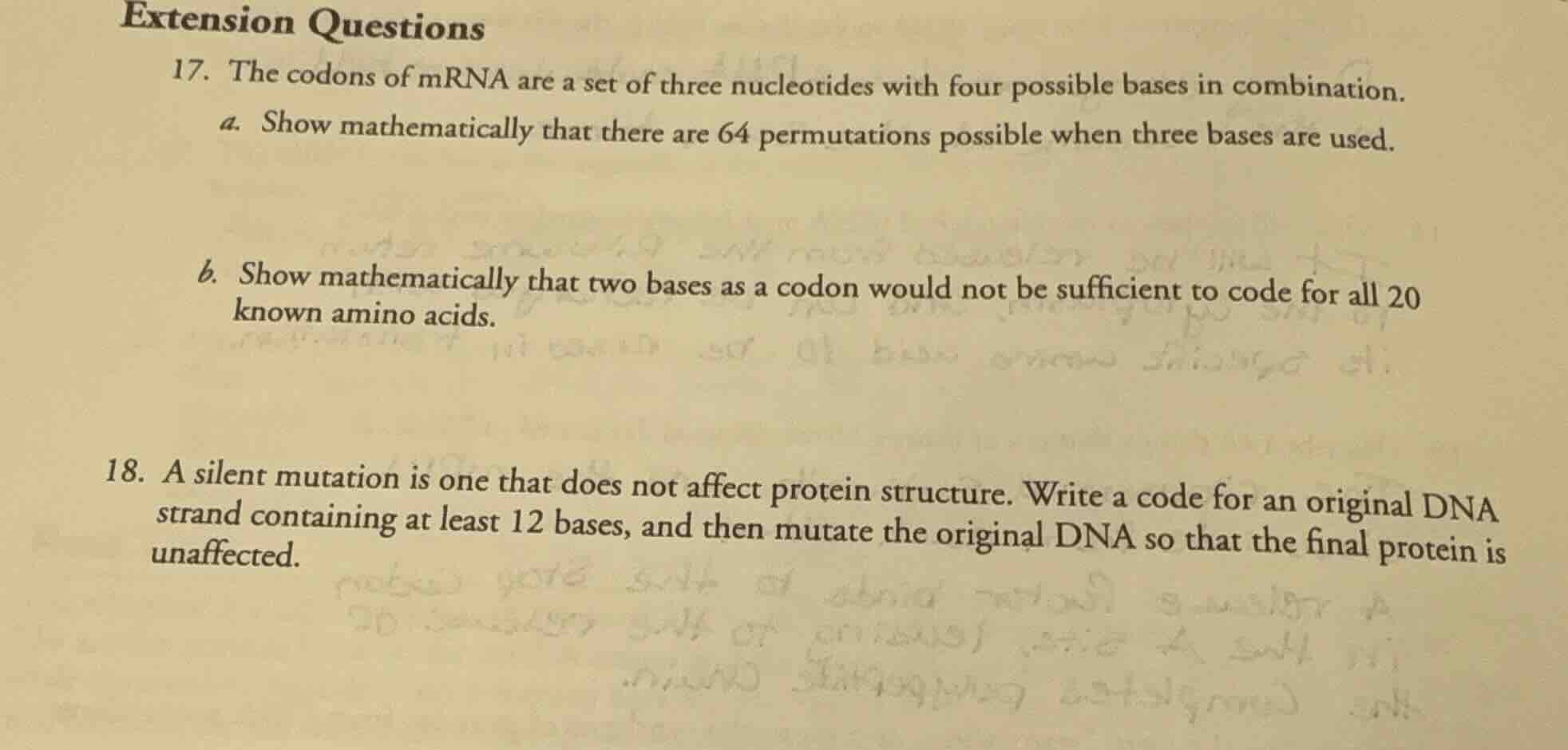
- the codons of mrna are a set of three nucleotides with four possible bases in combination.
a. show mathematically that there are 64 permutations possible when three bases are used.
b. show mathematically that two bases as a codon would not be sufficient to code for all 20 known amino acids.
- a silent mutation is one that does not affect protein structure. write a code for an original dna strand containing at least 12 bases, and then mutate the original dna so that the final protein is unaffected.
17a
Step1: Identify the problem type
This is a permutation with repetition problem. For each position in the codon (which has 3 positions), there are 4 possible bases (since there are four possible nucleotide bases).
Step2: Apply the formula for permutations with repetition
The formula for the number of permutations of \( n \) objects taken \( r \) at a time with repetition allowed is \( n^r \). Here, \( n = 4 \) (the number of possible bases) and \( r = 3 \) (the number of nucleotides in a codon). So we calculate \( 4^3 \).
Step3: Calculate the result
\( 4^3=4\times4\times4 = 64 \).
Step1: Identify the problem type
Again, this is a permutation with repetition problem. Now, we consider \( r = 2 \) (two bases in a codon) and \( n = 4 \) (four possible bases).
Step2: Apply the formula for permutations with repetition
Using the formula \( n^r \), with \( n = 4 \) and \( r = 2 \), we calculate \( 4^2 \).
Step3: Calculate the result and compare
\( 4^2=4\times4 = 16 \). Since we need to code for 20 amino acids and 16 < 20, two bases as a codon are not sufficient.
Step1: Write the original DNA strand
A DNA strand is made up of the bases A, T, C, G. Let's write an original DNA strand with at least 12 bases. For example: \( \text{Original DNA: ATGCTAGCTACG} \) (12 bases).
Step2: Transcribe to mRNA and translate to amino acids (briefly)
First, transcribe DNA to mRNA (replace T with U). The original DNA: \( \text{ATGCTAGCTACG} \) transcribes to mRNA: \( \text{AUGCUAGCUACG} \). Now, we divide the mRNA into codons (groups of 3): \( \text{AUG, CUA, GCU, ACG} \). These codons code for specific amino acids (AUG: Met, CUA: Leu, GCU: Ala, ACG: Thr).
Step3: Perform a silent mutation
A silent mutation changes a base in the DNA, but the resulting codon in mRNA still codes for the same amino acid. Let's change the 3rd base of the first codon's DNA. The original DNA's first codon - coding region: \( \text{ATG} \) (codes for AUG in mRNA, Met). If we change it to \( \text{ATC} \) (DNA), the mRNA becomes \( \text{AUC} \)? Wait, no, wait. Wait, DNA to mRNA: T pairs with A, A pairs with U, G pairs with C, C pairs with G. Wait, original DNA: ATG. Transcription: A->U, T->A, G->C? No, no: DNA template strand? Wait, maybe I should consider the coding strand. Let's assume the DNA is the coding strand, so mRNA is the same as DNA except T is U. So original DNA: ATG (coding strand) -> mRNA: AUG (Met). Now, let's find a base change in DNA that still gives the same amino acid. The codon for Met is AUG. Are there other codons for Met? No, AUG is the only codon for Met. Wait, let's take another codon. Let's take the second codon: original DNA: CTA (coding strand) -> mRNA: CUA (Leu). The codons for Leu are CUU, CUC, CUA, CUG. So if we change the DNA from CTA to CTG (coding strand), then mRNA becomes CUG (still Leu). So let's mutate the original DNA. Original DNA: \( \text{ATGCTAGCTACG} \). Let's change the 6th base (T) to G. So mutated DNA: \( \text{ATGCGAGCTACG} \). Now, transcribe to mRNA: \( \text{AUGCGAGCUACG} \). The codons are \( \text{AUG, CGA, GCU, ACG} \). Wait, no, wait, the second codon: original DNA was CTA (coding strand) -> mRNA CUA (Leu). After mutation, DNA is CGA? No, wait, I messed up the position. Let's index the original DNA: positions 1 - 12: A(1), T(2), G(3), C(4), T(5), A(6), G(7), C(8), T(9), A(10), C(11), G(12). Let's take the codon starting at position 4: C(4), T(5), A(6) -> CTA (DNA coding) -> mRNA CUA (Leu). The codons for Leu are CUU, CUC, CUA, CUG. So if we change T(5) to C(5), then DNA becomes C(4), C(5), A(6) -> CCA? No, wait, no: the codon is three bases. Wait, position 4 - 6: C, T, A (CTA). If we change T (position 5) to C, then it's CCA? No, C, C, A: CCA. Wait, no, that's a different codon. Wait, maybe a better example. Let's take the codon for Ala: GCU (mRNA) comes from DNA GCT (coding strand). The codons for Ala are GCU, GCC, GCA, GCG. So if we change the third base of GCT (DNA) to C, so GCC (DNA) -> mRNA GCC (Ala). So let's modify the original DNA. Original DNA: ATGCTAGCTACG. Let's change the 8th base (C) to G? Wait, no, the codon for Ala is GCT (DNA coding) -> mRNA GCU (Ala). If we change T (position 9) to C, then DNA becomes GCC (position 7 - 9: G, C, C) -> mRNA GCC (Ala). So original DNA: ATGCTAGCTACG (positions 7 - 9: G, C, T). Mutated DNA: ATGCTAGCCACG (positions 7 - 9: G, C, C). Now, transcribe to mRNA: AUGCUAGCCACG. The codons: AUG (Met), CUA (Leu), GCC (Ala), ACG (Thr). The Ala codon was originally GCU (from GCT DNA) and now is GCC (from GCC DNA), but both GCU and GCC code for Ala. So the protein is unaffected.

Snap & solve any problem in the app
Get step-by-step solutions on Sovi AI
Photo-based solutions with guided steps
Explore more problems and detailed explanations
Using the formula for permutations with repetition \( n^r \) (where \( n = 4 \) bases and \( r = 3 \) positions in the codon), we get \( 4^3=64 \), showing there are 64 possible permutations.