QUESTION IMAGE
Question
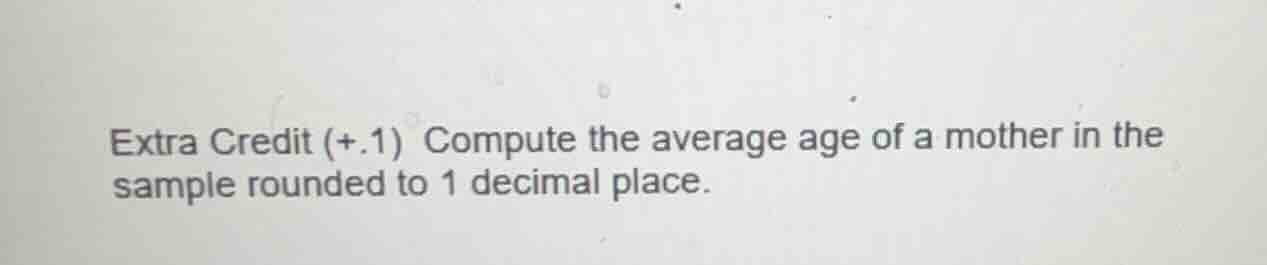
extra credit (+.1) compute the average age of a mother in the sample rounded to 1 decimal place.
To solve this problem, we need the data (ages of mothers in the sample) to compute the average. Since the data is not provided, we can't proceed with the calculation. However, here's the general method:
Step 1: Sum the ages
Let the ages of mothers be \( x_1, x_2, \dots, x_n \) where \( n \) is the number of mothers in the sample. Calculate the sum \( S = x_1 + x_2 + \dots + x_n \).
Step 2: Calculate the average
The average (mean) age \( \bar{x} \) is given by the formula:
\[
\bar{x} = \frac{S}{n}
\]
Step 3: Round to 1 decimal place
Round the result from Step 2 to one decimal place using the rounding rules (look at the second decimal digit; if it's 5 or more, round up the first decimal digit, otherwise leave it as is).
Since the data is missing, please provide the ages of the mothers in the sample to get the final answer.

Snap & solve any problem in the app
Get step-by-step solutions on Sovi AI
Photo-based solutions with guided steps
Explore more problems and detailed explanations
To solve this problem, we need the data (ages of mothers in the sample) to compute the average. Since the data is not provided, we can't proceed with the calculation. However, here's the general method:
Step 1: Sum the ages
Let the ages of mothers be \( x_1, x_2, \dots, x_n \) where \( n \) is the number of mothers in the sample. Calculate the sum \( S = x_1 + x_2 + \dots + x_n \).
Step 2: Calculate the average
The average (mean) age \( \bar{x} \) is given by the formula:
\[
\bar{x} = \frac{S}{n}
\]
Step 3: Round to 1 decimal place
Round the result from Step 2 to one decimal place using the rounding rules (look at the second decimal digit; if it's 5 or more, round up the first decimal digit, otherwise leave it as is).
Since the data is missing, please provide the ages of the mothers in the sample to get the final answer.