QUESTION IMAGE
Question
factoring variable expressions
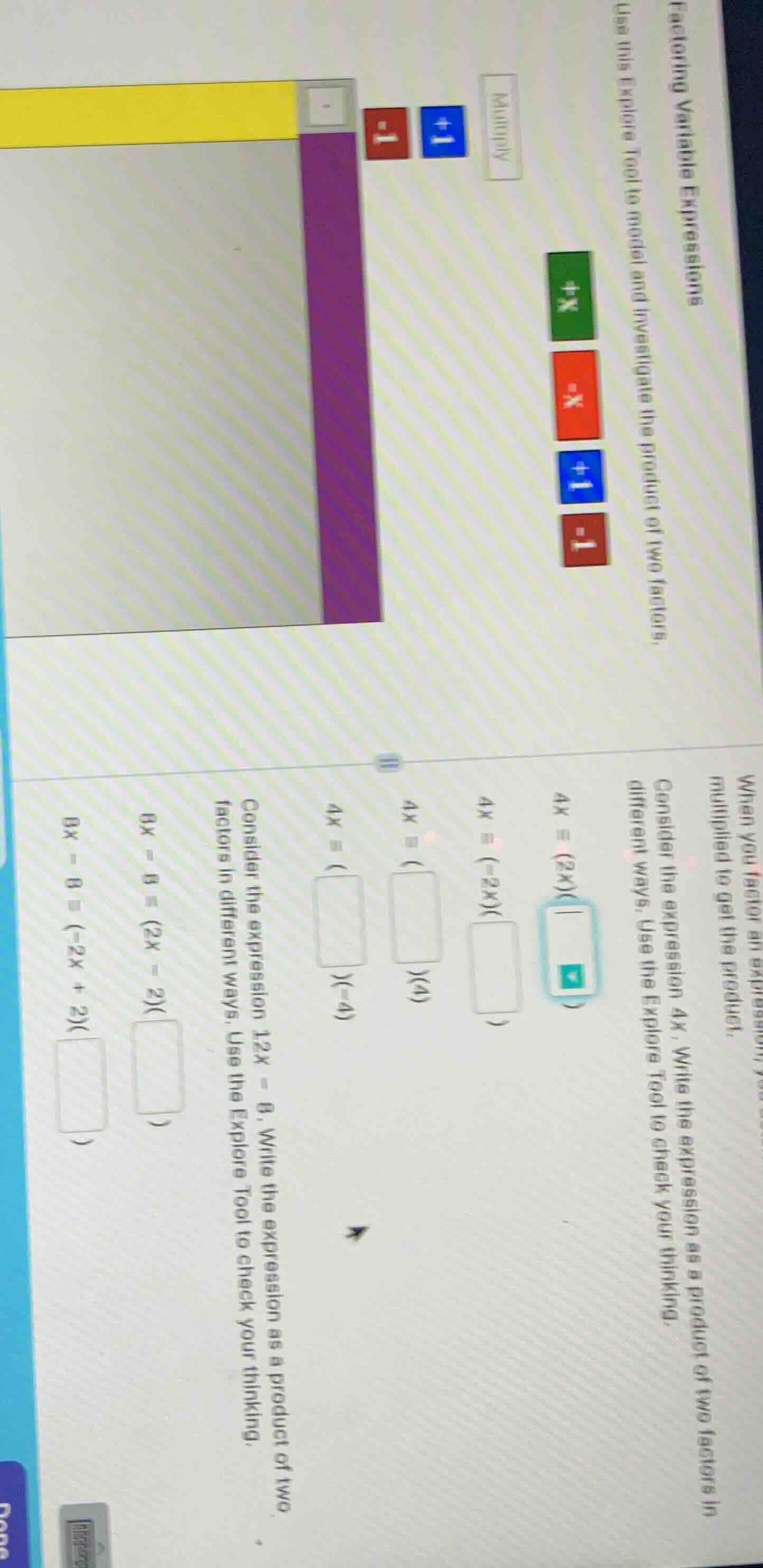
use this explore tool to model and investigate the product of two factors.
when you factor an expression, you multiplied to get the product.
consider the expression ( 4x ). write the expression as a product of two factors in different ways. use the explore tool to check your thinking.
( 4x = (2x)(square) )
( 4x = (-2x)(square) )
( 4x = (square)(4) )
( 4x = (square)(-4) )
consider the expression ( 12x - 8 ). write the expression as a product of two factors in different ways. use the explore tool to check your thinking.
( 8x - 8 = (2x - 2)(square) )
( 8x - 8 = (-2x + 2)(square) )
Part 1: Factoring \(4x\)
For \(4x=(2x)(\square)\)
Step1: Solve for the missing factor
We know that if \(4x = (2x)\times(\square)\), we can divide both sides by \(2x\) (assuming \(x
eq0\)) to find the missing factor. So \(\square=\frac{4x}{2x}\).
Step2: Simplify the fraction
Simplifying \(\frac{4x}{2x}\), the \(x\) terms cancel out (for \(x
eq0\)) and \(\frac{4}{2} = 2\). So the missing factor is \(2\).
For \(4x=(-2x)(\square)\)
Step1: Solve for the missing factor
If \(4x=(-2x)\times(\square)\), divide both sides by \(-2x\) (assuming \(x
eq0\)): \(\square=\frac{4x}{-2x}\).
Step2: Simplify the fraction
Simplifying \(\frac{4x}{-2x}\), the \(x\) terms cancel out (for \(x
eq0\)) and \(\frac{4}{-2}=-2\). So the missing factor is \(-2\).
For \(4x=(\square)(4)\)
Step1: Solve for the missing factor
If \(4x = (\square)\times4\), divide both sides by \(4\): \(\square=\frac{4x}{4}\).
Step2: Simplify the fraction
Simplifying \(\frac{4x}{4}\), we get \(x\). So the missing factor is \(x\).
For \(4x=(\square)(-4)\)
Step1: Solve for the missing factor
If \(4x=(\square)\times(-4)\), divide both sides by \(-4\): \(\square=\frac{4x}{-4}\).
Step2: Simplify the fraction
Simplifying \(\frac{4x}{-4}\), we get \(-x\). So the missing factor is \(-x\).
Part 2: Factoring \(12x - 8\)
For \(12x - 8=(2x - 2)(\square)\)
Step1: Factor out the common factor from \(12x-8\)
First, factor out \(4\) from \(12x - 8\): \(12x-8 = 4(3x - 2)\). Now, factor out \(2\) from \(2x - 2\): \(2x - 2=2(x - 1)\). Let's expand \((2x - 2)\times\square=2(x - 1)\times\square\) and set it equal to \(4(3x - 2)=2\times2(3x - 2)\). So \(2(x - 1)\times\square=2\times2(3x - 2)\). Divide both sides by \(2\): \((x - 1)\times\square = 2(3x - 2)\). Wait, maybe a better way: divide \(12x - 8\) by \(2x - 2\). Using polynomial long division or factoring:
\(12x-8=4(3x - 2)\), \(2x - 2 = 2(x - 1)\). Let's find \(k\) such that \(2(x - 1)\times k=4(3x - 2)\). Then \(k=\frac{4(3x - 2)}{2(x - 1)}=\frac{2(3x - 2)}{x - 1}\). Wait, maybe I made a mistake. Wait, let's try another approach. Let \(12x-8=(2x - 2)\times a\). Then \(a=\frac{12x - 8}{2x - 2}=\frac{4(3x - 2)}{2(x - 1)}=\frac{2(3x - 2)}{x - 1}\). Wait, that seems complicated. Wait, maybe the original problem has a typo? Wait, no, maybe I misread. Wait, the next one is \(8x - 8=(2x - 2)(\square)\)? Wait, no, the user's problem says "Consider the expression \(12x - 8\). Write the expression as a product of two factors in different ways. Use the Explore Tool to check your thinking. \(8x - 8=(2x - 2)(\square)\)" Wait, maybe it's \(8x - 8\) instead of \(12x - 8\) for that sub - problem? Let's assume it's \(8x - 8\).
For \(8x - 8=(2x - 2)(\square)\)
Step1: Factor out common factors
Factor out \(4\) from \(8x - 8\): \(8x - 8 = 4(2x - 2)\). Factor out \(2\) from \(2x - 2\): \(2x - 2=2(x - 1)\). Now, \(8x - 8=8(x - 1)=2\times4(x - 1)\), and \(2x - 2 = 2(x - 1)\). So if \(8x - 8=(2x - 2)\times\square\), then \(\square=\frac{8x - 8}{2x - 2}=\frac{8(x - 1)}{2(x - 1)} = 4\) (for \(x
eq1\)).
For \(8x - 8=(-2x + 2)(\square)\)
Step1: Factor the left - hand side and the right - hand side
Factor out \(-4\) from \(-2x + 2\): \(-2x + 2=-2(x - 1)\). Factor out \(8\) from \(8x - 8\): \(8x - 8 = 8(x - 1)\). Let \(8x - 8=(-2x + 2)\times\square=-2(x - 1)\times\square\). Then \(-2(x - 1)\times\square=8(x - 1)\). Divide both sides by \(-2(x - 1)\) (assuming \(x
eq1\)): \(\square=\frac{8(x - 1)}{-2(x - 1)}=-4\).
Final Answers (for the sub - problems of factoring \(4x\)):
- For \(4x=(2x)(\squar…

Snap & solve any problem in the app
Get step-by-step solutions on Sovi AI
Photo-based solutions with guided steps
Explore more problems and detailed explanations
Part 1: Factoring \(4x\)
For \(4x=(2x)(\square)\)
Step1: Solve for the missing factor
We know that if \(4x = (2x)\times(\square)\), we can divide both sides by \(2x\) (assuming \(x
eq0\)) to find the missing factor. So \(\square=\frac{4x}{2x}\).
Step2: Simplify the fraction
Simplifying \(\frac{4x}{2x}\), the \(x\) terms cancel out (for \(x
eq0\)) and \(\frac{4}{2} = 2\). So the missing factor is \(2\).
For \(4x=(-2x)(\square)\)
Step1: Solve for the missing factor
If \(4x=(-2x)\times(\square)\), divide both sides by \(-2x\) (assuming \(x
eq0\)): \(\square=\frac{4x}{-2x}\).
Step2: Simplify the fraction
Simplifying \(\frac{4x}{-2x}\), the \(x\) terms cancel out (for \(x
eq0\)) and \(\frac{4}{-2}=-2\). So the missing factor is \(-2\).
For \(4x=(\square)(4)\)
Step1: Solve for the missing factor
If \(4x = (\square)\times4\), divide both sides by \(4\): \(\square=\frac{4x}{4}\).
Step2: Simplify the fraction
Simplifying \(\frac{4x}{4}\), we get \(x\). So the missing factor is \(x\).
For \(4x=(\square)(-4)\)
Step1: Solve for the missing factor
If \(4x=(\square)\times(-4)\), divide both sides by \(-4\): \(\square=\frac{4x}{-4}\).
Step2: Simplify the fraction
Simplifying \(\frac{4x}{-4}\), we get \(-x\). So the missing factor is \(-x\).
Part 2: Factoring \(12x - 8\)
For \(12x - 8=(2x - 2)(\square)\)
Step1: Factor out the common factor from \(12x-8\)
First, factor out \(4\) from \(12x - 8\): \(12x-8 = 4(3x - 2)\). Now, factor out \(2\) from \(2x - 2\): \(2x - 2=2(x - 1)\). Let's expand \((2x - 2)\times\square=2(x - 1)\times\square\) and set it equal to \(4(3x - 2)=2\times2(3x - 2)\). So \(2(x - 1)\times\square=2\times2(3x - 2)\). Divide both sides by \(2\): \((x - 1)\times\square = 2(3x - 2)\). Wait, maybe a better way: divide \(12x - 8\) by \(2x - 2\). Using polynomial long division or factoring:
\(12x-8=4(3x - 2)\), \(2x - 2 = 2(x - 1)\). Let's find \(k\) such that \(2(x - 1)\times k=4(3x - 2)\). Then \(k=\frac{4(3x - 2)}{2(x - 1)}=\frac{2(3x - 2)}{x - 1}\). Wait, maybe I made a mistake. Wait, let's try another approach. Let \(12x-8=(2x - 2)\times a\). Then \(a=\frac{12x - 8}{2x - 2}=\frac{4(3x - 2)}{2(x - 1)}=\frac{2(3x - 2)}{x - 1}\). Wait, that seems complicated. Wait, maybe the original problem has a typo? Wait, no, maybe I misread. Wait, the next one is \(8x - 8=(2x - 2)(\square)\)? Wait, no, the user's problem says "Consider the expression \(12x - 8\). Write the expression as a product of two factors in different ways. Use the Explore Tool to check your thinking. \(8x - 8=(2x - 2)(\square)\)" Wait, maybe it's \(8x - 8\) instead of \(12x - 8\) for that sub - problem? Let's assume it's \(8x - 8\).
For \(8x - 8=(2x - 2)(\square)\)
Step1: Factor out common factors
Factor out \(4\) from \(8x - 8\): \(8x - 8 = 4(2x - 2)\). Factor out \(2\) from \(2x - 2\): \(2x - 2=2(x - 1)\). Now, \(8x - 8=8(x - 1)=2\times4(x - 1)\), and \(2x - 2 = 2(x - 1)\). So if \(8x - 8=(2x - 2)\times\square\), then \(\square=\frac{8x - 8}{2x - 2}=\frac{8(x - 1)}{2(x - 1)} = 4\) (for \(x
eq1\)).
For \(8x - 8=(-2x + 2)(\square)\)
Step1: Factor the left - hand side and the right - hand side
Factor out \(-4\) from \(-2x + 2\): \(-2x + 2=-2(x - 1)\). Factor out \(8\) from \(8x - 8\): \(8x - 8 = 8(x - 1)\). Let \(8x - 8=(-2x + 2)\times\square=-2(x - 1)\times\square\). Then \(-2(x - 1)\times\square=8(x - 1)\). Divide both sides by \(-2(x - 1)\) (assuming \(x
eq1\)): \(\square=\frac{8(x - 1)}{-2(x - 1)}=-4\).
Final Answers (for the sub - problems of factoring \(4x\)):
- For \(4x=(2x)(\square)\): \(\boldsymbol{2}\)
- For \(4x=(-2x)(\square)\): \(\boldsymbol{-2}\)
- For \(4x=(\square)(4)\): \(\boldsymbol{x}\)
- For \(4x=(\square)(-4)\): \(\boldsymbol{-x}\)
(For the \(8x - 8\) sub - problems, if we assume the first one is \(8x - 8=(2x - 2)(\square)\), the answer is \(4\); for \(8x - 8=(-2x + 2)(\square)\), the answer is \(-4\))