QUESTION IMAGE
Question
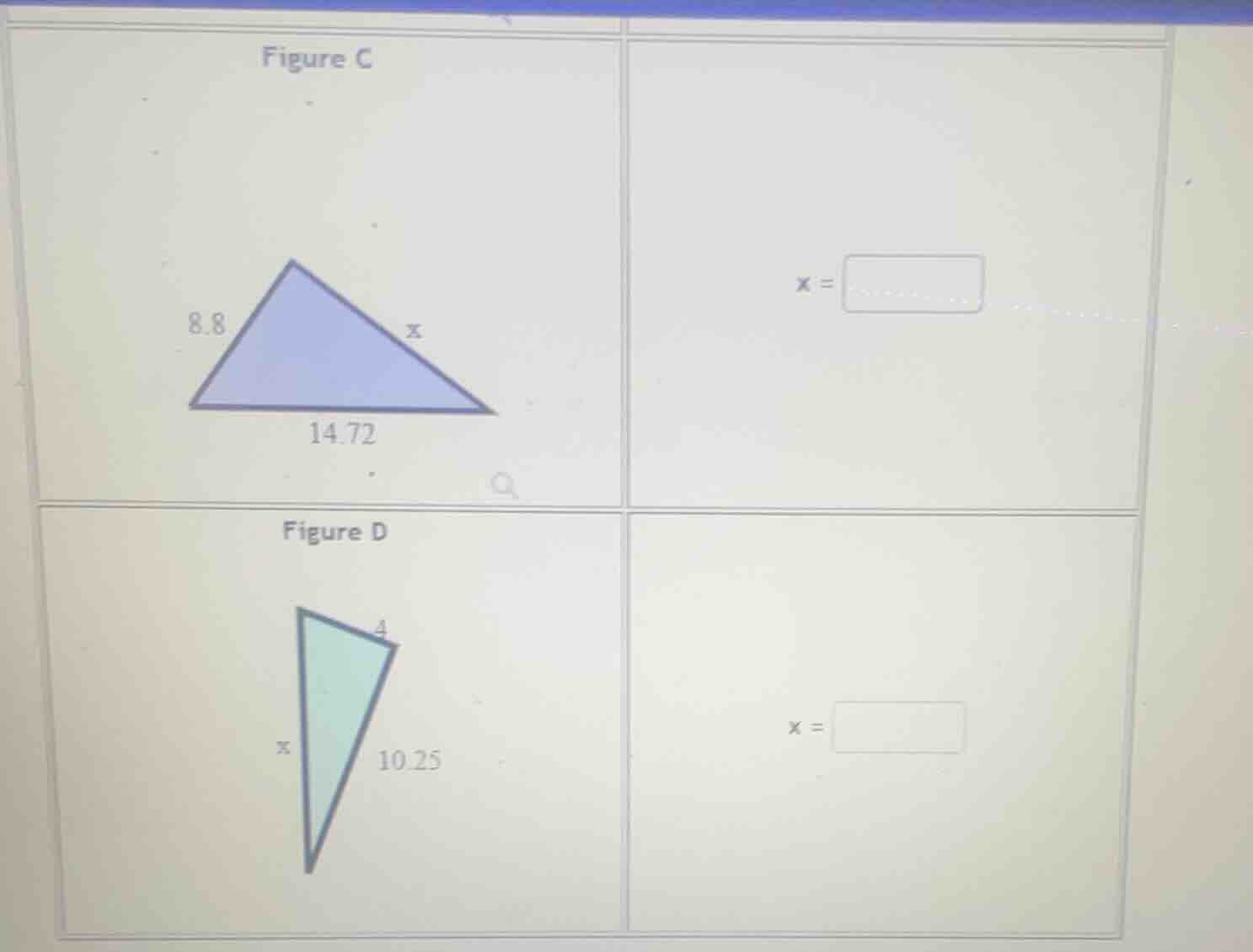
figure c
8.8, x, 14.72
x =
figure d
x, 4, 10.25
x =
Step1: Apply triangle inequality (Figure C)
The sum of any two sides of a triangle must be greater than the third side. We find the range for $x$:
$14.72 - 8.8 < x < 14.72 + 8.8$
$\implies 5.92 < x < 23.52$
Assuming we solve for a valid side length (if this is a right triangle, no right angle marked, so use inequality for valid $x$; if it's similar, no info, so use triangle inequality for valid range, but if we assume it's a triangle where we can find a reasonable value, but the basic valid range is above.
Step2: Apply triangle inequality (Figure D)
Use the same rule for the second triangle:
$10.25 - 4 < x < 10.25 + 4$
$\implies 6.25 < x < 14.25$
If we assume these are triangles where we need a valid possible value (since no other info is given, we can state the valid ranges, or if we assume integer values, common valid values are within the range. But the standard solution is the valid interval for $x$.

Snap & solve any problem in the app
Get step-by-step solutions on Sovi AI
Photo-based solutions with guided steps
Explore more problems and detailed explanations
For Figure C: $5.92 < x < 23.52$
For Figure D: $6.25 < x < 14.25$
*Note: If the triangles are right triangles (no right angle indicated), but if we assume the longest side is the hypotenuse for Figure C:
Step1: Assume right triangle (Figure C, hypotenuse=14.72)
$x = \sqrt{14.72^2 - 8.8^2}$
$x = \sqrt{(14.72-8.8)(14.72+8.8)} = \sqrt{5.92 \times 23.52} \approx \sqrt{139.2384} \approx 11.8$
Step2: Assume right triangle (Figure D, hypotenuse=x)
$x = \sqrt{10.25^2 + 4^2} = \sqrt{105.0625 + 16} = \sqrt{121.0625} \approx 11.0$
If right triangle is assumed: