QUESTION IMAGE
Question
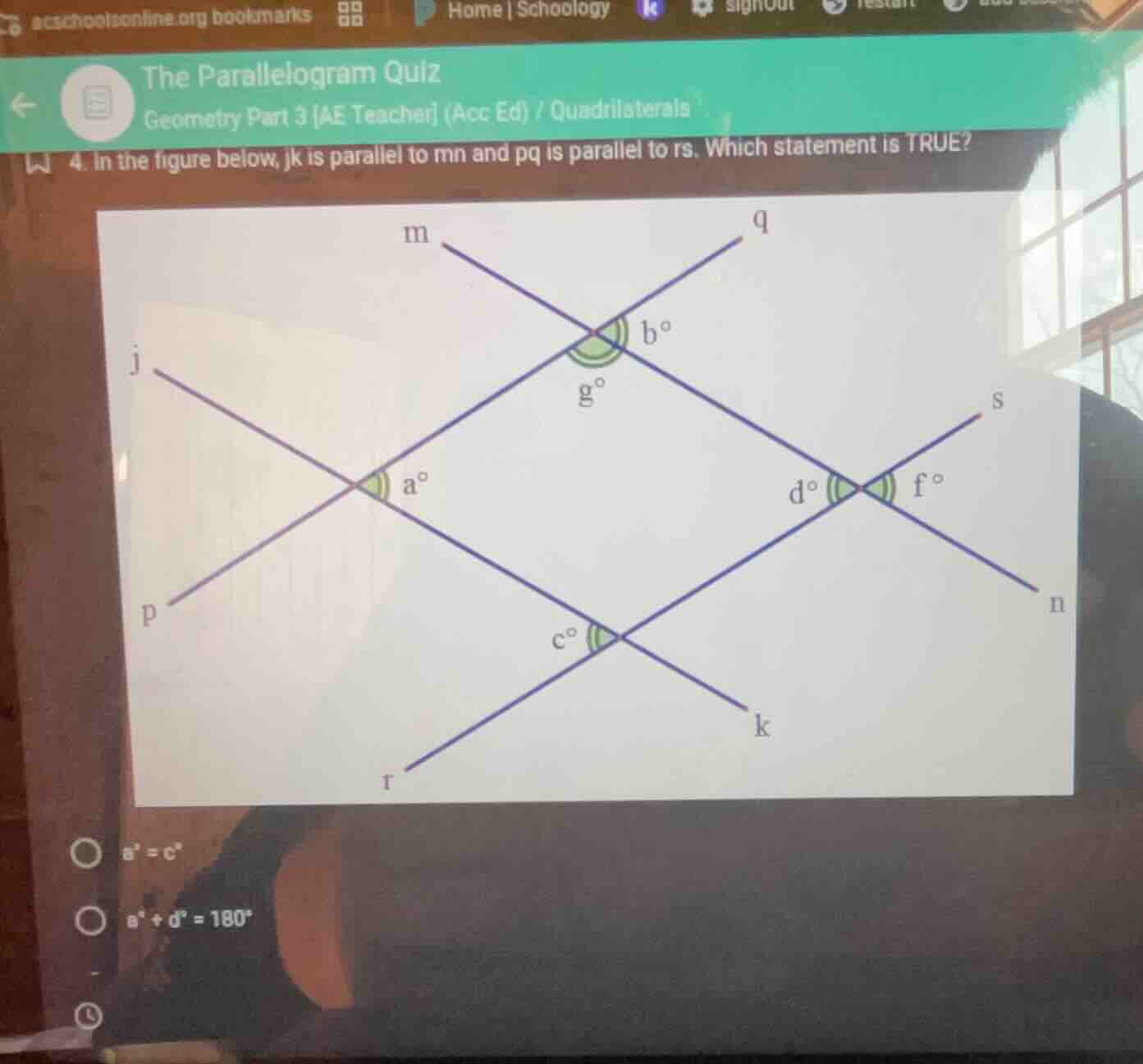
- in the figure below, jk is parallel to mn and pq is parallel to rs. which statement is true? options: a° = c°, a° + d° = 180° (and other options not fully visible)
Step1: Analyze angle relationships
First, use properties of parallel lines and vertical/adjacent angles.
- $\angle a$ and $\angle g$ are corresponding angles (since $jk \parallel mn$, cut by transversal $pq$), so $a = g$.
- $\angle g$ and $\angle b$ are supplementary: $g + b = 180^\circ$, so $a + b = 180^\circ$.
- $\angle b$ and $\angle d$ are corresponding angles (since $pq \parallel rs$, cut by transversal $mn$), so $b = d$.
- Substitute $b = d$ into $a + b = 180^\circ$: $a + d = 180^\circ$.
- For $a = c$: $\angle c$ and $\angle d$ are supplementary ($c + d = 180^\circ$), and $a + d = 180^\circ$, so $a = c$ would only hold if $d = d$ (which is always true, but this contradicts the supplementary relationship unless $a=c=90^\circ$, which is not given). So $a
eq c$ in general.
Step2: Verify the true statement
From the above deductions, $a^\circ + d^\circ = 180^\circ$ is the valid true statement.

Snap & solve any problem in the app
Get step-by-step solutions on Sovi AI
Photo-based solutions with guided steps
Explore more problems and detailed explanations
$a^\circ + d^\circ = 180^\circ$