QUESTION IMAGE
Question
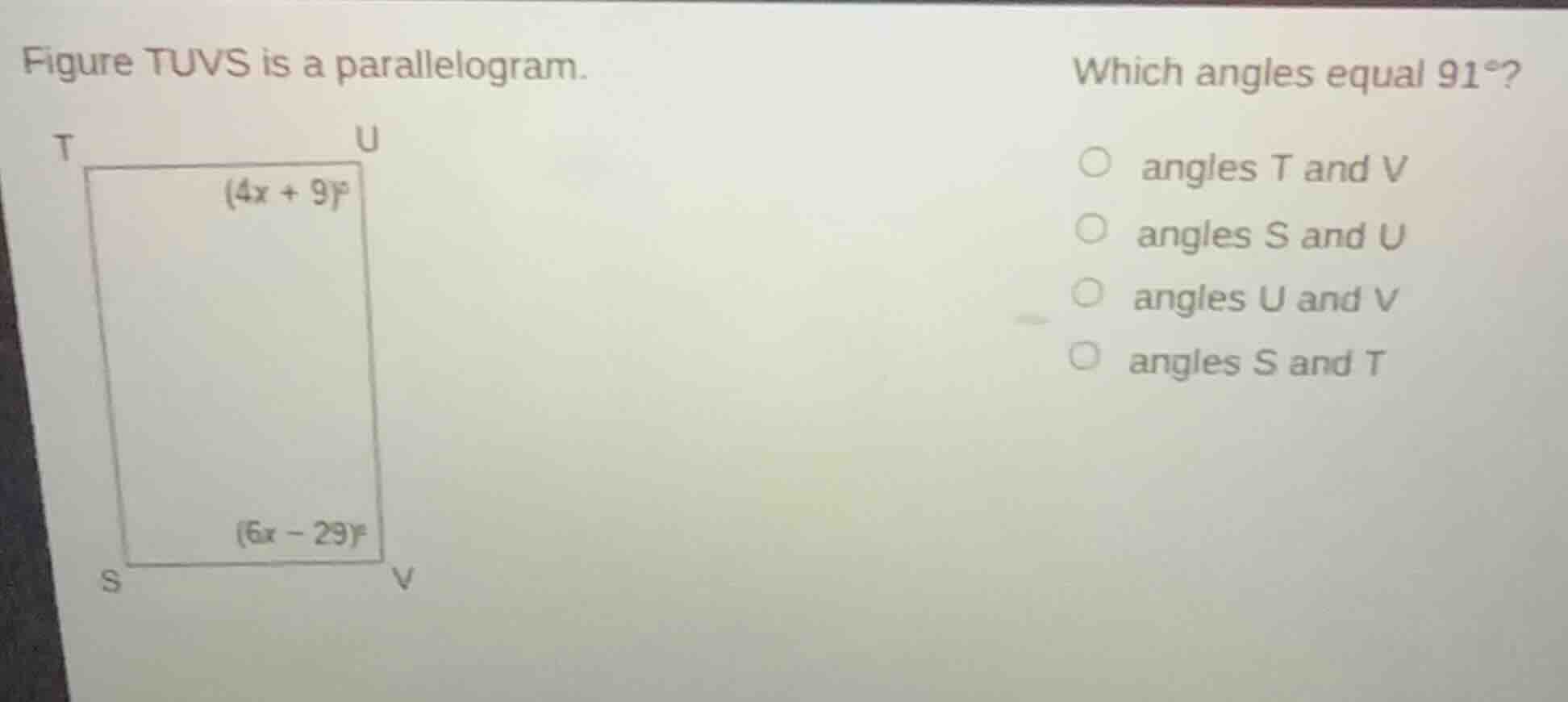
figure tuvs is a parallelogram. which angles equal 91°? (4x + 9)° (6x - 29)° angles t and v angles s and u angles u and v angles s and t
Step1: Recall parallelogram angle property
In a parallelogram, opposite angles are equal. So, angle \( U \) and angle \( V \) (wait, no, looking at the figure, angle \( U \) is \( (4x + 9)^\circ \) and angle \( V \) is \( (6x - 29)^\circ \)? Wait, no, in a parallelogram, consecutive angles are supplementary, but opposite angles are equal. Wait, actually, in a parallelogram, opposite angles are equal. Wait, the figure is TUV S, so sides TU and SV are opposite, TV and SU are opposite? Wait, no, the angles at U and V: wait, no, in a parallelogram, opposite angles are equal. Wait, the angles given are \( (4x + 9)^\circ \) at U and \( (6x - 29)^\circ \) at V? Wait, no, maybe U and V are adjacent? Wait, no, maybe U and S are opposite? Wait, no, let's correct. In a parallelogram, opposite angles are equal. So angle U and angle S? No, wait, the figure: T connected to U and S, U connected to T and V, V connected to U and S, S connected to V and T. So TUV S is a parallelogram, so TU is parallel to SV, and TV is parallel to SU. So angle U and angle S are consecutive? Wait, no, angle at U: \( (4x + 9)^\circ \), angle at V: \( (6x - 29)^\circ \). Wait, in a parallelogram, opposite angles are equal. Wait, maybe angle U and angle V are not opposite. Wait, maybe the two angles given are opposite angles? Wait, no, in a parallelogram, opposite angles are equal, so \( 4x + 9 = 6x - 29 \). Let's solve for x.
Step2: Solve for x
Set \( 4x + 9 = 6x - 29 \)
Subtract \( 4x \) from both sides: \( 9 = 2x - 29 \)
Add 29 to both sides: \( 38 = 2x \)
Divide by 2: \( x = 19 \)
Step3: Calculate angle measure
Now plug x = 19 into \( 4x + 9 \): \( 4(19) + 9 = 76 + 9 = 85 \)? Wait, that can't be. Wait, maybe I made a mistake. Wait, maybe the angles are consecutive angles? No, consecutive angles in a parallelogram are supplementary. Wait, maybe the two angles are adjacent? No, wait, maybe the angles at U and V are adjacent? Wait, no, maybe the angles given are opposite angles. Wait, no, maybe I misread the figure. Wait, the figure is a parallelogram, so angle T and angle V are opposite, angle U and angle S are opposite? Wait, no, let's re-express. Let's assume that angle U and angle S are opposite? No, the angles given are at U: \( (4x + 9)^\circ \) and at V: \( (6x - 29)^\circ \). Wait, maybe the two angles are adjacent and supplementary? Wait, no, in a parallelogram, consecutive angles are supplementary. Wait, maybe I messed up the property. Wait, in a parallelogram, opposite angles are equal, so if angle U and angle S are opposite, but the angles given are at U and V. Wait, maybe the figure is a parallelogram, so TU is parallel to SV, and TV is parallel to SU. So angle at U: between TU and UV, angle at V: between UV and VS. So TU is parallel to VS, so angle U and angle V are same-side interior angles, hence supplementary. Wait, no, same-side interior angles are supplementary. Wait, but the problem says "which angles equal 91°". Wait, maybe my initial assumption is wrong. Wait, let's solve \( 4x + 9 = 6x - 29 \):
\( 4x + 9 = 6x - 29 \)
\( 9 + 29 = 6x - 4x \)
\( 38 = 2x \)
\( x = 19 \)
Then angle U: \( 4(19) + 9 = 85 \), angle V: \( 6(19) - 29 = 114 - 29 = 85 \). Wait, that's not 91. Wait, maybe the angles are consecutive and supplementary? Wait, no, maybe I made a mistake in the angle labels. Wait, maybe angle T and angle U are consecutive, and angle T and angle V are opposite? Wait, the options are angles T and V, S and U, U and V, S and T.
Wait, let's re-express. Let's suppose that in parallelogram TUV S, angle T and angle V are opposite, angle U a…

Snap & solve any problem in the app
Get step-by-step solutions on Sovi AI
Photo-based solutions with guided steps
Explore more problems and detailed explanations
angles T and V