QUESTION IMAGE
Question
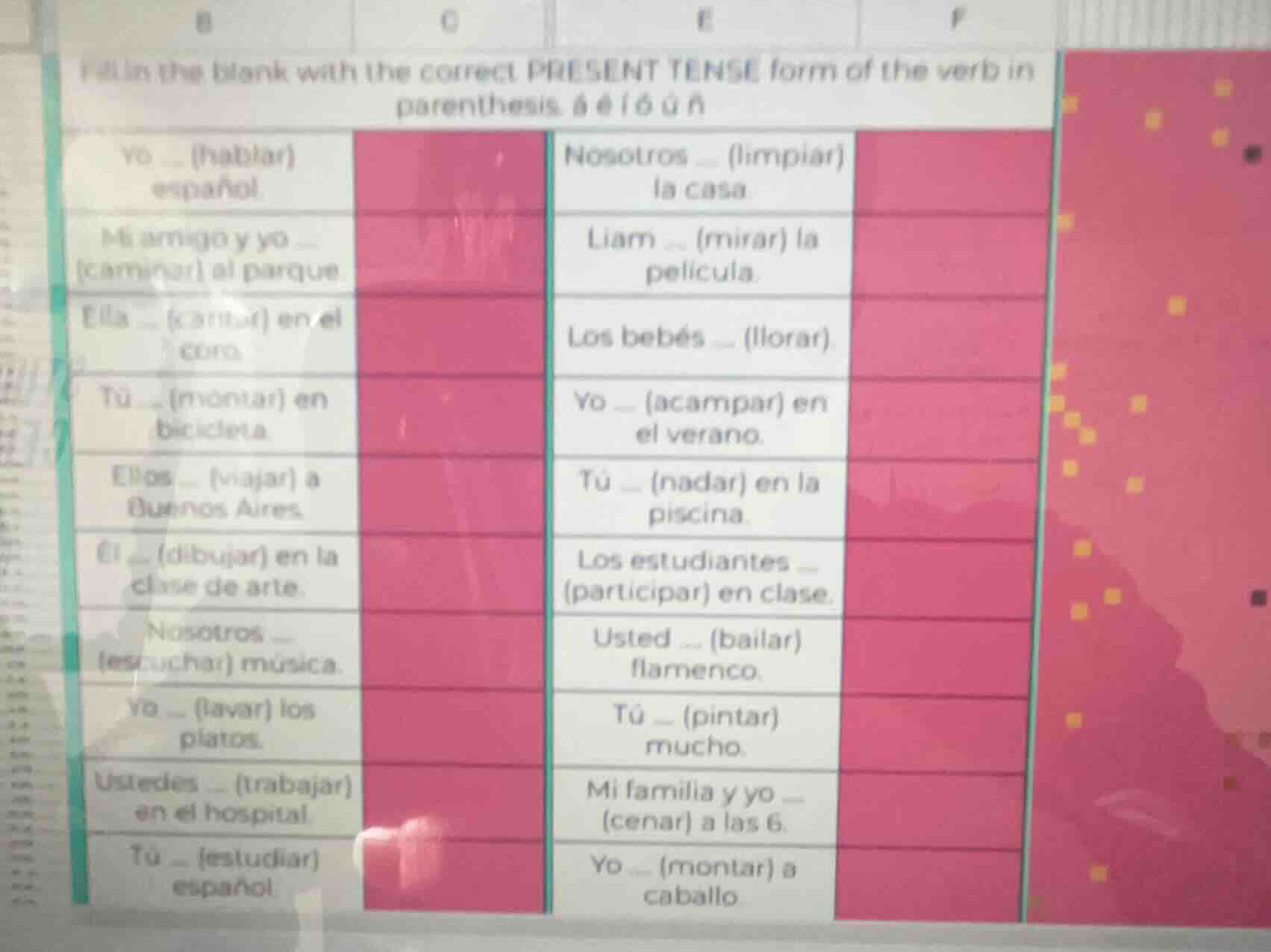
fill in the blank with the correct present tense form of the verb in parenthesis.
yo __ (hablar) español.
mi amigo y yo __ (caminar) al parque.
ella __ (cantar) en el coro.
tú __ (montar) en bicicleta.
ellos __ (viajar) a buenos aires.
él __ (dibujar) en la clase de arte.
nosotros __ (escuchar) música.
yo __ (lavar) los platos.
ustedes __ (trabajar) en el hospital.
tú __ (estudiar) español.
nosotros __ (limpiar) la casa.
liam __ (mirar) la película.
los bebés __ (llorar).
yo __ (acampar) en el verano.
tú __ (nadar) en la piscina.
los estudiantes __ (participar) en clase.
usted __ (bailar) flamenco.
tú __ (pintar) mucho.
mi familia y yo __ (cenar) a las 6.
yo __ (montar) a caballo.
To solve this, we need to conjugate the given -ar verbs in the present tense for the respective subjects. Remember the present tense conjugation rules for -ar verbs: for a verb ending in -ar (like hablar, limpiar, etc.), the endings are: yo -o, tú -as, él/ella/usted -a, nosotros -amos, vosotros -áis, ellos/ellas/ustedes -an. Let's go through each sentence:
1. Yo (hablar) español.
- Subject: yo (first person singular)
- Conjugation of hablar: yo hablo (since -ar verb, yo takes -o ending)
2. Mi amigo y yo (caminar) al parque.
- Subject: mi amigo y yo (first person plural: nosotros)
- Conjugation of caminar: nosotros caminamos ( -ar verb, nosotros takes -amos ending)
3. Ella (cantar) en el coro.
- Subject: ella (third person singular, feminine)
- Conjugation of cantar: ella canta ( -ar verb, ella takes -a ending)
4. Tú (montar) en bicicleta.
- Subject: tú (second person singular)
- Conjugation of montar: tú montas ( -ar verb, tú takes -as ending)
5. Ellos (viajar) a Buenos Aires.
- Subject: ellos (third person plural, masculine)
- Conjugation of viajar: ellos viajan ( -ar verb, ellos takes -an ending)
6. Él (dibujar) en la clase de arte.
- Subject: él (third person singular, masculine)
- Conjugation of dibujar: él dibuja ( -ar verb, él takes -a ending)
7. Nosotros (escuchar) música.
- Subject: nosotros (first person plural)
- Conjugation of escuchar: nosotros escuchamos ( -ar verb, nosotros takes -amos ending)
8. Yo (lavar) los platos.
- Subject: yo (first person singular)
- Conjugation of lavar: yo lavo ( -ar verb, yo takes -o ending)
9. Ustedes (trabajar) en el hospital.
- Subject: ustedes (second person plural, formal in some regions, but takes -an ending for -ar verbs)
- Conjugation of trabajar: ustedes trabajan ( -ar verb, ustedes takes -an ending)
10. Tú (estudiar) español.
- Subject: tú (second person singular)
- Conjugation of estudiar: tú estudias ( -ar verb, tú takes -as ending)
11. Nosotros (limpiar) la casa.
- Subject: nosotros (first person plural)
- Conjugation of limpiar: nosotros limpiamos ( -ar verb, nosotros takes -amos ending)
12. Liam (mirar) la película.
- Subject: Liam (third person singular, masculine, same as él)
- Conjugation of mirar: Liam mira ( -ar verb, él takes -a ending)
13. Los bebés (llorar)
- Subject: los bebés (third person plural, masculine: ellos)
- Conjugation of llorar: los bebés lloran ( -ar verb, ellos takes -an ending)
14. Yo (acampar) en el verano.
- Subject: yo (first person singular)
- Conjugation of acampar: yo acampo ( -ar verb, yo takes -o ending)
15. Tú (nadar) en la piscina.
- Subject: tú (second person singular)
- Conjugation of nadar: tú nadas ( -ar verb, tú takes -as ending)
16. Los estudiantes (participar) en clase.
- Subject: los estudiantes (third person plural, masculine: ellos)
- Conjugation of participar: los estudiantes participan ( -ar verb, ellos takes -an ending)
17. Usted (bailar) flamenco.
- Subject: usted (third person singular, formal)
- Conjugation of bailar: usted baila ( -ar verb, usted takes -a ending)
18. Tú (pintar) mucho.
- Subject: tú (second person singular)
- Conjugation of pintar: tú pintas ( -ar verb, tú takes -as ending)
19. Mi familia y yo (cenar) a las 6.
- Subject: mi familia y yo (first person plural: nosotros)
- Conjugation of cenar: nosotros cenamos ( -ar verb, nosotros takes -amos ending)
20. Yo (montar) a caballo.
- Subject: yo (first person singular)
- Conjugation of montar: yo monto ( -ar verb, yo takes -o ending)
Now, filling in the blanks with the conjugated verbs:…

Snap & solve any problem in the app
Get step-by-step solutions on Sovi AI
Photo-based solutions with guided steps
Explore more problems and detailed explanations
To solve this, we need to conjugate the given -ar verbs in the present tense for the respective subjects. Remember the present tense conjugation rules for -ar verbs: for a verb ending in -ar (like hablar, limpiar, etc.), the endings are: yo -o, tú -as, él/ella/usted -a, nosotros -amos, vosotros -áis, ellos/ellas/ustedes -an. Let's go through each sentence:
1. Yo (hablar) español.
- Subject: yo (first person singular)
- Conjugation of hablar: yo hablo (since -ar verb, yo takes -o ending)
2. Mi amigo y yo (caminar) al parque.
- Subject: mi amigo y yo (first person plural: nosotros)
- Conjugation of caminar: nosotros caminamos ( -ar verb, nosotros takes -amos ending)
3. Ella (cantar) en el coro.
- Subject: ella (third person singular, feminine)
- Conjugation of cantar: ella canta ( -ar verb, ella takes -a ending)
4. Tú (montar) en bicicleta.
- Subject: tú (second person singular)
- Conjugation of montar: tú montas ( -ar verb, tú takes -as ending)
5. Ellos (viajar) a Buenos Aires.
- Subject: ellos (third person plural, masculine)
- Conjugation of viajar: ellos viajan ( -ar verb, ellos takes -an ending)
6. Él (dibujar) en la clase de arte.
- Subject: él (third person singular, masculine)
- Conjugation of dibujar: él dibuja ( -ar verb, él takes -a ending)
7. Nosotros (escuchar) música.
- Subject: nosotros (first person plural)
- Conjugation of escuchar: nosotros escuchamos ( -ar verb, nosotros takes -amos ending)
8. Yo (lavar) los platos.
- Subject: yo (first person singular)
- Conjugation of lavar: yo lavo ( -ar verb, yo takes -o ending)
9. Ustedes (trabajar) en el hospital.
- Subject: ustedes (second person plural, formal in some regions, but takes -an ending for -ar verbs)
- Conjugation of trabajar: ustedes trabajan ( -ar verb, ustedes takes -an ending)
10. Tú (estudiar) español.
- Subject: tú (second person singular)
- Conjugation of estudiar: tú estudias ( -ar verb, tú takes -as ending)
11. Nosotros (limpiar) la casa.
- Subject: nosotros (first person plural)
- Conjugation of limpiar: nosotros limpiamos ( -ar verb, nosotros takes -amos ending)
12. Liam (mirar) la película.
- Subject: Liam (third person singular, masculine, same as él)
- Conjugation of mirar: Liam mira ( -ar verb, él takes -a ending)
13. Los bebés (llorar)
- Subject: los bebés (third person plural, masculine: ellos)
- Conjugation of llorar: los bebés lloran ( -ar verb, ellos takes -an ending)
14. Yo (acampar) en el verano.
- Subject: yo (first person singular)
- Conjugation of acampar: yo acampo ( -ar verb, yo takes -o ending)
15. Tú (nadar) en la piscina.
- Subject: tú (second person singular)
- Conjugation of nadar: tú nadas ( -ar verb, tú takes -as ending)
16. Los estudiantes (participar) en clase.
- Subject: los estudiantes (third person plural, masculine: ellos)
- Conjugation of participar: los estudiantes participan ( -ar verb, ellos takes -an ending)
17. Usted (bailar) flamenco.
- Subject: usted (third person singular, formal)
- Conjugation of bailar: usted baila ( -ar verb, usted takes -a ending)
18. Tú (pintar) mucho.
- Subject: tú (second person singular)
- Conjugation of pintar: tú pintas ( -ar verb, tú takes -as ending)
19. Mi familia y yo (cenar) a las 6.
- Subject: mi familia y yo (first person plural: nosotros)
- Conjugation of cenar: nosotros cenamos ( -ar verb, nosotros takes -amos ending)
20. Yo (montar) a caballo.
- Subject: yo (first person singular)
- Conjugation of montar: yo monto ( -ar verb, yo takes -o ending)
Now, filling in the blanks with the conjugated verbs:
- Yo hablo español.
- Mi amigo y yo caminamos al parque.
- Ella canta en el coro.
- Tú montas en bicicleta.
- Ellos viajan a Buenos Aires.
- Él dibuja en la clase de arte.
- Nosotros escuchamos música.
- Yo lavo los platos.
- Ustedes trabajan en el hospital.
- Tú estudias español.
- Nosotros limpiamos la casa.
- Liam mira la película.
- Los bebés lloran
- Yo acampo en el verano.
- Tú nadas en la piscina.
- Los estudiantes participan en clase.
- Usted baila flamenco.
- Tú pintas mucho.
- Mi familia y yo cenamos a las 6.
- Yo monto a caballo.