QUESTION IMAGE
Question
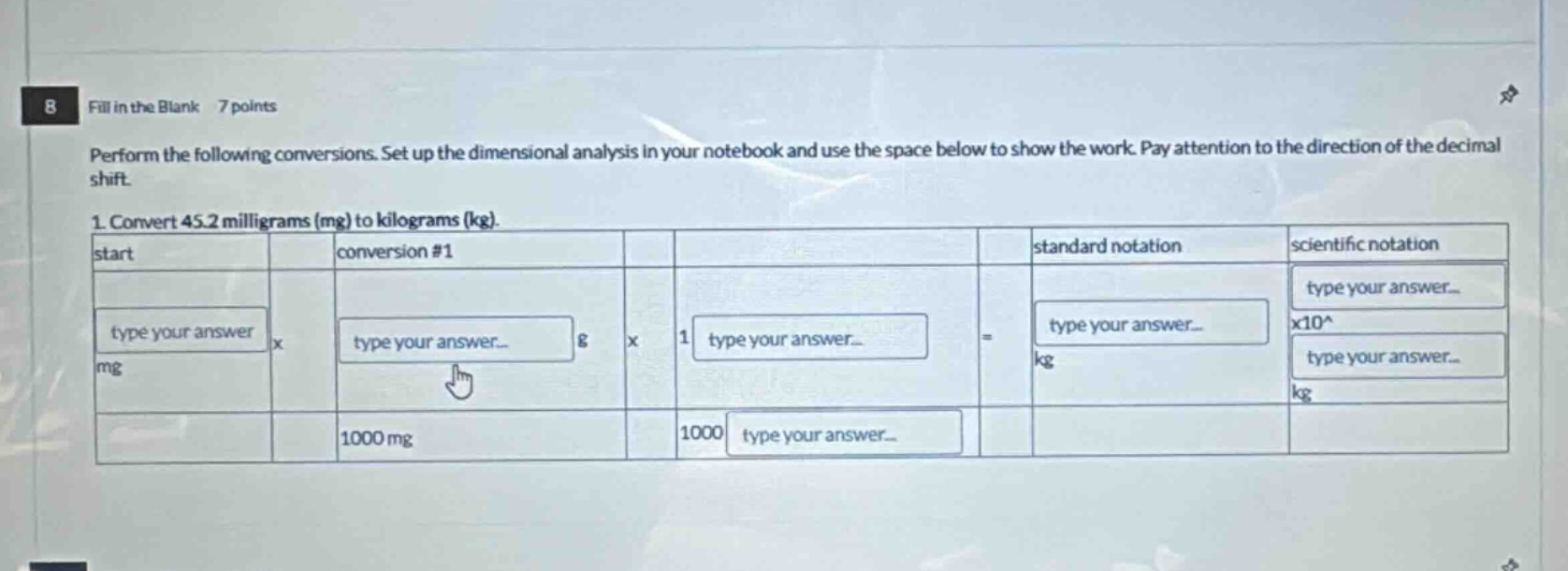
8 fill in the blank 7 points perform the following conversions. set up the dimensional analysis in your notebook and use the space below to show the work. pay attention to the direction of the decimal shift. 1. convert 45.2 milligrams (mg) to kilograms (kg). start conversion #1 standard notation scientific notation type your answer... type your answer x type your answer... g x 1 type your answer... = type your answer... x10^ mg kg type your answer... kg 1000 mg 1000 type your answer...
Step1: Convert mg to g
We know that \( 1\ g = 1000\ mg \), so to convert milligrams to grams, we use the conversion factor \( \frac{1\ g}{1000\ mg} \).
\( 45.2\ mg\times\frac{1\ g}{1000\ mg}=\frac{45.2}{1000}\ g = 0.0452\ g \)
Step2: Convert g to kg
We know that \( 1\ kg = 1000\ g \), so to convert grams to kilograms, we use the conversion factor \( \frac{1\ kg}{1000\ g} \).
\( 0.0452\ g\times\frac{1\ kg}{1000\ g}=\frac{0.0452}{1000}\ kg = 0.0000452\ kg \)
Step3: Express in scientific notation
To write \( 0.0000452\) in scientific notation, we move the decimal point 5 places to the right, so it becomes \( 4.52\times 10^{-5}\).
Filling in the table:
- start: \( 45.2\) mg
- conversion #1: \( \frac{1}{1000}\) (since \( 1\ g = 1000\ mg \), the conversion factor from mg to g is \( \frac{1\ g}{1000\ mg}\), so the numerator for the first conversion box is 1 and denominator is 1000, but in the table's "conversion #1" box (the one with the g), it's the numerator of the first conversion factor, so 1? Wait, no, let's re - examine the table structure. The table has "start" as [value] mg, then "x" [conversion #1] g / 1000 mg (since the bottom row has 1000 mg). Then "x" 1 [conversion #2] kg / 1000 g (since the bottom row has 1000 [blank] and we know 1 kg = 1000 g, so the blank is g).
So:
- start: \( 45.2\)
- conversion #1 (the box with g): \( 1\) (because the conversion factor is \( \frac{1\ g}{1000\ mg}\), so the numerator is 1)
- then the next conversion factor (the box with kg): \( \frac{1\ kg}{1000\ g}\), so the numerator (the box with 1 and then the unit) is \( 1\) and the denominator's unit (the bottom row's last blank) is \( g\)
- standard notation: \( 0.0000452\) kg
- scientific notation: coefficient \( 4.52\), exponent \( - 5\)

Snap & solve any problem in the app
Get step-by-step solutions on Sovi AI
Photo-based solutions with guided steps
Explore more problems and detailed explanations
- start: \( 45.2\)
- conversion #1 (g box): \( 1\)
- conversion #2 (kg box numerator): \( 1\), conversion #2 (denominator unit, bottom row last blank): \( g\)
- standard notation: \( 0.0000452\)
- scientific notation: \( 4.52\times10^{-5}\) (so coefficient is \( 4.52\), exponent is \( - 5\))