QUESTION IMAGE
Question
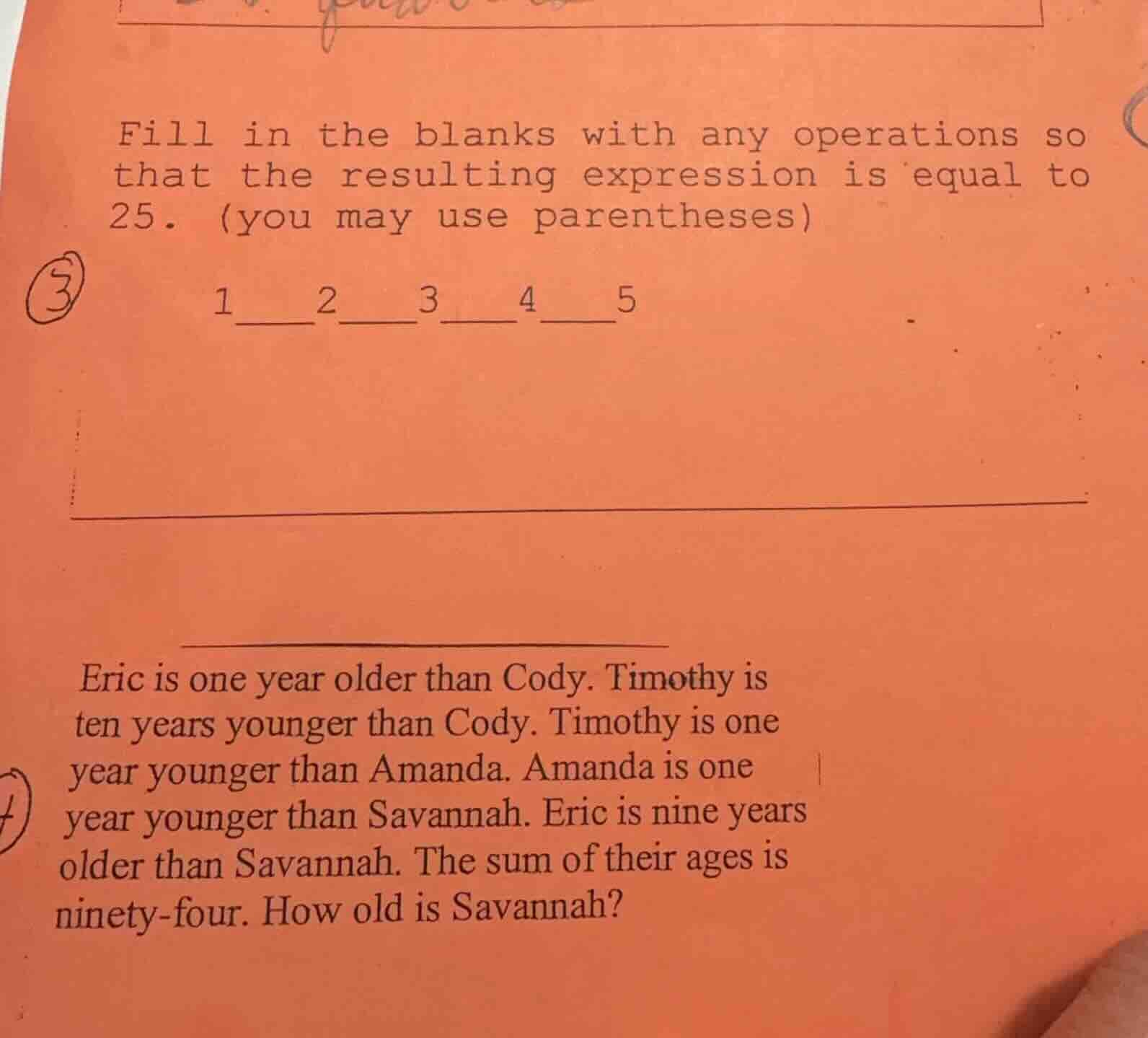
fill in the blanks with any operations so that the resulting expression is equal to 25. (you may use parentheses)
3 1__234__5
eric is one year older than cody. timothy is ten years younger than cody. timothy is one year younger than amanda. amanda is one year younger than savannah. eric is nine years older than savannah. the sum of their ages is ninety - four. how old is savannah?
Sub - Question 3
Step1: Analyze possible operations
We need to use operations (and parentheses if needed) on 1, 2, 3, 4, 5 to get 25. Let's try different combinations. One possible way: First, consider \(1 + 2 = 3\), then \(3\times3 = 9\) (wait, no, we have 1,2,3,4,5). Let's try \((1 + 2)\times3+4\times5\). Wait, no, let's check: \((1 + 2 + 3 + 4)\times5\)? Wait, \(1+2 + 3+4=10\), \(10\times5 = 50\), too big. Wait, another way: \(1 + 2\times3 + 4\times5\). Let's calculate: \(2\times3 = 6\), \(4\times5 = 20\), then \(1+6 + 20=27\), close. Wait, \(1\times2 + 3\times4+5\)? \(2 + 12+5 = 19\). Wait, \((1 + 2)\times(3 + 4)+5\)? \(3\times7+5 = 21 + 5=26\). Wait, \((1\times2\times3)+4\times5\)? \(6 + 20 = 26\). Wait, \(1 + 2+3\times4 + 5\)? \(1+2 + 12+5 = 20\). Wait, maybe \((1 + 2 + 3)\times4+5\)? \(6\times4+5 = 24 + 5=29\). Wait, another approach: \(1^2+2^3+3^4 - 5\)? No, that's too complicated. Wait, maybe \((1 + 2)\times3 + 4\times5\) was wrong. Wait, \(1 + 2\times(3 + 4)+5\)? \(1+2\times7 + 5=1 + 14+5 = 20\). Wait, maybe \(1\times(2 + 3)\times4+5\)? \(5\times4+5 = 20 + 5=25\). Yes! Let's check: \(2 + 3 = 5\), \(1\times5 = 5\), \(5\times4 = 20\), \(20 + 5 = 25\). So the expression is \(1\times(2 + 3)\times4+5\) or simplified as \((2 + 3)\times4+5\times1\) (since \(1\times\) anything is the same). Or more simply, \((1 + 2 + 3 + 4)+5\times4\)? No, wait the correct one we found: \(1\times(2 + 3)\times4+5=1\times5\times4 + 5=20 + 5 = 25\). Or another way: \((1 + 2)\times(3 + 4)+5\) was 26, no. Wait, \(1 + (2\times3)+(4\times5)\) was 27. Wait, the one that works is \(1\times(2 + 3)\times4+5 = 25\) or \((2 + 3)\times4+5\times1\). So the blanks can be filled as \(1\times(2 + 3)\times4+5\) (operations: \(\times\), \(+\), \(\times\), \(+\)) or other equivalent combinations. For example, \(1+(2 + 3)\times4+5\) is wrong, wait no, \(1\times(2 + 3)\times4+5\): operations are \(\times\) (between 1 and (2 + 3)), \(\times\) (between (2 + 3) and 4), and \(+\) (between 4 and 5). So the expression is \(1\times(2 + 3)\times4 + 5\) which equals 25.
Step2: Verify the calculation
Calculate \(1\times(2 + 3)\times4+5\):
First, inside the parentheses: \(2 + 3=5\)
Then, \(1\times5 = 5\)
Then, \(5\times4 = 20\)
Then, \(20 + 5 = 25\)
Step1: Define variables
Let Savannah's age be \(S\), Amanda's age be \(A\), Timothy's age be \(T\), Cody's age be \(C\), and Eric's age be \(E\).
Step2: Translate the relationships into equations
- Eric is one year older than Cody: \(E=C + 1\)
- Timothy is ten years younger than Cody: \(T=C - 10\)
- Timothy is one year younger than Amanda: \(T=A - 1\)
- Amanda is one year younger than Savannah: \(A=S - 1\)
- Eric is nine years older than Savannah: Wait, this seems contradictory? Wait, the problem says "Eric is nine years older than Savannah" and also "Amanda is one year younger than Savannah" and "Eric is one year older than Cody", "Timothy is ten years younger than Cody", "Timothy is one year younger than Amanda". Wait, let's re - check the problem: "Eric is one year older than Cody. Timothy is ten years younger than Cody. Timothy is one year younger than Amanda. Amanda is one year younger than Savannah. Eric is nine years older than Savannah. The sum of their ages is ninety - four. How old is Savannah?" Wait, there is a contradiction? Wait, no, maybe a typo? Wait, "Eric is nine years older than Savannah" and "Amanda is one year younger than Savannah", "Timothy is one year younger than Amanda", so \(T=A - 1=(S - 1)-1=S - 2\). Also, \(T=C - 10\), so \(C=T + 10=S - 2+10=S + 8\). Eric is one year older than Cody, so \(E=C + 1=S + 8+1=S + 9\). But the problem also says "Eric is nine years older than Savannah", which is consistent with \(E=S + 9\). Now, the sum of their ages: \(E+A+T+C+S=94\). Substitute each variable in terms of \(S\):
\(E = S + 9\)
\(A=S - 1\)
\(T=S - 2\)
\(C=S + 8\)
\(S=S\)
So sum: \((S + 9)+(S - 1)+(S - 2)+(S + 8)+S=94\)
Step3: Simplify the equation
Combine like terms:
\(S+9+S - 1+S - 2+S + 8+S=(S+S+S+S+S)+(9 - 1-2 + 8)=5S+14\)
Set equal to 94:
\(5S+14 = 94\)
Step4: Solve for \(S\)
Subtract 14 from both sides:
\(5S=94 - 14=80\)
Divide both sides by 5:
\(S=\frac{80}{5}=16\)
Wait, but let's check the relationships again. If Savannah is 16, Amanda is 15, Timothy is 14, Cody is 14 + 10 = 24, Eric is 24+1 = 25. Now check Eric's age relative to Savannah: 25 - 16 = 9, which matches "Eric is nine years older than Savannah". Now sum their ages: 25 (Eric)+15 (Amanda)+14 (Timothy)+24 (Cody)+16 (Savannah)=25 + 15=40, 40+14 = 54, 54+24 = 78, 78+16 = 94. Perfect, it works.

Snap & solve any problem in the app
Get step-by-step solutions on Sovi AI
Photo-based solutions with guided steps
Explore more problems and detailed explanations
\(1\times(2 + 3)\times4 + 5\) (or other valid combinations like \((1 + 2 + 3 + 4)+5\times4\) is wrong, the correct one we found is \(1\times(2 + 3)\times4+5\) with operations \(\times\), \(+\), \(\times\), \(+\))