QUESTION IMAGE
Question
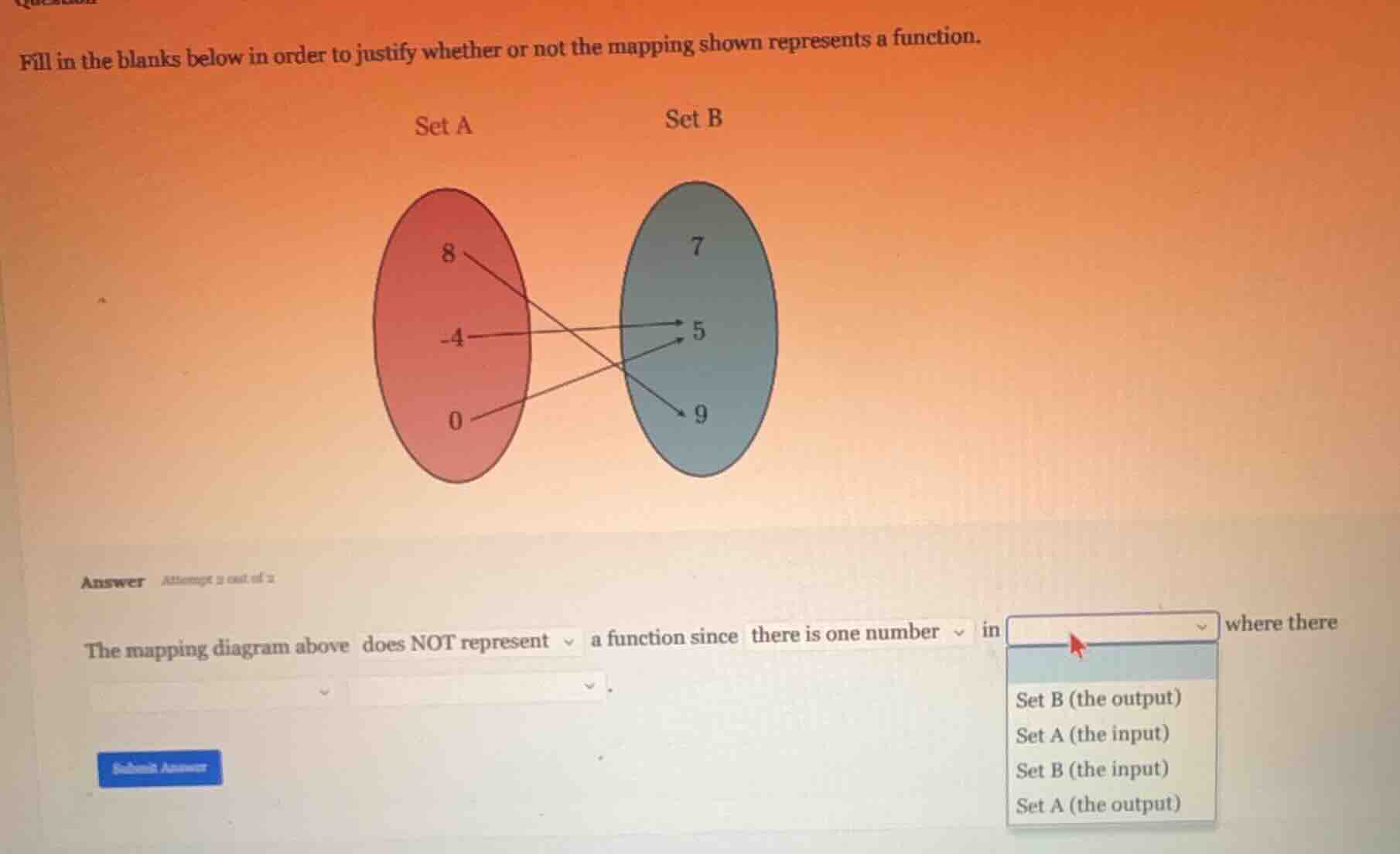
fill in the blanks below in order to justify whether or not the mapping shown represents a function.
the mapping diagram above does not represent a function since there is one number in
set b (the output)
set a (the input)
set b (the input)
set a (the output)
where there
To determine if a mapping is a function, each element in the input set (Set A) must map to exactly one element in the output set (Set B). Let's analyze the mapping:
Step 1: Identify the input and output sets
In a mapping diagram, Set A is the input (domain) and Set B is the output (codomain/range).
Step 2: Check the mapping for each element in Set A
- The element \( 8 \) in Set A maps to \( 5 \) and \( 9 \) in Set B.
- The element \( -4 \) in Set A maps to \( 5 \).
- The element \( 0 \) in Set A maps to \( 5 \) and \( 9 \).
Wait, actually, the key point for a function is that each element in the domain (Set A) must have exactly one image in the codomain (Set B). Wait, no—wait, the definition of a function is that every element in the domain (input set) has exactly one corresponding element in the codomain (output set). Wait, but in the mapping shown, let's look again. Wait, the problem says "does NOT represent a function". Wait, maybe I misread. Wait, let's check the elements:
Looking at Set A (input): \( 8 \), \( -4 \), \( 0 \).
- \( 8 \) maps to \( 5 \) and \( 9 \)? Wait, no, the arrows: \( 8 \) has an arrow to \( 5 \) and \( 9 \)? Wait, the diagram: \( 8 \) points to \( 5 \) and \( 9 \)? Wait, \( -4 \) points to \( 5 \), \( 0 \) points to \( 5 \) and \( 9 \)? Wait, no, let's re-express:
Wait, Set A: \( 8 \), \( -4 \), \( 0 \)
Set B: \( 7 \), \( 5 \), \( 9 \)
Arrows:
- \( 8 \) → \( 5 \), \( 8 \) → \( 9 \) (two arrows from \( 8 \))
- \( -4 \) → \( 5 \) (one arrow)
- \( 0 \) → \( 5 \), \( 0 \) → \( 9 \) (two arrows from \( 0 \))
Wait, but the problem's dropdown is about "there is one number in [Set A (the input)] where there [are multiple outputs]". Wait, the definition of a function is that each element in the domain (Set A) has exactly one output in Set B. So if an element in Set A (input) maps to more than one element in Set B (output), then it's not a function.
So the mapping does NOT represent a function because there is one number in Set A (the input) where there are multiple mappings (i.e., more than one output in Set B). Wait, but the dropdown options: the first blank after "in" is a dropdown with Set B (output), Set A (input), etc. Wait, the sentence structure: "there is one number in [Set A (the input)] where there [are multiple outputs]". Wait, let's parse the sentence:
"The mapping diagram above does NOT represent a function since there is one number in [Set A (the input)] where there [are multiple outputs (i.e., more than one mapping to Set B)]."
Wait, the dropdown for the first blank (after "in") should be "Set A (the input)" because the number is in the input set (domain) that has multiple outputs.
Wait, let's check the options:
The dropdown has:
- Set B (the output)
- Set A (the input)
- Set B (the input)
- Set A (the output)
Since the input set is Set A, and the problem is about an element in the input set (Set A) having multiple outputs, the correct choice for the first dropdown (after "in") is "Set A (the input)".
Then, the next part: "where there [are multiple mappings to Set B]" or "more than one corresponding element in Set B".
So putting it together:
The mapping diagram above does NOT represent a function since there is one number in Set A (the input) where there are more than one corresponding element in Set B (or "multiple outputs", etc.).
So the first dropdown (after "in") should be "Set A (the input)".

Snap & solve any problem in the app
Get step-by-step solutions on Sovi AI
Photo-based solutions with guided steps
Explore more problems and detailed explanations
The mapping diagram above does NOT represent a function since there is one number in \(\boldsymbol{\text{Set A (the input)}}\) where there are \(\boldsymbol{\text{more than one corresponding element in Set B}}\) (or similar phrasing about multiple outputs).
For the dropdown, the selected option for the first blank (after "in") is:
Set A (the input)