QUESTION IMAGE
Question
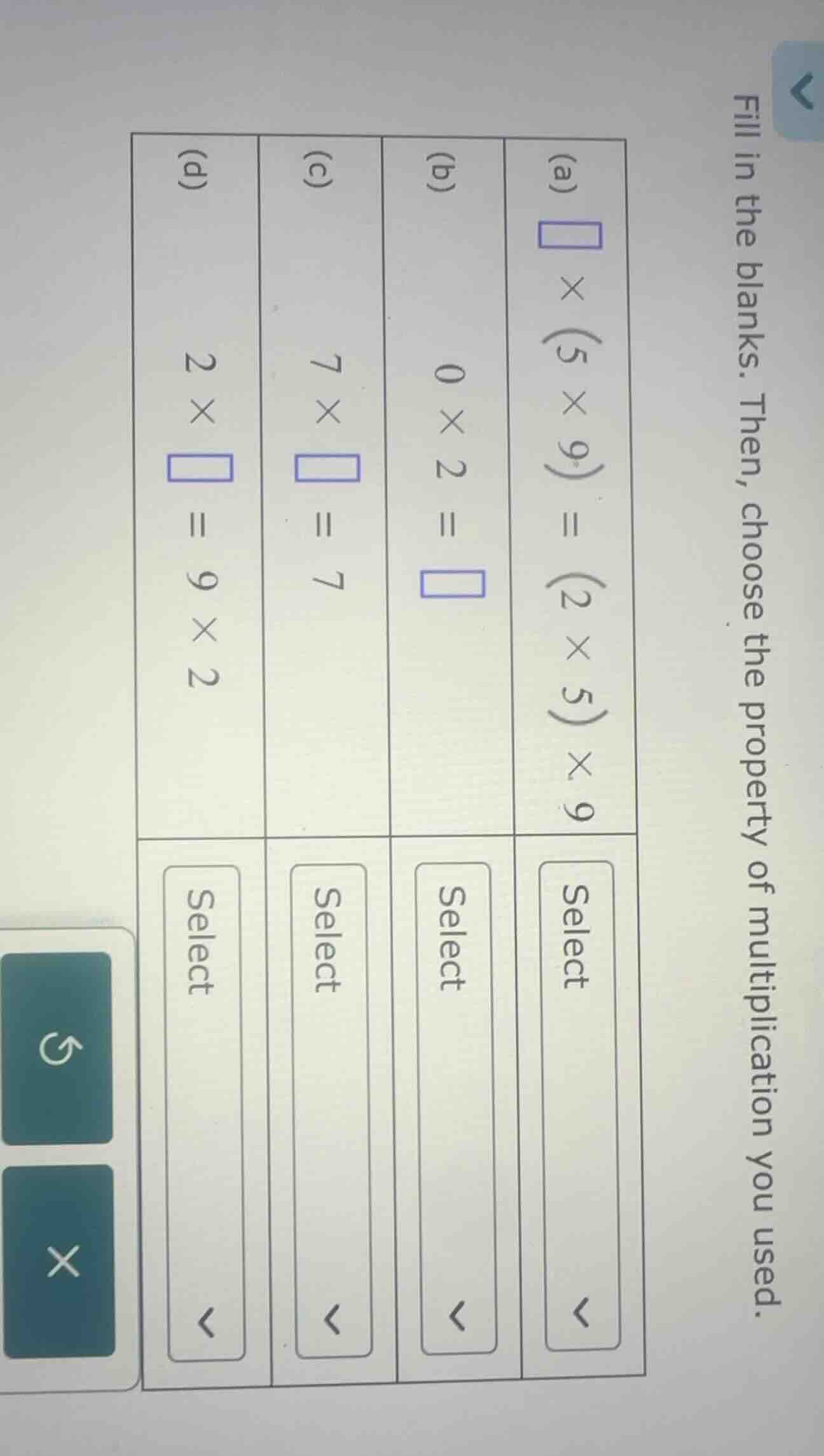
fill in the blanks. then, choose the property of multiplication you used.
(a) square \times (5 \times 9) = (2 \times 5) \times 9
select
(b) 0 \times 2 = square
select
(c) 7 \times square = 7
select
(d) 2 \times square = 9 \times 2
select
Part (a)
Step1: Identify the property.
The equation \( \square \times (5 \times 9) = (2 \times 5) \times 9 \) shows the associative property of multiplication, but also, by comparing the left and right sides, the missing number should be 2 because the associative property (or also commutative in a way here as we can see the order of 2 and the group changes, but mainly associative for grouping, but the number is 2 to make both sides have \( 2 \times (5 \times 9) \) and \( (2 \times 5) \times 9 \)).
So the blank is 2.
Step2: Confirm.
If we put 2 in the blank, \( 2\times(5\times9)=(2\times5)\times9 \), which holds true by the associative property of multiplication (and also commutative as we can reorder the factors).
Part (b)
Step1: Recall the property of 0 in multiplication.
Any number multiplied by 0 is 0. So \( 0\times2 = 0 \).
Part (c)
Step1: Recall the identity property of multiplication.
Any number multiplied by 1 is the number itself. So \( 7\times1 = 7 \).
Part (d)

Snap & solve any problem in the app
Get step-by-step solutions on Sovi AI
Photo-based solutions with guided steps
Explore more problems and detailed explanations
s:
(a) The blank is \( \boldsymbol{2} \) (using associative/commutative property of multiplication).
(b) The blank is \( \boldsymbol{0} \) (using zero property of multiplication: \( 0\times a = 0 \)).
(c) The blank is \( \boldsymbol{1} \) (using identity property of multiplication: \( a\times1 = a \)).
(d) The blank is \( \boldsymbol{9} \) (using commutative property of multiplication: \( a\times b = b\times a \)).