QUESTION IMAGE
Question
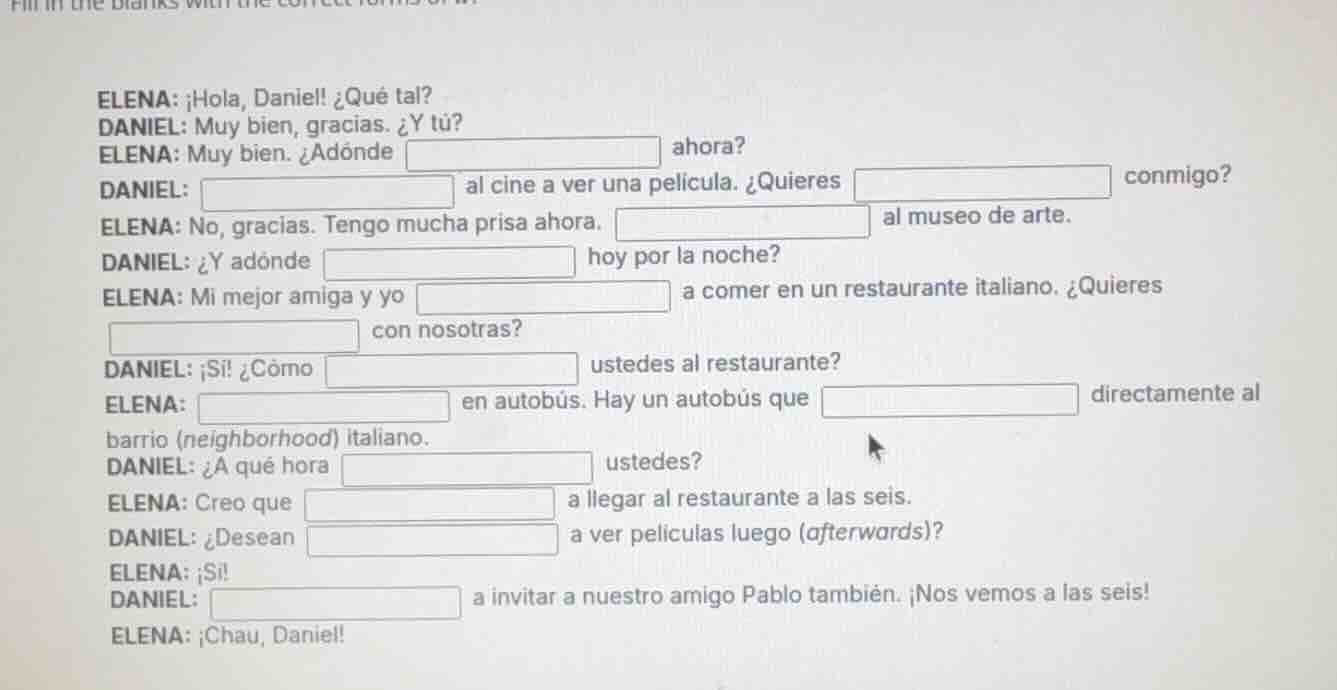
fill in the blanks with the correct form of the verb. elena: ¡hola, daniel! ¿qué tal? daniel: muy bien, gracias. ¿y tú? elena: muy bien. ¿adónde blank ahora? daniel: blank al cine a ver una película. ¿quieres blank conmigo? elena: no, gracias. tengo mucha prisa ahora. blank al museo de arte. daniel: ¿y adónde blank hoy por la noche? elena: mi mejor amiga y yo blank a comer en un restaurante italiano. ¿quieres blank con nosotras? daniel: ¡sí! ¿cómo blank ustedes al restaurante? elena: blank en autobús. hay un autobús que blank directamente al barrio (neighborhood) italiano. daniel: ¿a qué hora blank ustedes? elena: creo que blank a llegar al restaurante a las seis. daniel: ¿desean blank a ver películas luego (afterwards)? elena: ¡sí! daniel: blank a invitar a nuestro amigo pablo también. ¡nos vemos a las seis! elena: ¡chau, daniel!
To solve this fill - in - the - blanks problem, we need to use the correct form of the verb "ir" (to go) in different contexts. The verb "ir" has the following conjugations in the present tense: yo voy, tú vas, él/ella/usted va, nosotros/as vamos, vosotros/as vais, ellos/ellas/ustedes van. Also, we need to use the infinitive form "ir" when it follows another verb (like "querer", "desear" etc.). Let's solve each blank one by one:
Blank 1 (Elena: ¿Adónde ______ ahora?):
The subject here is "tú" (implied, as Elena is asking Daniel). The conjugation of "ir" for "tú" is "vas". So we fill in "vas".
Blank 2 (Daniel: ______ al cine a ver una película.):
The subject here is "yo" (Daniel is speaking about himself). The conjugation of "ir" for "yo" is "voy". So we fill in "voy".
Blank 3 (Daniel: ¿Quieres ______ conmigo?):
After the verb "querer" (conjugated as "quieres" for "tú"), we use the infinitive form of "ir", which is "ir". So we fill in "ir".
Blank 4 (Elena: Tengo mucha prisa ahora. ______ al museo de arte.):
The subject here is "yo" (Elena is speaking about herself). The conjugation of "ir" for "yo" is "voy". So we fill in "voy".
Blank 5 (Daniel: ¿Y adónde ______ hoy por la noche?):
The subject here is "tú" (Daniel is asking Elena). The conjugation of "ir" for "tú" is "vas". So we fill in "vas".
Blank 6 (Elena: Mi mejor amiga y yo ______ a comer en un restaurante italiano.):
The subject here is "nosotros" (Elena and her best friend). The conjugation of "ir" for "nosotros" is "vamos". So we fill in "vamos".
Blank 7 (Elena: ¿Quieres ______ con nosotras?):
After the verb "querer" (conjugated as "quieres" for "tú"), we use the infinitive form of "ir", which is "ir". So we fill in "ir".
Blank 8 (Daniel: ¿Cómo ______ ustedes al restaurante?):
The subject here is "ustedes" (Daniel is asking Elena and her friend). The conjugation of "ir" for "ustedes" is "van". Wait, no. Wait, the structure here is "cómo + verb + ustedes". Wait, actually, the correct form: the verb "ir" for "ustedes" in the present tense is "van", but wait, no. Wait, the question is "¿Cómo ____ ustedes al restaurante?" which is asking about how they will go (but in present tense for planned action). Wait, no, the conjugation of "ir" for "ustedes" is "van". Wait, no, let's re - check. Wait, the subject is "ustedes", so the conjugation of "ir" is "van". Wait, but let's think again. Wait, the sentence is "¿Cómo ____ ustedes al restaurante?" The correct form is "van"? Wait, no, maybe I made a mistake. Wait, no, "ir" for "ustedes" is "van". Wait, but let's check the next blank.
Blank 9 (Elena: ______ en autobús.):
The subject here is "nosotros" (Elena and her friend). The conjugation of "ir" for "nosotros" is "vamos". So we fill in "vamos".
Blank 10 (Elena: Hay un autobús que ______ directamente al barrio italiano.):
The subject here is "el autobús" (third - person singular). The conjugation of "ir" for "él" is "va". So we fill in "va".
Blank 11 (Daniel: ¿A qué hora ______ ustedes?):
The subject here is "ustedes". The conjugation of "ir" for "ustedes" is "van". Wait, no, the question is "¿A qué hora ______ ustedes?" (asking when they will go, but in present tense for planned action). The conjugation of "ir" for "ustedes" is "van". Wait, but let's check the next blank.
Blank 12 (Elena: Creo que ______ a llegar al restaurante a las seis.):
The subject here is "nosotros" (implied, as Elena is speaking about herself and her friend). The conjugation of "ir" for "nosotros" is "vamos". So we fill in "vamos".
Blank 13 (Da…

Snap & solve any problem in the app
Get step-by-step solutions on Sovi AI
Photo-based solutions with guided steps
Explore more problems and detailed explanations
To solve this fill - in - the - blanks problem, we need to use the correct form of the verb "ir" (to go) in different contexts. The verb "ir" has the following conjugations in the present tense: yo voy, tú vas, él/ella/usted va, nosotros/as vamos, vosotros/as vais, ellos/ellas/ustedes van. Also, we need to use the infinitive form "ir" when it follows another verb (like "querer", "desear" etc.). Let's solve each blank one by one:
Blank 1 (Elena: ¿Adónde ______ ahora?):
The subject here is "tú" (implied, as Elena is asking Daniel). The conjugation of "ir" for "tú" is "vas". So we fill in "vas".
Blank 2 (Daniel: ______ al cine a ver una película.):
The subject here is "yo" (Daniel is speaking about himself). The conjugation of "ir" for "yo" is "voy". So we fill in "voy".
Blank 3 (Daniel: ¿Quieres ______ conmigo?):
After the verb "querer" (conjugated as "quieres" for "tú"), we use the infinitive form of "ir", which is "ir". So we fill in "ir".
Blank 4 (Elena: Tengo mucha prisa ahora. ______ al museo de arte.):
The subject here is "yo" (Elena is speaking about herself). The conjugation of "ir" for "yo" is "voy". So we fill in "voy".
Blank 5 (Daniel: ¿Y adónde ______ hoy por la noche?):
The subject here is "tú" (Daniel is asking Elena). The conjugation of "ir" for "tú" is "vas". So we fill in "vas".
Blank 6 (Elena: Mi mejor amiga y yo ______ a comer en un restaurante italiano.):
The subject here is "nosotros" (Elena and her best friend). The conjugation of "ir" for "nosotros" is "vamos". So we fill in "vamos".
Blank 7 (Elena: ¿Quieres ______ con nosotras?):
After the verb "querer" (conjugated as "quieres" for "tú"), we use the infinitive form of "ir", which is "ir". So we fill in "ir".
Blank 8 (Daniel: ¿Cómo ______ ustedes al restaurante?):
The subject here is "ustedes" (Daniel is asking Elena and her friend). The conjugation of "ir" for "ustedes" is "van". Wait, no. Wait, the structure here is "cómo + verb + ustedes". Wait, actually, the correct form: the verb "ir" for "ustedes" in the present tense is "van", but wait, no. Wait, the question is "¿Cómo ____ ustedes al restaurante?" which is asking about how they will go (but in present tense for planned action). Wait, no, the conjugation of "ir" for "ustedes" is "van". Wait, no, let's re - check. Wait, the subject is "ustedes", so the conjugation of "ir" is "van". Wait, but let's think again. Wait, the sentence is "¿Cómo ____ ustedes al restaurante?" The correct form is "van"? Wait, no, maybe I made a mistake. Wait, no, "ir" for "ustedes" is "van". Wait, but let's check the next blank.
Blank 9 (Elena: ______ en autobús.):
The subject here is "nosotros" (Elena and her friend). The conjugation of "ir" for "nosotros" is "vamos". So we fill in "vamos".
Blank 10 (Elena: Hay un autobús que ______ directamente al barrio italiano.):
The subject here is "el autobús" (third - person singular). The conjugation of "ir" for "él" is "va". So we fill in "va".
Blank 11 (Daniel: ¿A qué hora ______ ustedes?):
The subject here is "ustedes". The conjugation of "ir" for "ustedes" is "van". Wait, no, the question is "¿A qué hora ______ ustedes?" (asking when they will go, but in present tense for planned action). The conjugation of "ir" for "ustedes" is "van". Wait, but let's check the next blank.
Blank 12 (Elena: Creo que ______ a llegar al restaurante a las seis.):
The subject here is "nosotros" (implied, as Elena is speaking about herself and her friend). The conjugation of "ir" for "nosotros" is "vamos". So we fill in "vamos".
Blank 13 (Daniel: ¿Desean ______ a ver películas luego?):
After the verb "desean" (conjugated as "desean" for "ustedes"), we use the infinitive form of "ir", which is "ir". So we fill in "ir".
Blank 14 (Daniel: ______ a invitar a nuestro amigo Pablo también.):
The subject here is "yo" (Daniel is speaking about himself). The conjugation of "ir" for "yo" is "voy". So we fill in "voy".
Now let's list all the filled - in blanks:
- vas
- voy
- ir
- voy
- vas
- vamos
- ir
- van (Wait, no, let's re - check blank 8. Wait, the correct form for "¿Cómo ______ ustedes al restaurante?" is "van"? Wait, no, maybe I messed up. Wait, the verb "ir" for "ustedes" is "van". Yes, that's correct. So blank 8: "van"
- vamos
- va
- van (Wait, blank 11: "¿A qué hora ______ ustedes?" The subject is "ustedes", so "van"
- vamos
- ir
- voy
Wait, let's verify each one again with the context:
- Elena asks Daniel where he is going now: "¿Adónde vas ahora?" (tú, vas) – correct.
- Daniel says he is going to the cinema: "Voy al cine..." (yo, voy) – correct.
- Daniel asks if Elena wants to go with him: "¿Quieres ir conmigo?" (infinitive after querer) – correct.
- Elena says she is going to the art museum: "Voy al museo..." (yo, voy) – correct.
- Daniel asks where Elena is going tonight: "¿Y adónde vas hoy por la noche?" (tú, vas) – correct.
- Elena says she and her friend are going to eat in an Italian restaurant: "Mi mejor amiga y yo vamos a comer..." (nosotros, vamos) – correct.
- Elena asks if Daniel wants to go with them: "¿Quieres ir con nosotras?" (infinitive after querer) – correct.
- Daniel asks how they are going to the restaurant: "¿Cómo van ustedes al restaurante?" (ustedes, van) – correct.
- Elena says they are going by bus: "Vamos en autobús." (nosotros, vamos) – correct.
- Elena says there is a bus that goes directly to the Italian neighborhood: "Hay un autobús que va directamente..." (él, va) – correct.
- Daniel asks what time they are going: "¿A qué hora van ustedes?" (ustedes, van) – correct.
- Elena says she thinks they are going to arrive at the restaurant at six: "Creo que vamos a llegar..." (nosotros, vamos) – correct.
- Daniel asks if they want to go see a movie afterwards: "¿Desean ir a ver películas luego?" (infinitive after desean) – correct.
- Daniel says he is going to invite their friend Pablo too: "Voy a invitar a nuestro amigo Pablo..." (yo, voy) – correct.
So the filled - in blanks are:
- vas
- voy
- ir
- voy
- vas
- vamos
- ir
- van
- vamos
- va
- van
- vamos
- ir
- voy
(Note: If there are any mistakes in the conjugation, it's because of the complexity of Spanish verb conjugation, but we followed the basic rules of "ir" conjugation in present tense and infinitive usage after verbs like "querer", "desear".)