QUESTION IMAGE
Question
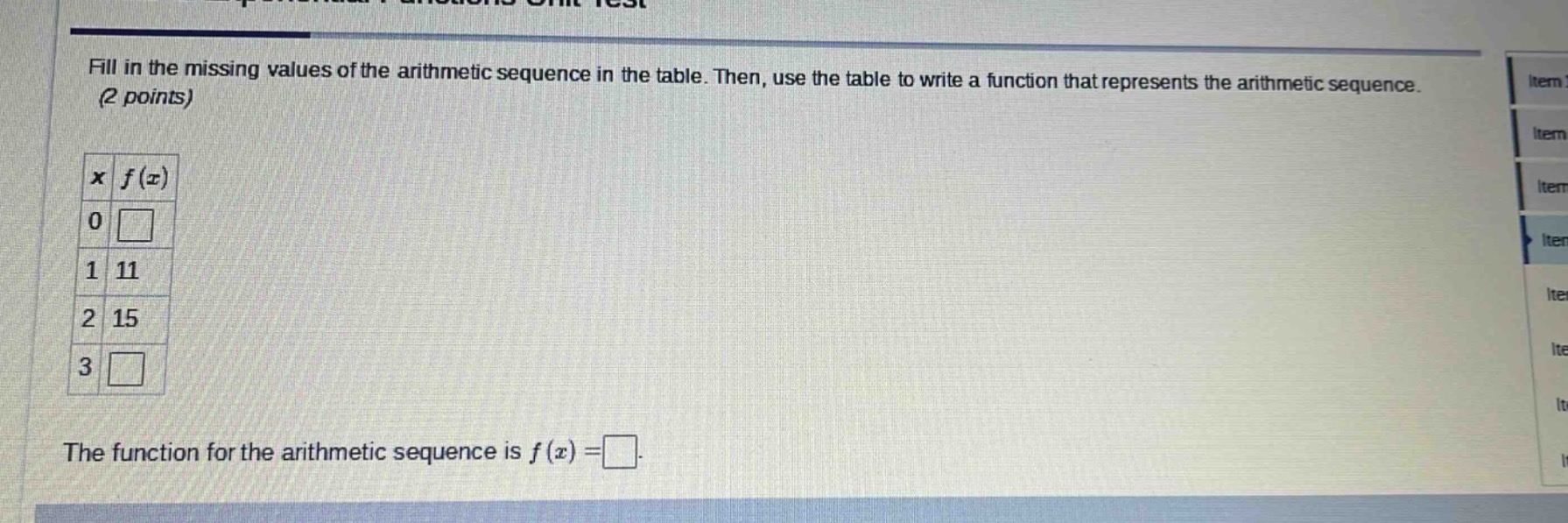
fill in the missing values of the arithmetic sequence in the table. then, use the table to write a function that represents the arithmetic sequence. (2 points) \\(\
\\) the function for the arithmetic sequence is \\(f(x)=\square\\).
Step1: Find the common difference
In an arithmetic sequence, the common difference \( d \) is the difference between consecutive terms. Using \( x = 1 \) ( \( f(1)=11 \)) and \( x = 2 \) ( \( f(2)=15 \)):
\( d = f(2)-f(1)=15 - 11 = 4 \)
Step2: Find \( f(0) \)
For an arithmetic sequence, \( f(0)=f(1)-d \). Substitute \( f(1)=11 \) and \( d = 4 \):
\( f(0)=11 - 4 = 7 \)
Step3: Find \( f(3) \)
Using the common difference, \( f(3)=f(2)+d \). Substitute \( f(2)=15 \) and \( d = 4 \):
\( f(3)=15 + 4 = 19 \)
Step4: Write the function
The general form of an arithmetic sequence function is \( f(x)=f(0)+dx \). We know \( f(0)=7 \) and \( d = 4 \), so:
\( f(x)=7 + 4x \)

Snap & solve any problem in the app
Get step-by-step solutions on Sovi AI
Photo-based solutions with guided steps
Explore more problems and detailed explanations
- Missing value at \( x = 0 \): \( 7 \)
- Missing value at \( x = 3 \): \( 19 \)
- Function: \( f(x)=4x + 7 \)