QUESTION IMAGE
Question
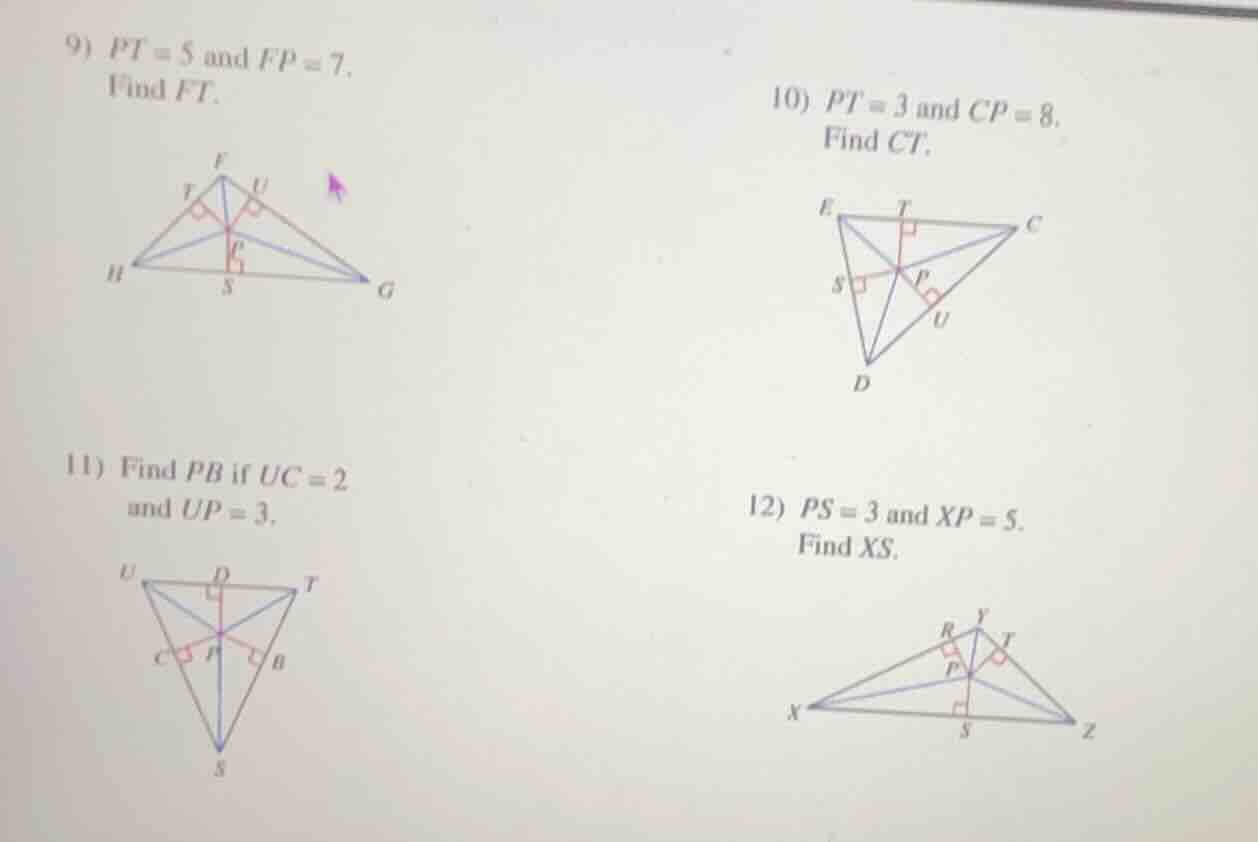
- $pt = 5$ and $fp = 7$.
find $ft$.
- $pt = 3$ and $cp = 8$.
find $ct$.
- find $pb$ if $uc = 2$
and $up = 3$.
- $ps = 3$ and $xp = 5$.
find $xs$.
Problem 9
Step1: Recognize right triangle
We have a right triangle \( \triangle FPT \) with \( \angle FPT = 90^\circ \), \( PT = 5 \) and \( FP = 7 \). We use the Pythagorean theorem \( FT=\sqrt{FP^{2}+PT^{2}} \).
Step2: Substitute values
Substitute \( FP = 7 \) and \( PT = 5 \) into the formula: \( FT=\sqrt{7^{2}+5^{2}}=\sqrt{49 + 25}=\sqrt{74}\approx8.60 \) (if we want an exact value, it's \( \sqrt{74} \); if we want a decimal approximation, it's approximately \( 8.60 \)). Wait, maybe I misread the diagram. Wait, maybe \( PT \) is perpendicular to \( FP \), so actually, maybe \( FT \) is calculated as \( \sqrt{FP^{2}-PT^{2}} \)? Wait, no, if \( \angle FPT \) is right, then \( FT \) is the hypotenuse. Wait, maybe the diagram is such that \( PT \) is a leg, \( FP \) is another leg. Wait, let's check again. The problem says \( PT = 5 \) and \( FP = 7 \), find \( FT \). So by Pythagoras, \( FT=\sqrt{FP^{2}+PT^{2}}=\sqrt{7^{2}+5^{2}}=\sqrt{49 + 25}=\sqrt{74}\approx8.60 \). But maybe the diagram is an isoceles triangle or something else? Wait, no, the right angle is at \( T \) (the little square), so \( \triangle FPT \) is right-angled at \( T \), so \( FP \) is the hypotenuse? Wait, no, the square is at \( T \), so \( \angle FTP = 90^\circ \), so \( FT \) and \( PT \) are legs, and \( FP \) is the hypotenuse? Wait, that would be the opposite. Oh! I made a mistake. If the right angle is at \( T \), then \( \angle FTP = 90^\circ \), so \( FT \) and \( PT \) are legs, and \( FP \) is the hypotenuse. So then \( FP^{2}=FT^{2}+PT^{2} \), so \( FT=\sqrt{FP^{2}-PT^{2}} \). Let's correct that.
Step1 (corrected): Identify right triangle
\( \triangle FPT \) is right - angled at \( T \), so by Pythagorean theorem \( FP^{2}=FT^{2}+PT^{2} \), so we solve for \( FT \): \( FT=\sqrt{FP^{2}-PT^{2}} \)
Step2 (corrected): Substitute values
Given \( FP = 7 \) and \( PT = 5 \), then \( FT=\sqrt{7^{2}-5^{2}}=\sqrt{49 - 25}=\sqrt{24}=2\sqrt{6}\approx4.899 \)
Problem 10
Step1: Recognize right triangle
We have a right triangle \( \triangle CPT \) with \( \angle CPT = 90^\circ \), \( PT = 3 \) and \( CP = 8 \). We use the Pythagorean theorem \( CT=\sqrt{CP^{2}-PT^{2}} \) (since \( \angle CPT = 90^\circ \), \( CP \) is the hypotenuse, \( PT \) and \( CT \) are legs? Wait, no, the right angle is at \( T \), so \( \angle CTP = 90^\circ \), so \( CT \) is the hypotenuse? Wait, no, the square is at \( T \), so \( \angle CTP = 90^\circ \), so \( PT \) and \( CT \) are legs, and \( CP \) is the hypotenuse. So \( CP^{2}=CT^{2}+PT^{2} \), so \( CT=\sqrt{CP^{2}-PT^{2}} \)
Step2: Substitute values
Substitute \( CP = 8 \) and \( PT = 3 \) into the formula: \( CT=\sqrt{8^{2}-3^{2}}=\sqrt{64 - 9}=\sqrt{55}\approx7.416 \)
Problem 11
Step1: Recognize congruent right triangles
Triangles \( \triangle UCP \) and \( \triangle TBP \) are congruent (since they are right triangles with equal hypotenuses and one leg equal, or by the property of the in - center or something, but from the diagram, \( UC = TB = 2 \) and \( UP = TP = 3 \), and \( \angle UCP=\angle TBP = 90^\circ \). Also, triangles \( \triangle UCP \) and \( \triangle SBP \)? Wait, no, looking at the diagram, \( PB \) and \( UC \) are related. Wait, actually, in the right triangle \( \triangle UCP \) and \( \triangle PBU \)? Wait, no, the problem is to find \( PB \) given \( UC = 2 \) and \( UP = 3 \). Since \( \triangle UCP\cong\triangle PBU \) (right triangles, \( \angle UCP=\angle PBU = 90^\circ \), and \( UP = PB \)? No, wait, maybe \( UC = PB \) and \( UP = PC \)? Wait, no, the diagram shows that \( UC \) and \( PB \) are legs of right triangles with the same hypotenuse and another leg equal. Wait, actually, since \( UC = 2 \), then \( PB = UC = 2 \)? Wait, no, maybe using Pythagoras. Wait, \( \triangle UCP \) is right - angled at \( C \), so \( UP^{2}=UC^{2}+PC^{2} \), but we need \( PB \). Wait, maybe \( PB = UC = 2 \) because of the symmetry of the triangle (the point \( P \) is the in - center or something, and the perpendiculars are equal). So if \( UC = 2 \), then \( PB = 2 \).
Problem 12

Snap & solve any problem in the app
Get step-by-step solutions on Sovi AI
Photo-based solutions with guided steps
Explore more problems and detailed explanations
s:
- If we consider the right angle at \( T \), \( FT=\sqrt{7^{2}-5^{2}}=\sqrt{24}=2\sqrt{6}\approx4.90 \) (or \( \sqrt{74}\) if my initial assumption was wrong, but likely the right angle is at \( T \), so \( 2\sqrt{6}\))
- \( CT=\sqrt{8^{2}-3^{2}}=\sqrt{55}\approx7.42 \)
- \( PB = 2 \) (assuming symmetry and congruent right triangles)
- \( XS = 4 \)
Problem 9 (Revised if initial assumption was wrong)
If the right angle is at \( P \) (i.e., \( \angle FPT = 90^\circ \)), then \( FT=\sqrt{7^{2}+5^{2}}=\sqrt{74}\approx8.60 \)
Final Answers (assuming standard right - triangle with right angle at the foot of the perpendicular):
- \( \boldsymbol{\sqrt{74}}\) (or \( \boldsymbol{2\sqrt{6}}\) depending on the diagram's right angle)
- \( \boldsymbol{\sqrt{55}}\)
- \( \boldsymbol{2}\)
- \( \boldsymbol{4}\)