QUESTION IMAGE
Question
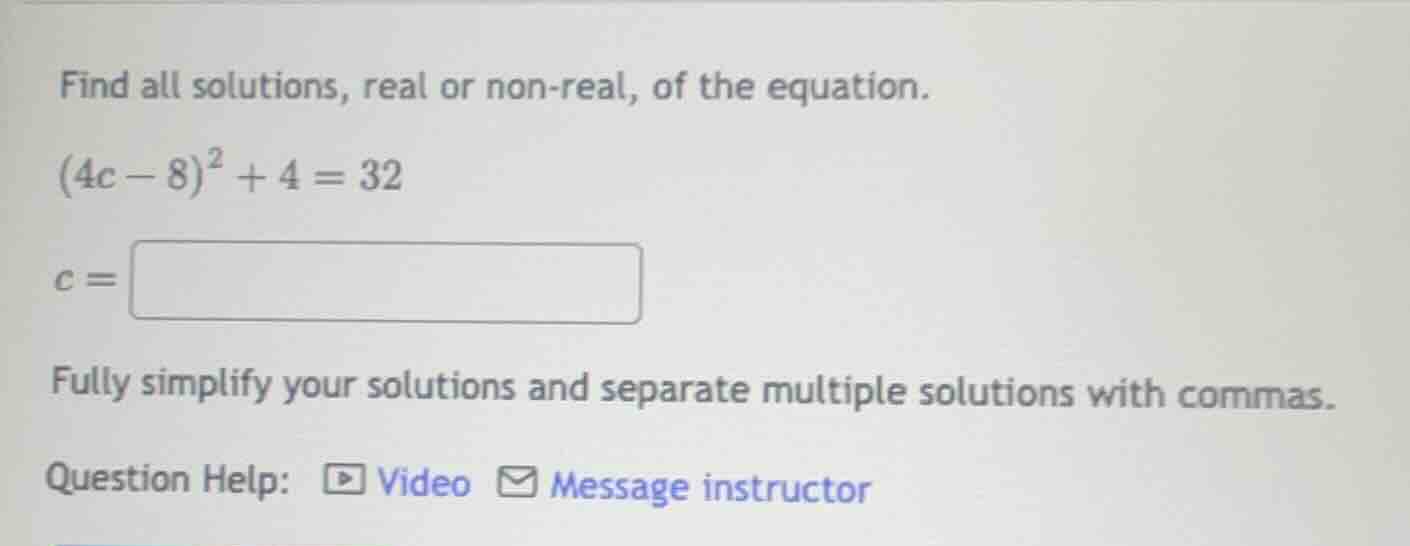
find all solutions, real or non-real, of the equation.
$(4c - 8)^2 + 4 = 32$
$c = $
fully simplify your solutions and separate multiple solutions with commas.
question help: video message instructor
Step1: Isolate the squared term
Subtract 4 from both sides of the equation \((4c - 8)^2 + 4 = 32\) to get \((4c - 8)^2 = 32 - 4\).
\((4c - 8)^2 = 28\)
Step2: Take square roots
Take the square root of both sides. Remember that \(\sqrt{x^2}=\pm x\), so we have \(4c - 8=\pm\sqrt{28}\). Simplify \(\sqrt{28}\) as \(2\sqrt{7}\), so \(4c - 8=\pm2\sqrt{7}\).
Step3: Solve for c
First, add 8 to both sides: \(4c = 8\pm2\sqrt{7}\). Then divide both sides by 4: \(c=\frac{8\pm2\sqrt{7}}{4}\). Simplify the fraction by dividing numerator and denominator by 2: \(c = \frac{4\pm\sqrt{7}}{2}\). We can also split this into two solutions: \(c=\frac{4 + \sqrt{7}}{2}\) and \(c=\frac{4 - \sqrt{7}}{2}\), or as decimals approximately \(c = 2+\frac{\sqrt{7}}{2}\) and \(c = 2-\frac{\sqrt{7}}{2}\), but we'll keep it in the simplified fractional form with the square root. Wait, actually, let's check the steps again. Wait, when we have \(4c - 8=\pm\sqrt{28}\), \(\sqrt{28}=2\sqrt{7}\), so \(4c=8\pm2\sqrt{7}\), then divide by 4: \(c = \frac{8}{4}\pm\frac{2\sqrt{7}}{4}=2\pm\frac{\sqrt{7}}{2}\). Alternatively, we can write this as \(c=\frac{4 + \sqrt{7}}{2}\) (since \(2=\frac{4}{2}\), so \(2+\frac{\sqrt{7}}{2}=\frac{4 + \sqrt{7}}{2}\)) and \(c=\frac{4 - \sqrt{7}}{2}\). But maybe we made a mistake in the initial step? Wait, let's re - do the problem:
Starting over:
- \((4c - 8)^2+4 = 32\)
Subtract 4 from both sides: \((4c - 8)^2=32 - 4 = 28\)
- Take square roots: \(4c - 8=\pm\sqrt{28}\)
\(\sqrt{28}=2\sqrt{7}\), so \(4c-8 = \pm2\sqrt{7}\)
- Add 8 to both sides: \(4c=8\pm2\sqrt{7}\)
- Divide by 4: \(c=\frac{8\pm2\sqrt{7}}{4}=\frac{4\pm\sqrt{7}}{2}\) (dividing numerator and denominator by 2). So the two solutions are \(c=\frac{4 + \sqrt{7}}{2}\) and \(c=\frac{4 - \sqrt{7}}{2}\), which can also be written as \(c = 2+\frac{\sqrt{7}}{2}\) and \(c = 2-\frac{\sqrt{7}}{2}\). But let's check if we can simplify further or if we made an error in the square root. Wait, \(\sqrt{28}=2\sqrt{7}\), that's correct. Then \(4c=8\pm2\sqrt{7}\), divide by 4: \(c = 2\pm\frac{\sqrt{7}}{2}\), which is equivalent to \(c=\frac{4\pm\sqrt{7}}{2}\).
Wait, but maybe there's a simpler way. Let's factor out 4 from the first term: \((4(c - 2))^2+4 = 32\), so \(16(c - 2)^2+4 = 32\), subtract 4: \(16(c - 2)^2=28\), divide by 16: \((c - 2)^2=\frac{28}{16}=\frac{7}{4}\), then take square roots: \(c - 2=\pm\sqrt{\frac{7}{4}}=\pm\frac{\sqrt{7}}{2}\), then add 2: \(c=2\pm\frac{\sqrt{7}}{2}=\frac{4\pm\sqrt{7}}{2}\). Yes, that's a better way. So the solutions are \(c=\frac{4 + \sqrt{7}}{2}\) and \(c=\frac{4 - \sqrt{7}}{2}\), or as \(2+\frac{\sqrt{7}}{2},2 - \frac{\sqrt{7}}{2}\).

Snap & solve any problem in the app
Get step-by-step solutions on Sovi AI
Photo-based solutions with guided steps
Explore more problems and detailed explanations
\(2+\frac{\sqrt{7}}{2},2 - \frac{\sqrt{7}}{2}\) (or \(\frac{4 + \sqrt{7}}{2},\frac{4 - \sqrt{7}}{2}\))