QUESTION IMAGE
Question
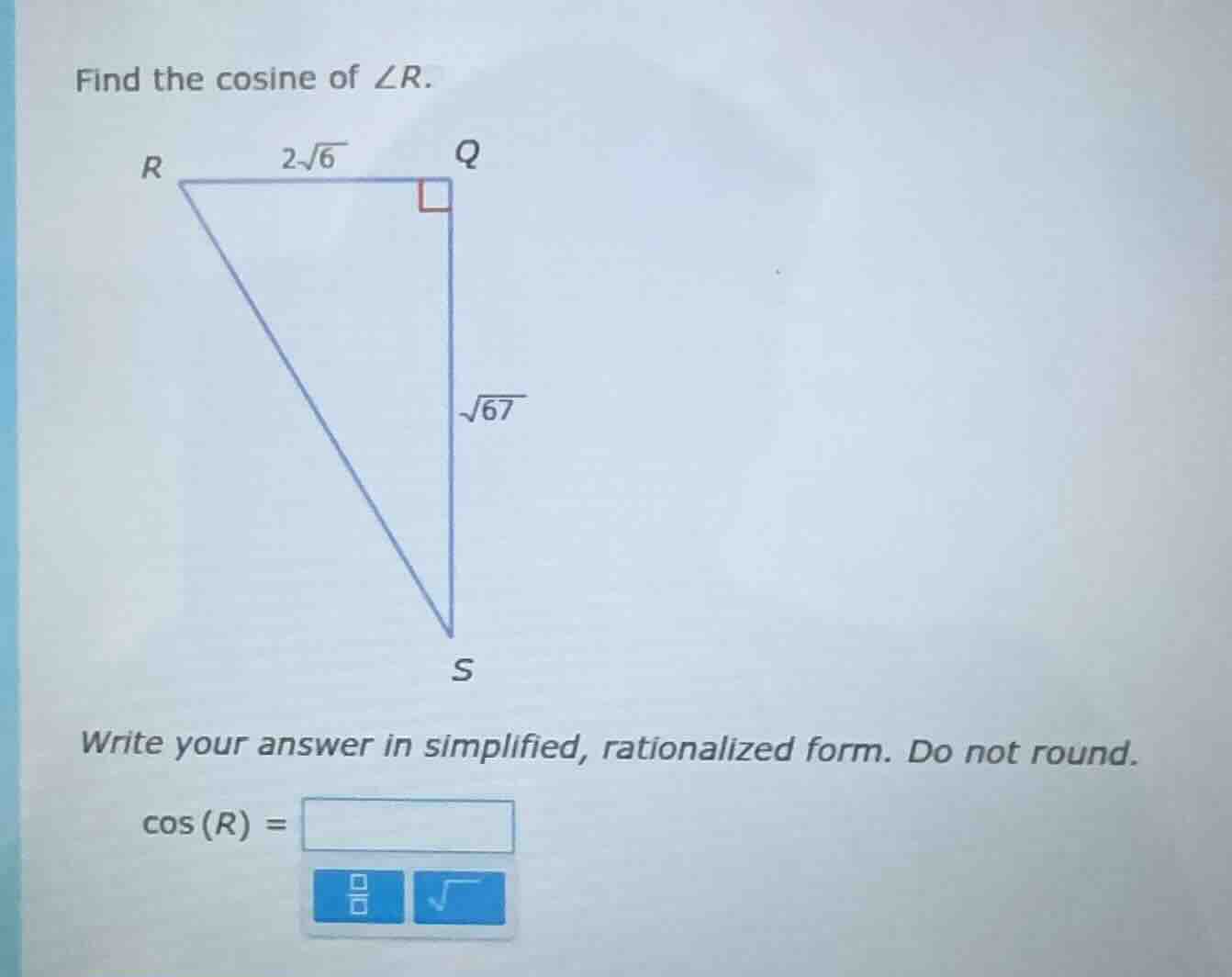
find the cosine of ∠r.
triangle rqs with right angle at q, rq = 2√6, qs = √67
write your answer in simplified, rationalized form. do not round.
cos(r) = blank box fraction and square root buttons
Step1: Recall cosine definition
In a right triangle, $\cos(\theta) = \frac{\text{adjacent}}{\text{hypotenuse}}$. For $\angle R$, adjacent side is $RQ = 2\sqrt{6}$, need to find hypotenuse $RS$.
Step2: Calculate hypotenuse
Using Pythagorean theorem: $RS^2 = RQ^2 + QS^2$.
$RQ = 2\sqrt{6}$, so $RQ^2 = (2\sqrt{6})^2 = 4\times6 = 24$.
$QS = \sqrt{67}$, so $QS^2 = 67$.
Thus, $RS^2 = 24 + 67 = 91$, so $RS = \sqrt{91}$.
Step3: Compute $\cos(R)$
$\cos(R) = \frac{\text{adjacent to } R}{\text{hypotenuse}} = \frac{2\sqrt{6}}{\sqrt{91}}$. Rationalize denominator: multiply numerator and denominator by $\sqrt{91}$:
$\frac{2\sqrt{6}\times\sqrt{91}}{\sqrt{91}\times\sqrt{91}} = \frac{2\sqrt{546}}{91}$. Wait, no—wait, $24 + 67 = 91$? Wait, $2\sqrt{6}$ squared: $(2)^2\times(\sqrt{6})^2 = 4\times6 = 24$. $\sqrt{67}$ squared is 67. 24 + 67 = 91. Correct. Then adjacent is $RQ = 2\sqrt{6}$, hypotenuse $RS = \sqrt{91}$. Wait, but maybe I mixed up adjacent and opposite? Wait, $\angle R$: right angle at $Q$, so sides: $RQ$ (horizontal), $QS$ (vertical), $RS$ (hypotenuse). So for $\angle R$, the adjacent side is $RQ$ (next to $\angle R$), opposite is $QS$, hypotenuse $RS$. So $\cos(R) = \frac{RQ}{RS} = \frac{2\sqrt{6}}{\sqrt{91}}$. Rationalize: multiply numerator and denominator by $\sqrt{91}$: $\frac{2\sqrt{6}\times\sqrt{91}}{91} = \frac{2\sqrt{546}}{91}$? Wait, no, $\sqrt{6}\times\sqrt{91} = \sqrt{6\times91} = \sqrt{546}$. But wait, maybe I made a mistake in hypotenuse? Wait, let's check again. $RQ = 2\sqrt{6}$, $QS = \sqrt{67}$. So $RS^2 = (2\sqrt{6})^2 + (\sqrt{67})^2 = 24 + 67 = 91$, so $RS = \sqrt{91}$. Correct. Then $\cos(R) = \frac{\text{adjacent}}{\text{hypotenuse}} = \frac{2\sqrt{6}}{\sqrt{91}}$. Rationalizing: $\frac{2\sqrt{6}\times\sqrt{91}}{91} = \frac{2\sqrt{546}}{91}$? Wait, but maybe simplify $\sqrt{546}$? 546 = 6×91 = 6×7×13. No common factors with 91 (91=7×13). So 546=6×7×13, 91=7×13. So $\sqrt{546} = \sqrt{6\times7\times13}$, $\sqrt{91}=\sqrt{7\times13}$. So $\frac{2\sqrt{6\times7\times13}}{7\times13} = \frac{2\sqrt{6}\times\sqrt{91}}{91}$. Wait, but maybe the problem is that I misidentified adjacent? Wait, no—wait, $\angle R$: the angle at $R$, so the sides: from $R$, the two sides are $RQ$ (length $2\sqrt{6}$) and $RS$ (hypotenuse), and the other side is $QS$ (length $\sqrt{67}$). Wait, no, in triangle $RQS$, right-angled at $Q$, so vertices $R$, $Q$, $S$ with right angle at $Q$. So sides: $RQ$ (between $R$ and $Q$), $QS$ (between $Q$ and $S$), $RS$ (between $R$ and $S$). So for angle $R$, the adjacent side is $RQ$ (since it's one of the sides forming angle $R$, other than hypotenuse), and opposite is $QS$. So cosine is adjacent over hypotenuse: $RQ / RS$. So $RQ = 2\sqrt{6}$, $RS = \sqrt{(2\sqrt{6})^2 + (\sqrt{67})^2} = \sqrt{24 + 67} = \sqrt{91}$. So $\cos(R) = \frac{2\sqrt{6}}{\sqrt{91}}$. Rationalizing: multiply numerator and denominator by $\sqrt{91}$: $\frac{2\sqrt{6}\times\sqrt{91}}{91} = \frac{2\sqrt{546}}{91}$. Wait, but maybe I made a mistake in Pythagorean theorem? Let's recalculate $RQ^2$: $(2\sqrt{6})^2 = 4 \times 6 = 24$. $QS^2 = (\sqrt{67})^2 = 67$. 24 + 67 = 91. Correct. So hypotenuse is $\sqrt{91}$. Then adjacent is $2\sqrt{6}$, so $\cos(R) = \frac{2\sqrt{6}}{\sqrt{91}} = \frac{2\sqrt{546}}{91}$? Wait, no, $\sqrt{6}\times\sqrt{91} = \sqrt{6\times91} = \sqrt{546}$. Alternatively, maybe the problem expects leaving it as $\frac{2\sqrt{6}}{\sqrt{91}}$ but rationalized. Wait, but let's check again. Wait, maybe I swapped adjacent and opposite? Wait, angle R: the sides: at R, the two sides are RQ (horizontal) and RS (hypo…

Snap & solve any problem in the app
Get step-by-step solutions on Sovi AI
Photo-based solutions with guided steps
Explore more problems and detailed explanations
$\frac{2\sqrt{546}}{91}$ (or simplified as $\frac{2\sqrt{6}}{\sqrt{91}}$ rationalized to $\frac{2\sqrt{546}}{91}$)