QUESTION IMAGE
Question
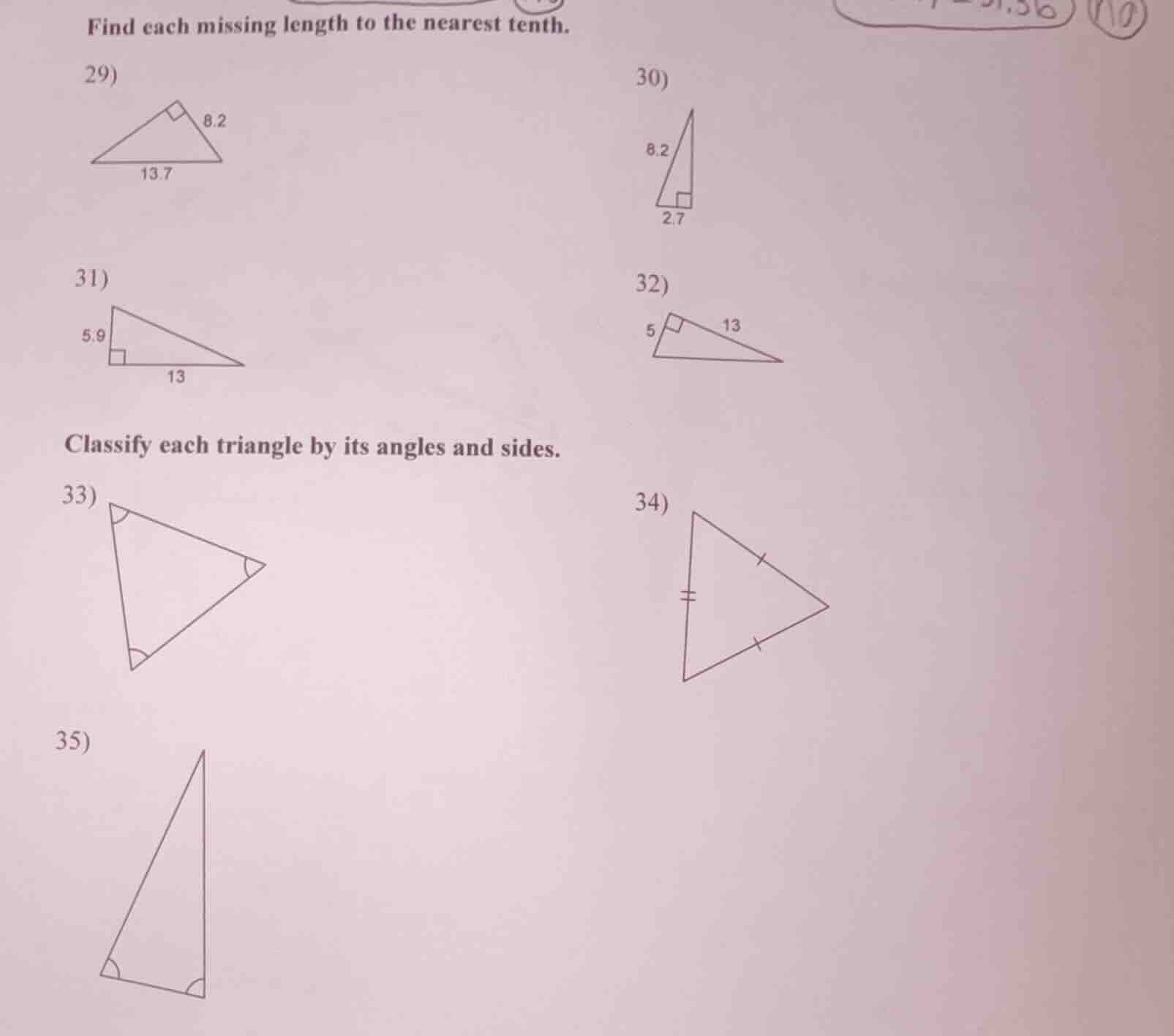
find each missing length to the nearest tenth.
29)
(right triangle with one leg 8.2 and hypotenuse 13.7)
30)
(right triangle with one leg 8.2 and the other leg 2.7)
31)
(right triangle with one leg 5.9 and the other leg 13)
32)
(right triangle with one leg 5 and hypotenuse 13)
classify each triangle by its angles and sides.
33)
(triangle with all angles acute)
34)
(triangle with two equal sides, isosceles triangle)
35)
(triangle with one obtuse angle)
Problem 29:
Step1: Identify triangle type (right triangle)
We have a right triangle with hypotenuse \( c = 13.7 \) and one leg \( b = 8.2 \). We need to find the other leg \( a \). Use the Pythagorean theorem: \( a^2 + b^2 = c^2 \), so \( a = \sqrt{c^2 - b^2} \).
Step2: Substitute values
\( a = \sqrt{13.7^2 - 8.2^2} = \sqrt{187.69 - 67.24} = \sqrt{120.45} \approx 10.97 \approx 11.0 \) (to the nearest tenth)
Step1: Identify triangle type (right triangle)
Right triangle with legs \( a = 2.7 \) and \( b = 8.2 \). Find hypotenuse \( c \) using \( c = \sqrt{a^2 + b^2} \).
Step2: Substitute values
\( c = \sqrt{2.7^2 + 8.2^2} = \sqrt{7.29 + 67.24} = \sqrt{74.53} \approx 8.63 \approx 8.6 \) (to the nearest tenth)
Step1: Identify triangle type (right triangle)
Right triangle with legs \( a = 5.9 \) and \( b = 13 \). Find hypotenuse \( c \) using \( c = \sqrt{a^2 + b^2} \).
Step2: Substitute values
\( c = \sqrt{5.9^2 + 13^2} = \sqrt{34.81 + 169} = \sqrt{203.81} \approx 14.27 \approx 14.3 \) (to the nearest tenth)

Snap & solve any problem in the app
Get step-by-step solutions on Sovi AI
Photo-based solutions with guided steps
Explore more problems and detailed explanations
\( 11.0 \)