QUESTION IMAGE
Question
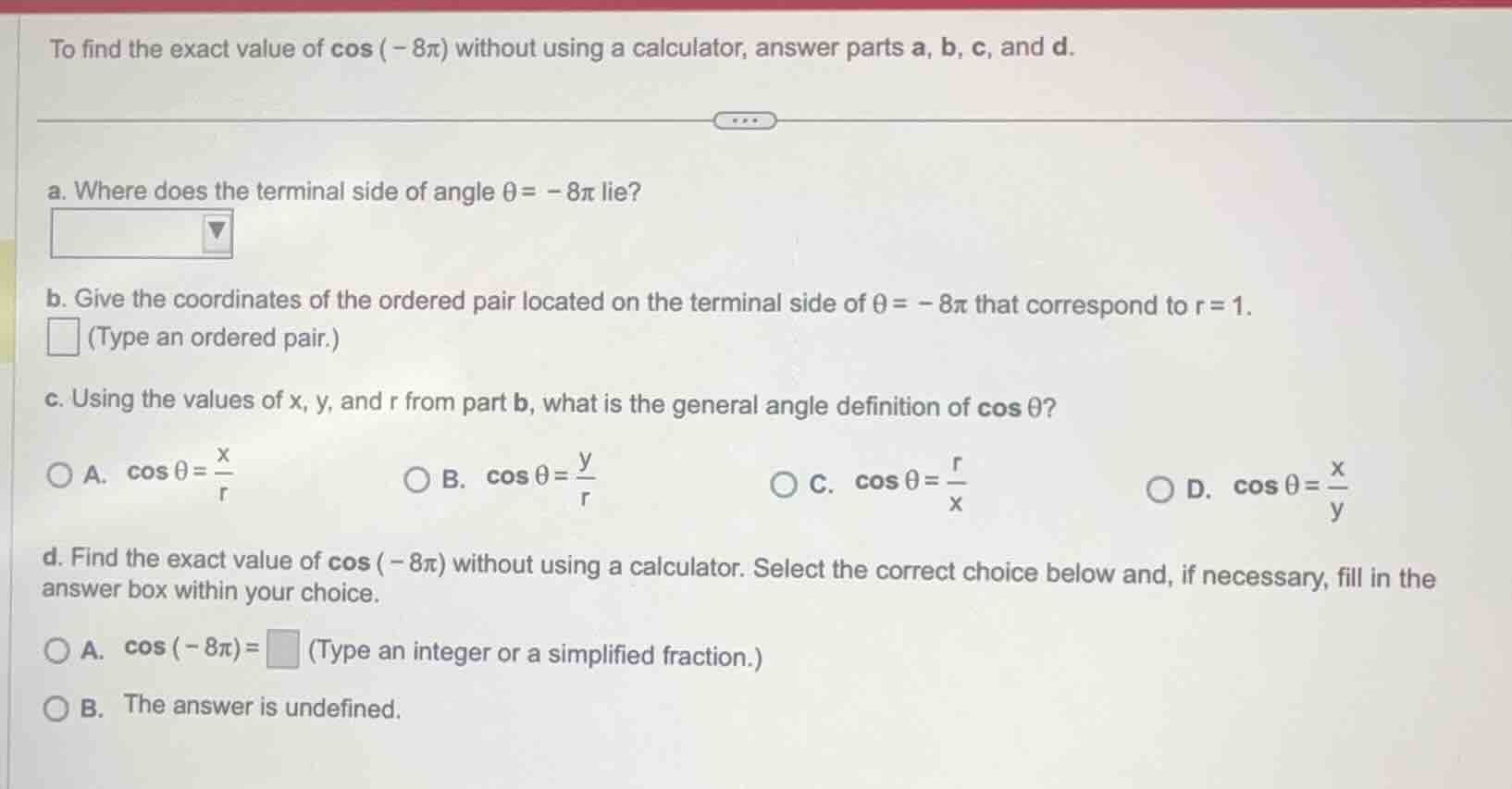
to find the exact value of \\(\cos(-8\pi)\\) without using a calculator, answer parts a, b, c, and d.\
\
\\(\boldsymbol{a}\\). where does the terminal side of angle \\(\theta = -8\pi\\) lie?\
\
\\(\boldsymbol{b}\\). give the coordinates of the ordered pair located on the terminal side of \\(\theta = -8\pi\\) that correspond to \\(r = 1\\).\
\\(\square\\) (type an ordered pair.)\
\
\\(\boldsymbol{c}\\). using the values of \\(x\\), \\(y\\), and \\(r\\) from part b, what is the general angle definition of \\(\cos\theta\\)?\
\\(\bigcirc\\) a. \\(\cos\theta = \frac{x}{r}\\)\
\\(\bigcirc\\) b. \\(\cos\theta = \frac{y}{r}\\)\
\\(\bigcirc\\) c. \\(\cos\theta = \frac{r}{x}\\)\
\\(\bigcirc\\) d. \\(\cos\theta = \frac{x}{y}\\)\
\
\\(\boldsymbol{d}\\). find the exact value of \\(\cos(-8\pi)\\) without using a calculator. select the correct choice below and, if necessary, fill in the answer box within your choice.\
\\(\bigcirc\\) a. \\(\cos(-8\pi) = \square\\) (type an integer or a simplified fraction.)\
\\(\bigcirc\\) b. the answer is undefined.
Part a
Step1: Recall coterminal angles
To find where the terminal side of \(\theta = - 8\pi\) lies, we use the concept of coterminal angles. The formula for coterminal angles is \(\theta + 2k\pi\), where \(k\) is an integer. We want to find a \(k\) such that the angle is between \(0\) and \(2\pi\).
Let's solve for \(k\) in the equation \(-8\pi+ 2k\pi=\alpha\), where \(\alpha\in[0,2\pi]\)
\(-8\pi + 2k\pi=0\) (we can start with \(\alpha = 0\))
\(2k\pi=8\pi\)
\(k = 4\)
So, \(-8\pi+2\times4\pi=0\). So the terminal side of \(\theta=-8\pi\) lies on the positive \(x\)-axis (same as the angle \(0\) or \(2k\pi\) for integer \(k\))
Step1: Recall unit circle coordinates
For an angle \(\theta\) in standard position, if \(r = 1\) (unit circle), the coordinates \((x,y)\) are given by \(x=\cos\theta\) and \(y = \sin\theta\). Since \(\theta=-8\pi\) is coterminal with \(0\), \(\cos(- 8\pi)=\cos(0) = 1\) and \(\sin(-8\pi)=\sin(0)=0\)
So the ordered pair \((x,y)\) when \(r = 1\) and \(\theta=-8\pi\) is \((1,0)\)
Step1: Recall the definition of cosine in terms of coordinates
For a point \((x,y)\) on the terminal side of an angle \(\theta\) and \(r=\sqrt{x^{2}+y^{2}}\), the definition of \(\cos\theta\) is \(\cos\theta=\frac{x}{r}\)
So among the options, option A is \(\cos\theta=\frac{x}{r}\)

Snap & solve any problem in the app
Get step-by-step solutions on Sovi AI
Photo-based solutions with guided steps
Explore more problems and detailed explanations
On the positive \(x\)-axis (or same as angle \(0\) or \(2k\pi\) for integer \(k\))