QUESTION IMAGE
Question
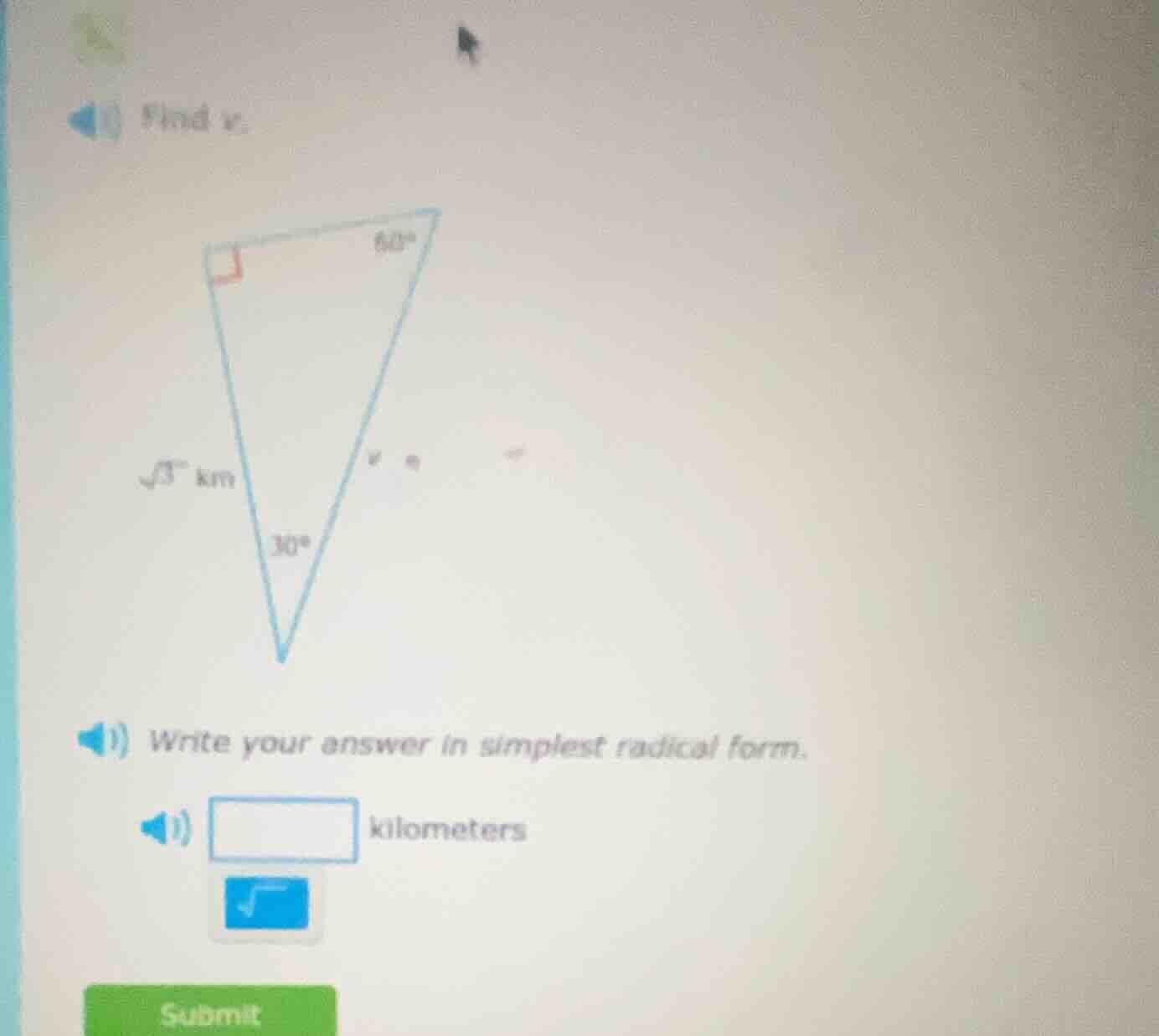
find x.
(image of a right triangle with angles 60°, 30°, and right angle, one leg is \\(\sqrt{3}\\) km, side x is another side. )
write your answer in simplest radical form.
\\(\square\\) kilometers
Step1: Identify the triangle type
This is a right - angled triangle with angles \(30^{\circ}\), \(60^{\circ}\) and \(90^{\circ}\). In a \(30 - 60 - 90\) triangle, the sides are in the ratio \(1:\sqrt{3}:2\), where the side opposite \(30^{\circ}\) is the shortest side (let's call it \(a\)), the side opposite \(60^{\circ}\) is \(a\sqrt{3}\), and the hypotenuse is \(2a\).
We are given the side adjacent to the \(30^{\circ}\) angle (and opposite to the \(60^{\circ}\) angle) as \(\sqrt{3}\) km. Let the side opposite \(30^{\circ}\) be \(x\) (wait, no, wait. Wait, the side with length \(\sqrt{3}\) is adjacent to \(30^{\circ}\) and opposite to \(60^{\circ}\). Let's use trigonometric ratios. Let's consider the angle \(30^{\circ}\). The tangent of an angle in a right - triangle is \(\tan\theta=\frac{\text{opposite}}{\text{adjacent}}\). For \(\theta = 30^{\circ}\), \(\tan(30^{\circ})=\frac{x}{\sqrt{3}}\), but \(\tan(30^{\circ})=\frac{1}{\sqrt{3}}\). Wait, or we can use the ratio of sides in \(30 - 60 - 90\) triangle.
Wait, the side opposite \(30^{\circ}\) is \(x\), the side opposite \(60^{\circ}\) is \(x\sqrt{3}\), and the hypotenuse is \(2x\). We are given that the side opposite \(60^{\circ}\) is \(\sqrt{3}\) km. So if \(x\sqrt{3}=\sqrt{3}\), then \(x = 1\)? No, wait, no. Wait, maybe I mixed up the angles. Wait, the right angle is at the top, the angle at the top - right is \(60^{\circ}\), the angle at the bottom is \(30^{\circ}\). So the side adjacent to \(30^{\circ}\) is \(\sqrt{3}\) km, and the side opposite to \(30^{\circ}\) is \(x\) km.
We know that \(\tan(30^{\circ})=\frac{\text{opposite}}{\text{adjacent}}=\frac{x}{\sqrt{3}}\). Since \(\tan(30^{\circ})=\frac{1}{\sqrt{3}}\), we have \(\frac{1}{\sqrt{3}}=\frac{x}{\sqrt{3}}\), so \(x = 1\)? No, that can't be. Wait, maybe using cosine. \(\cos(30^{\circ})=\frac{\text{adjacent}}{\text{hypotenuse}}\), but we can also use the ratio of sides. Wait, another approach: in a \(30 - 60 - 90\) triangle, if the side opposite \(30^{\circ}\) is \(a\), side opposite \(60^{\circ}\) is \(a\sqrt{3}\), hypotenuse \(2a\).
Looking at the triangle, the side with length \(\sqrt{3}\) is opposite the \(60^{\circ}\) angle. So if the side opposite \(60^{\circ}\) is \(a\sqrt{3}=\sqrt{3}\), then \(a = 1\). But the side we are looking for \(x\) is opposite the \(30^{\circ}\) angle, so \(x=a = 1\)? No, that seems wrong. Wait, no, wait the side with \(\sqrt{3}\) is adjacent to the \(30^{\circ}\) angle. Wait, let's label the triangle: let the right - angle vertex be \(A\), the vertex with \(60^{\circ}\) be \(B\), and the vertex with \(30^{\circ}\) be \(C\). So \(AB\) is one leg, \(AC\) is the other leg (\(\sqrt{3}\) km), and \(BC\) is the hypotenuse. Angle at \(C\) is \(30^{\circ}\), angle at \(B\) is \(60^{\circ}\), angle at \(A\) is \(90^{\circ}\).
So, \(\tan(\angle C)=\tan(30^{\circ})=\frac{AB}{AC}\). We know \(AC = \sqrt{3}\) km, \(\tan(30^{\circ})=\frac{1}{\sqrt{3}}\), so \(\frac{1}{\sqrt{3}}=\frac{AB}{\sqrt{3}}\), so \(AB = 1\) km? Wait, but maybe we can use sine. \(\sin(30^{\circ})=\frac{AB}{BC}\), and \(\cos(30^{\circ})=\frac{AC}{BC}\). Since \(AC=\sqrt{3}\), and \(\cos(30^{\circ})=\frac{\sqrt{3}}{2}\), we have \(\frac{\sqrt{3}}{2}=\frac{\sqrt{3}}{BC}\), so \(BC = 2\) km. But we need to find \(x\) (assuming \(x\) is \(AB\)). Wait, maybe the problem is that the side with length \(\sqrt{3}\) is the adjacent side to \(30^{\circ}\), and we need to find the opposite side.
Wait, let's use trigonometric ratio: \(\tan\theta=\frac{\text{opposite}}{\text{adjacent}}\). For \(\theta = 30^{\circ}\), \(\tan(30^{\circ})=\f…

Snap & solve any problem in the app
Get step-by-step solutions on Sovi AI
Photo-based solutions with guided steps
Explore more problems and detailed explanations
\(1\)