QUESTION IMAGE
Question
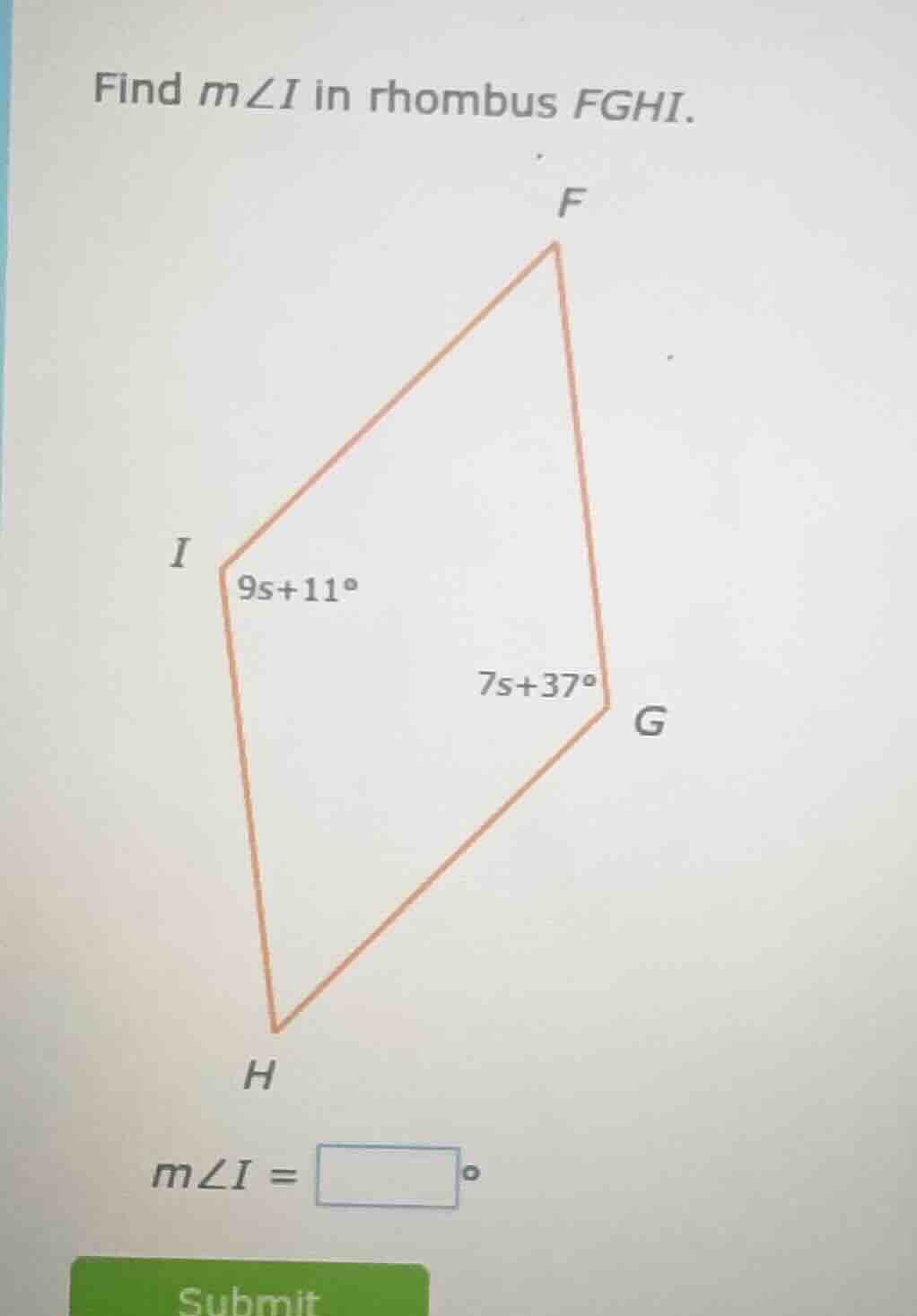
find ( mangle i ) in rhombus ( fghi ).
( mangle i = square^circ )
submit
Step1: Recall rhombus angle property
In a rhombus, adjacent angles are supplementary (sum to \(180^\circ\)), and opposite angles are equal. Here, \(\angle I\) and \(\angle G\) are adjacent? Wait, no, actually in rhombus \(FGHI\), \(\angle I\) and \(\angle G\) – wait, no, let's check the labels. The rhombus is \(FGHI\), so the vertices are \(F, G, H, I\) in order. So \(\angle I\) and \(\angle G\) – wait, no, actually, in a rhombus, consecutive angles (adjacent) are supplementary. Wait, but also, opposite angles are equal. Wait, maybe \(\angle I\) and \(\angle G\) – no, wait, the angles given: \(\angle I = 9s + 11^\circ\) and \(\angle G = 7s + 37^\circ\). Wait, in a rhombus, opposite angles are equal? No, wait, no: in a parallelogram (rhombus is a parallelogram), opposite angles are equal, and consecutive angles are supplementary. So \(FGHI\) is a parallelogram, so \(\angle I\) and \(\angle G\) – wait, no, \(\angle F\) and \(\angle H\) are opposite, \(\angle I\) and \(\angle G\) are opposite? Wait, no, the order is \(F, G, H, I\), so sides \(FG\) and \(HI\) are parallel, \(FI\) and \(GH\) are parallel. So \(\angle I\) and \(\angle G\) are consecutive angles? Wait, no, \(\angle I\) is at vertex \(I\), between \(FI\) and \(HI\); \(\angle G\) is at vertex \(G\), between \(FG\) and \(HG\). So \(FI \parallel HG\) and \(FG \parallel HI\), so \(\angle I\) and \(\angle G\) are same - side interior angles? Wait, no, in a parallelogram, consecutive angles (like \(\angle I\) and \(\angle H\), \(\angle H\) and \(\angle G\), \(\angle G\) and \(\angle F\), \(\angle F\) and \(\angle I\)) are supplementary. Wait, maybe I made a mistake. Wait, actually, in a rhombus (parallelogram), opposite angles are equal. So \(\angle I\) and \(\angle G\) – are they opposite? Wait, no, the vertices are \(F, G, H, I\), so opposite angles are \(\angle F\) and \(\angle H\), \(\angle I\) and \(\angle G\)? Wait, no, that can't be. Wait, maybe the angles given are opposite? Wait, the problem is that in the diagram, \(\angle I = 9s + 11\) and \(\angle G = 7s + 37\). Wait, maybe they are opposite angles? Wait, no, in a rhombus, opposite angles are equal. So if \(\angle I\) and \(\angle G\) are opposite, then \(9s + 11 = 7s + 37\). Wait, that makes sense. Let's try that.
So set \(9s + 11 = 7s + 37\) (since opposite angles in a rhombus are equal).
Step2: Solve for \(s\)
Subtract \(7s\) from both sides: \(9s - 7s + 11 = 37\)
Simplify: \(2s + 11 = 37\)
Subtract 11 from both sides: \(2s = 37 - 11 = 26\)
Divide by 2: \(s = \frac{26}{2} = 13\)
Step3: Find \(m\angle I\)
Now substitute \(s = 13\) into the expression for \(\angle I\): \(9s + 11\)
\(9(13) + 11 = 117 + 11 = 128^\circ\)
Wait, but let's check with the other angle. If \(s = 13\), then \(\angle G = 7(13) + 37 = 91 + 37 = 128^\circ\). Wait, but in a rhombus, consecutive angles should be supplementary. Wait, maybe I mixed up opposite and consecutive. Let's re - examine.
In a rhombus (parallelogram), consecutive angles are supplementary (sum to \(180^\circ\)), opposite angles are equal. So if \(\angle I\) and \(\angle G\) are consecutive, then \(9s + 11+7s + 37 = 180\)
Let's try that.
Step1 (corrected): Recall consecutive angles in rhombus
In a rhombus (parallelogram), consecutive angles are supplementary. So \(\angle I\) and \(\angle G\) are consecutive angles (since the rhombus is \(FGHI\), the order is \(F - G - H - I - F\), so \(\angle G\) and \(\angle I\) are consecutive, with a side \(GH\) and \(HI\) etc.). So \(m\angle I + m\angle G=180^\circ\)
So \((9s + 11)+(7s + 37)=180\)
Step2 (corrected): S…

Snap & solve any problem in the app
Get step-by-step solutions on Sovi AI
Photo-based solutions with guided steps
Explore more problems and detailed explanations
\(128\)