QUESTION IMAGE
Question
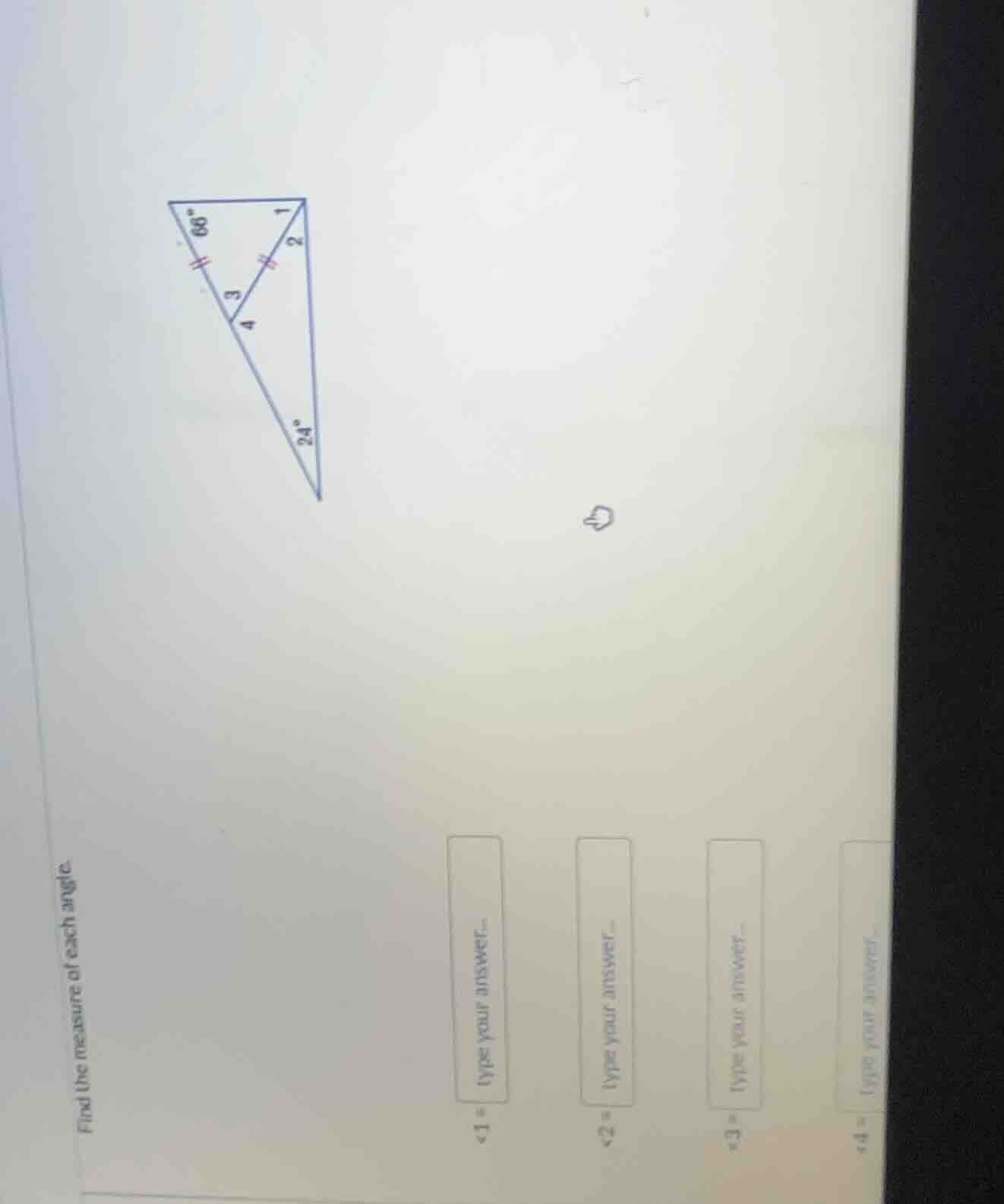
find the measure of each angle
∠1 = type your answer...
∠2 = type your answer...
∠3 = type your answer...
∠4 = type your answer...
Step1: Find angle 1 in the isosceles triangle
In the smaller triangle with two equal sides (marked with ticks), the vertex angle is \(68^\circ\). The sum of angles in a triangle is \(180^\circ\), and the base angles (angle 3 and the other equal angle) are equal. But first, angle 1: Wait, no, the larger triangle has angles \(68^\circ\), \(24^\circ\), so the third angle (angle 1 + angle 2) is \(180 - 68 - 24 = 88^\circ\). The smaller triangle is isosceles with vertex angle \(68^\circ\), so its base angles (angle 3) are \(\frac{180 - 68}{2} = 56^\circ\). Then angle 4 is supplementary to angle 3? Wait, no, angle 4 is an exterior angle or adjacent? Wait, let's re - analyze.
Wait, the larger triangle: angles sum to \(180^\circ\). So angle at the top (angle 1 + angle 2) = \(180 - 68 - 24=88^\circ\). The smaller triangle (with two equal sides) has angles: vertex angle \(68^\circ\), so the two base angles (angle 3 and the angle opposite to it) are equal. So angle 3=\(\frac{180 - 68}{2}=56^\circ\). Then angle 4 is a linear pair with angle 3? Wait, no, angle 4 and angle 3 are supplementary? Wait, angle 3 + angle 4 = \(180^\circ\)? No, angle 4 is an exterior angle of the smaller triangle. Wait, actually, in the smaller triangle, angle 3 is \(56^\circ\), then angle 4 is \(180 - 56 = 124^\circ\)? No, that can't be. Wait, maybe the smaller triangle is isosceles, so angle 3 = angle (the angle between the two equal sides). Wait, maybe I made a mistake. Let's start over.
The larger triangle: angles are \(68^\circ\), \(24^\circ\), and (angle 1 + angle 2). So \(68+24+(angle1 + angle2)=180\), so \(angle1 + angle2 = 88^\circ\). The smaller triangle (with two equal sides) has a vertex angle of \(68^\circ\), so it's an isosceles triangle, so the two base angles (let's call them angle 3 and angle x) are equal. So \(68 + 2\times angle3=180\), so \(2\times angle3 = 112\), so \(angle3 = 56^\circ\). Then angle 4 is a linear pair with angle 3? Wait, no, angle 4 and angle 3 are adjacent and form a linear pair? So angle 4 = \(180 - 56=124^\circ\)? No, that seems wrong. Wait, maybe angle 4 is equal to \(68 + 56\)? No, let's think about the larger triangle's angles.
Wait, angle 3 is \(56^\circ\), and in the larger triangle, angle 3 and angle 24^\circ and angle (angle 2) and angle 4? No, maybe angle 1: Wait, the smaller triangle is isosceles, so angle 3 = angle (the angle between the two equal sides). Then angle 4 is an exterior angle, so angle 4 = angle 3+68^\circ? No, that's the exterior angle theorem. Wait, exterior angle theorem: the exterior angle is equal to the sum of the two non - adjacent interior angles. So angle 4 is an exterior angle of the smaller isosceles triangle, so angle 4 = 68^\circ+56^\circ = 124^\circ? Wait, no, the exterior angle at angle 4: the two non - adjacent interior angles of the smaller triangle are \(68^\circ\) and \(56^\circ\), so angle 4 = \(68 + 56=124^\circ\). Then, in the larger triangle, we know angle 3 = 56^\circ, angle 24^\circ, and angle 4 is 124^\circ? No, that can't be. Wait, I think I messed up the diagram. Let's assume that the segment with two ticks is a mid - segment or something. Wait, maybe the smaller triangle is isosceles, so angle 1 = angle 2? Wait, no, the two equal sides are in the smaller triangle. Wait, the problem is to find angle 1, angle 2, angle 3, angle 4.
Let's try again:
- Find angle 3:
The smaller triangle is isosceles with vertex angle \(68^\circ\). Using the triangle angle sum formula \(A + B + C=180^\circ\), where \(A = 68^\circ\) and \(B = C=\) angle 3. So \(68+2\times angle3 = 180\).
\(2\time…

Snap & solve any problem in the app
Get step-by-step solutions on Sovi AI
Photo-based solutions with guided steps
Explore more problems and detailed explanations
\(angle1 = 56^\circ\), \(angle2 = 32^\circ\), \(angle3 = 56^\circ\), \(angle4 = 124^\circ\)