QUESTION IMAGE
Question
find the measure indicated.
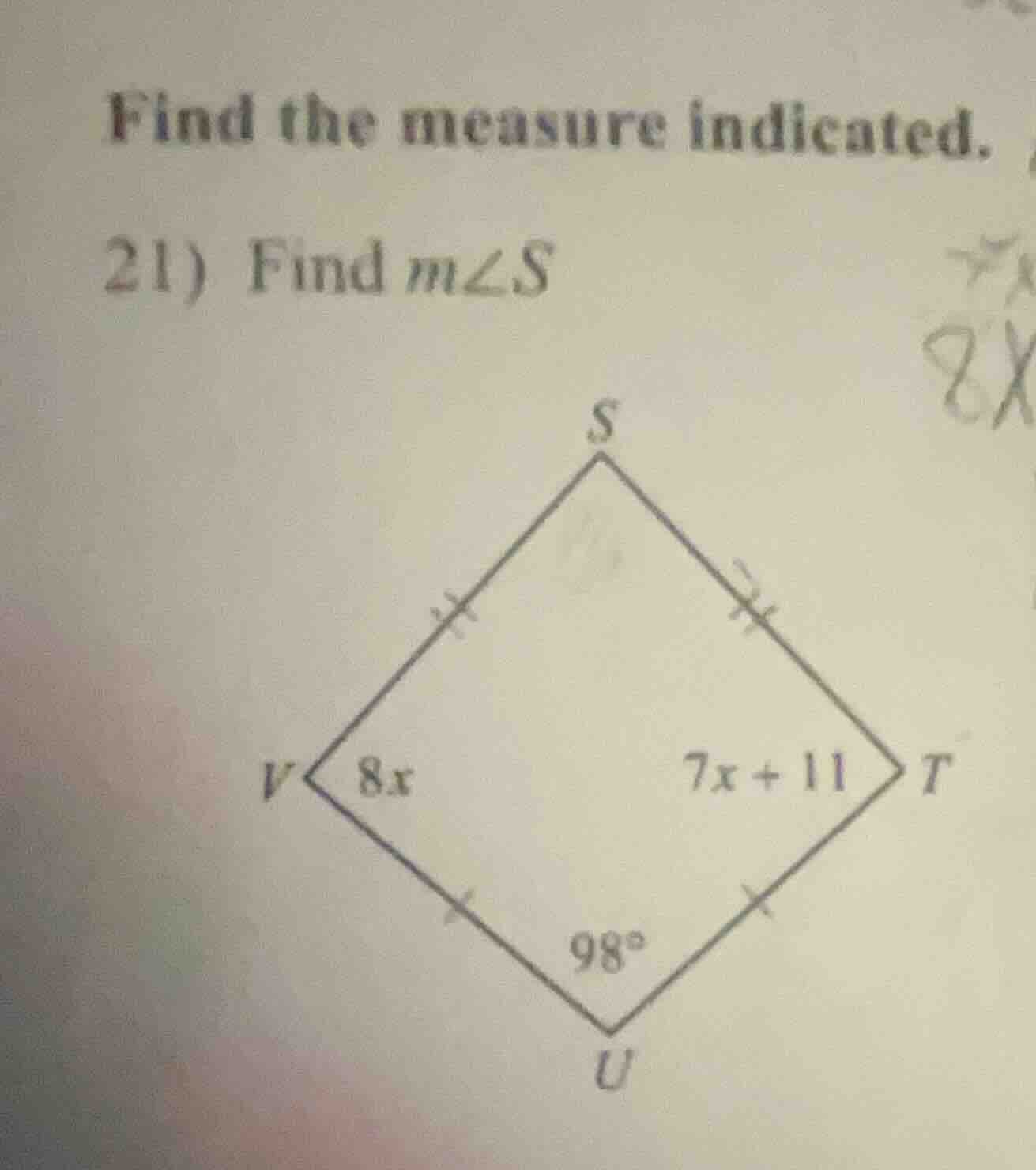
- find ( mangle s )
Step1: Identify properties of a rhombus
In a rhombus, opposite angles are equal, and adjacent angles are supplementary (sum to \(180^\circ\)). Also, opposite angles are equal, so \(\angle V=\angle T\) and \(\angle S=\angle U\)? Wait, no, wait. Wait, in a rhombus, opposite angles are equal, and adjacent angles are supplementary. Wait, looking at the diagram, sides are marked as equal, so it's a rhombus. So \(\angle V\) and \(\angle T\) should be equal? Wait, the angles at \(V\) is \(8x\), at \(T\) is \(7x + 11\). So set them equal: \(8x=7x + 11\).
Step2: Solve for \(x\)
\(8x=7x + 11\)
Subtract \(7x\) from both sides: \(x = 11\).
Step3: Find measure of \(\angle V\) and \(\angle T\)
Now, \(\angle V=8x=8\times11 = 88^\circ\), \(\angle T=7x + 11=7\times11+11 = 88^\circ\) (checks out). Now, in a rhombus, adjacent angles are supplementary. So \(\angle S\) and \(\angle U\) are adjacent to \(\angle V\) and \(\angle T\)? Wait, \(\angle U\) is \(98^\circ\). Wait, no, in a rhombus, opposite angles are equal. Wait, maybe I mixed up. Wait, \(\angle U\) is \(98^\circ\), so its opposite angle \(\angle S\)? Wait, no, wait the diagram: vertices are \(S\), \(T\), \(U\), \(V\) in order? So \(S\) connected to \(T\) and \(V\), \(T\) connected to \(S\) and \(U\), \(U\) connected to \(T\) and \(V\), \(V\) connected to \(U\) and \(S\). So the angles: \(\angle S\) is opposite \(\angle U\)? Wait, no, in a quadrilateral, opposite angles are \(\angle S\) and \(\angle U\), \(\angle V\) and \(\angle T\). Wait, but \(\angle U\) is \(98^\circ\), so if \(\angle S\) is opposite \(\angle U\), then they should be equal? But that contradicts. Wait, no, maybe I got the order wrong. Wait, adjacent angles: \(\angle S\) is adjacent to \(\angle V\) and \(\angle T\), and \(\angle U\) is adjacent to \(\angle V\) and \(\angle T\). Wait, in a rhombus, adjacent angles are supplementary. So \(\angle S + \angle V=180^\circ\), \(\angle S + \angle T=180^\circ\), \(\angle U + \angle V=180^\circ\), \(\angle U + \angle T=180^\circ\). Wait, \(\angle U\) is \(98^\circ\), so \(\angle S\) should be supplementary to \(\angle U\)? Wait, no, opposite angles in a rhombus are equal. Wait, maybe the diagram has \(\angle U = 98^\circ\), so its opposite angle is \(\angle S\)? But that would mean \(\angle S = 98^\circ\), but that doesn't fit with adjacent angles. Wait, no, I think I made a mistake. Wait, let's re-examine. The quadrilateral is a rhombus (all sides equal). In a rhombus, opposite angles are equal, and adjacent angles are supplementary. So if \(\angle U = 98^\circ\), then its opposite angle (say \(\angle S\)) should be equal? No, wait no: in a rhombus, opposite angles are equal, adjacent angles are supplementary. Wait, maybe the angles at \(V\) and \(T\) are equal (since they are opposite), and angles at \(S\) and \(U\) are equal (opposite). Then adjacent angles: \(\angle V + \angle S=180^\circ\), \(\angle S + \angle T=180^\circ\), etc. Wait, we found \(\angle V = 88^\circ\), so \(\angle S\) (adjacent to \(\angle V\)) should be \(180^\circ - 88^\circ = 92^\circ\)? Wait, but \(\angle U\) is \(98^\circ\), which would be opposite \(\angle S\), but \(92
eq98\). Wait, that's a problem. Wait, maybe I misidentified the opposite angles. Wait, let's look at the diagram again. The sides: \(SV\) and \(ST\) are marked with two ticks? Wait, no, the diagram: \(SV\) and \(ST\) have two ticks? Wait, no, the original diagram: \(SV\) and \(ST\) are marked with two ticks? Wait, maybe the sides \(SV\) and \(VT\)? No, the user's diagram: vertices \(S\), \(T\), \(U\), \(V\). \(SV\) and \(ST\) have…

Snap & solve any problem in the app
Get step-by-step solutions on Sovi AI
Photo-based solutions with guided steps
Explore more problems and detailed explanations
\(92^\circ\)