QUESTION IMAGE
Question
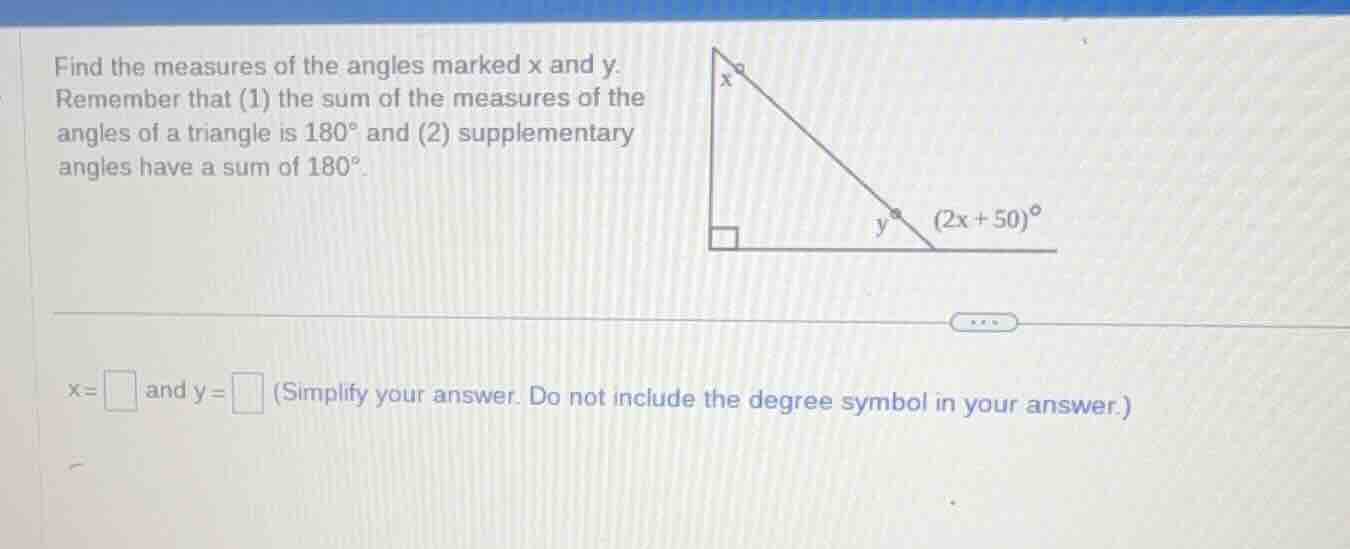
find the measures of the angles marked x and y. remember that (1) the sum of the measures of the angles of a triangle is 180° and (2) supplementary angles have a sum of 180°. x = \square and y = \square (simplify your answer. do not include the degree symbol in your answer.)
Step1: Analyze the right triangle
The triangle is a right triangle, so one angle is \(90^\circ\), another is \(x^\circ\), and the third angle (interior angle adjacent to \(y\)) and \(y\) are supplementary. Also, the exterior angle \((2x + 50)^\circ\) and the interior angle adjacent to it are supplementary. First, use the fact that in a right triangle, the two non - right angles are related to the exterior angle. The exterior angle of a triangle is equal to the sum of the two non - adjacent interior angles. So, \(2x + 50=90 + x\).
Step2: Solve for x
Solve the equation \(2x+50 = 90+x\). Subtract \(x\) from both sides: \(2x - x+50=90+x - x\), which gives \(x + 50=90\). Then subtract 50 from both sides: \(x=90 - 50=40\).
Step3: Solve for y
Now that we know \(x = 40\), the angle \(2x + 50=2\times40+50 = 80 + 50=130\). Since \(y\) and \(2x + 50\) are supplementary (they form a linear pair), \(y+2x + 50=180\). Substitute \(2x + 50 = 130\) into the equation: \(y+130 = 180\). Subtract 130 from both sides: \(y=180 - 130 = 50\). Or we can use the triangle angle sum. The interior angle adjacent to \(y\) is \(180 - y\). In the right triangle, \(90+x+(180 - y)=180\). Substitute \(x = 40\): \(90 + 40+180 - y=180\), \(310 - y=180\), \(y=310 - 180 = 130\)? Wait, no, I made a mistake. Wait, the exterior angle is equal to the sum of the two non - adjacent interior angles. The two non - adjacent interior angles of the exterior angle \((2x + 50)^\circ\) are the right angle (\(90^\circ\)) and \(x^\circ\). So \(2x+50=90 + x\) (correct). Then \(x = 40\). Now, the angle \(y\) and the interior angle at the base of the triangle (let's call it \(z\)) are supplementary, and \(z=180-(90 + x)=180-(90 + 40)=50\). So \(y = 180 - z=180 - 50 = 130\)? Wait, no, I messed up the exterior angle. Wait, the exterior angle is \(2x + 50\), and the interior angle adjacent to it is \(180-(2x + 50)\). In the triangle, the sum of angles is \(90+x+(180-(2x + 50))=180\). Let's expand: \(90+x + 180-2x - 50=180\), \(220 - x=180\), \(x=220 - 180 = 40\) (same as before). Then the interior angle adjacent to \(y\) is \(180-(2x + 50)=180-(80 + 50)=50\). Then, since \(y\) and this interior angle are supplementary, \(y = 180 - 50=130\)? Wait, now I'm confused. Wait, let's draw the triangle. It's a right - angled triangle, right angle at the bottom left. The base is horizontal, the other side is vertical. The hypotenuse is from the top left (right angle) to the bottom right. Then, there is an extension of the base to the right, forming an exterior angle at the bottom right vertex. So the interior angle at the bottom right of the triangle is \(180 - y\) (since \(y\) is the exterior angle there). In the triangle, the sum of angles is \(90 + x+(180 - y)=180\). So \(90+x + 180-y=180\), \(x - y=- 90\), \(y=x + 90\). But we also know that the exterior angle \(2x + 50\) and \(y\) are supplementary? No, the exterior angle and the interior angle at that vertex are supplementary. So \(2x + 50+(180 - y)=180\), \(2x+50 - y=0\), \(y = 2x+50\). But from the triangle angle sum: \(90+x+(180 - y)=180\), \(x - y=- 90\), \(y=x + 90\). So set \(2x + 50=x + 90\), \(2x - x=90 - 50\), \(x = 40\). Then \(y=x + 90=40+90 = 130\). Ah, I see my earlier mistake. The exterior angle is equal to the sum of the two non - adjacent interior angles. The two non - adjacent interior angles to the exterior angle \(2x + 50\) are \(x\) and \(90\), so \(2x+50=x + 90\) (correct). Then \(x = 40\), and \(y\) is supplementary to the interior angle at that vertex. The interior angle at that vertex is \(180 - y\), and in the tr…

Snap & solve any problem in the app
Get step-by-step solutions on Sovi AI
Photo-based solutions with guided steps
Explore more problems and detailed explanations
\(x = 40\) and \(y = 130\)