QUESTION IMAGE
Question
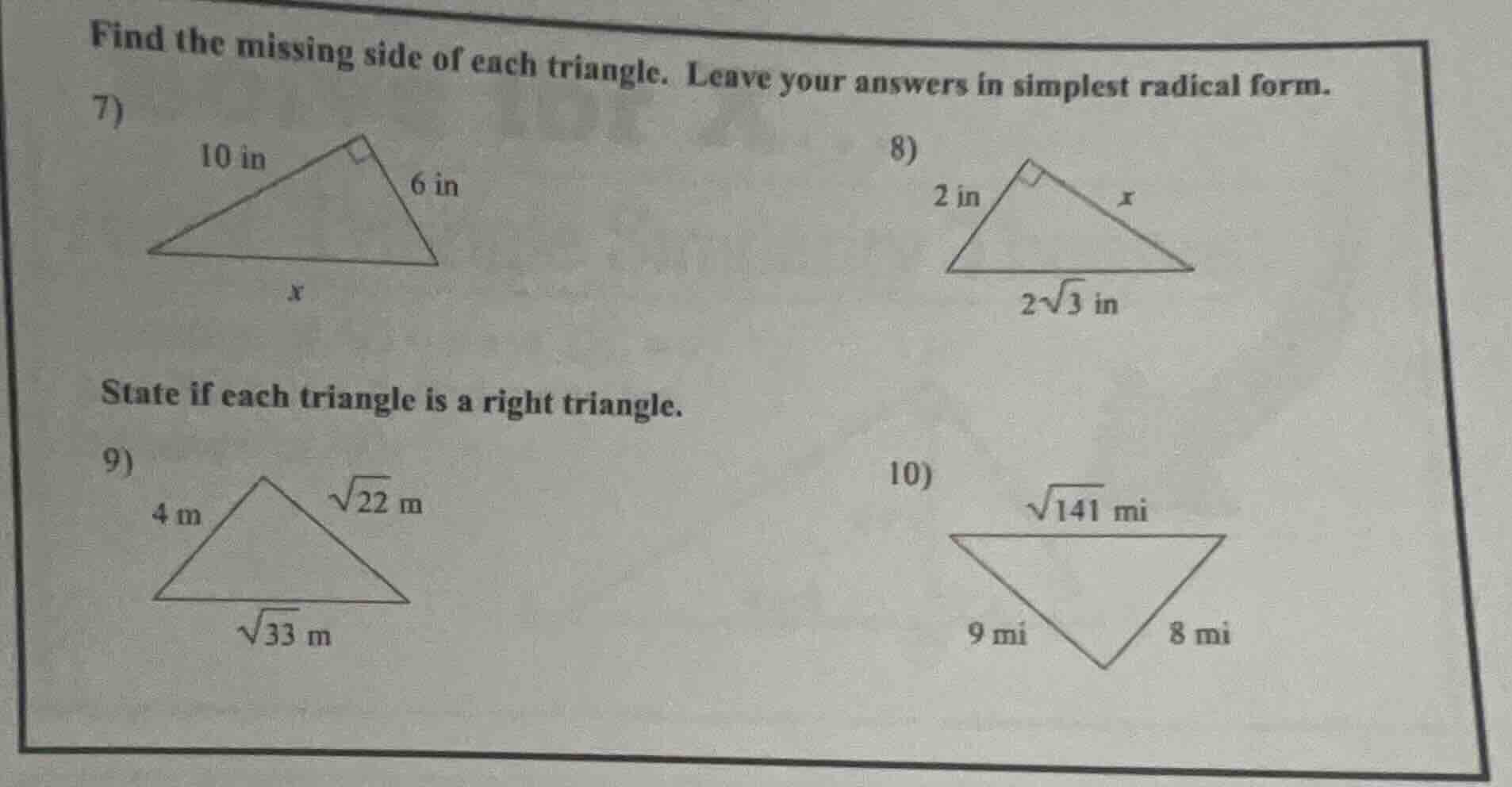
find the missing side of each triangle. leave your answers in simplest radical form.
7)
8)
state if each triangle is a right triangle.
9)
10)
Problem 7
Step1: Identify the triangle type (right triangle)
This is a right triangle, so we use the Pythagorean theorem: \( a^2 + b^2 = c^2 \), where \( a = 10 \), \( b = 6 \), and \( c = x \).
Step2: Apply the Pythagorean theorem
\( x^2 = 10^2 + 6^2 \)
\( x^2 = 100 + 36 \)
\( x^2 = 136 \)
\( x = \sqrt{136} = \sqrt{4 \times 34} = 2\sqrt{34} \)
Step1: Identify the triangle type (right triangle)
This is a right triangle, so we use the Pythagorean theorem: \( a^2 + b^2 = c^2 \), where \( a = 2 \), \( b = x \), and \( c = 2\sqrt{3} \).
Step2: Apply the Pythagorean theorem
\( (2\sqrt{3})^2 = 2^2 + x^2 \)
\( 12 = 4 + x^2 \)
\( x^2 = 12 - 4 = 8 \)
\( x = \sqrt{8} = 2\sqrt{2} \)
Step1: Recall the Pythagorean theorem for right triangles
For a triangle with sides \( a \), \( b \), \( c \) (where \( c \) is the longest side), it is a right triangle if \( a^2 + b^2 = c^2 \). Here, the sides are \( 4 \), \( \sqrt{22} \), \( \sqrt{33} \). The longest side is \( \sqrt{33} \) (since \( \sqrt{33} \approx 5.74 \), \( 4 = 4 \), \( \sqrt{22} \approx 4.69 \)).
Step2: Check the Pythagorean theorem
Calculate \( 4^2 + (\sqrt{22})^2 = 16 + 22 = 38 \)
Calculate \( (\sqrt{33})^2 = 33 \)
Since \( 38
eq 33 \), it is not a right triangle.

Snap & solve any problem in the app
Get step-by-step solutions on Sovi AI
Photo-based solutions with guided steps
Explore more problems and detailed explanations
\( 2\sqrt{34} \) in