QUESTION IMAGE
Question
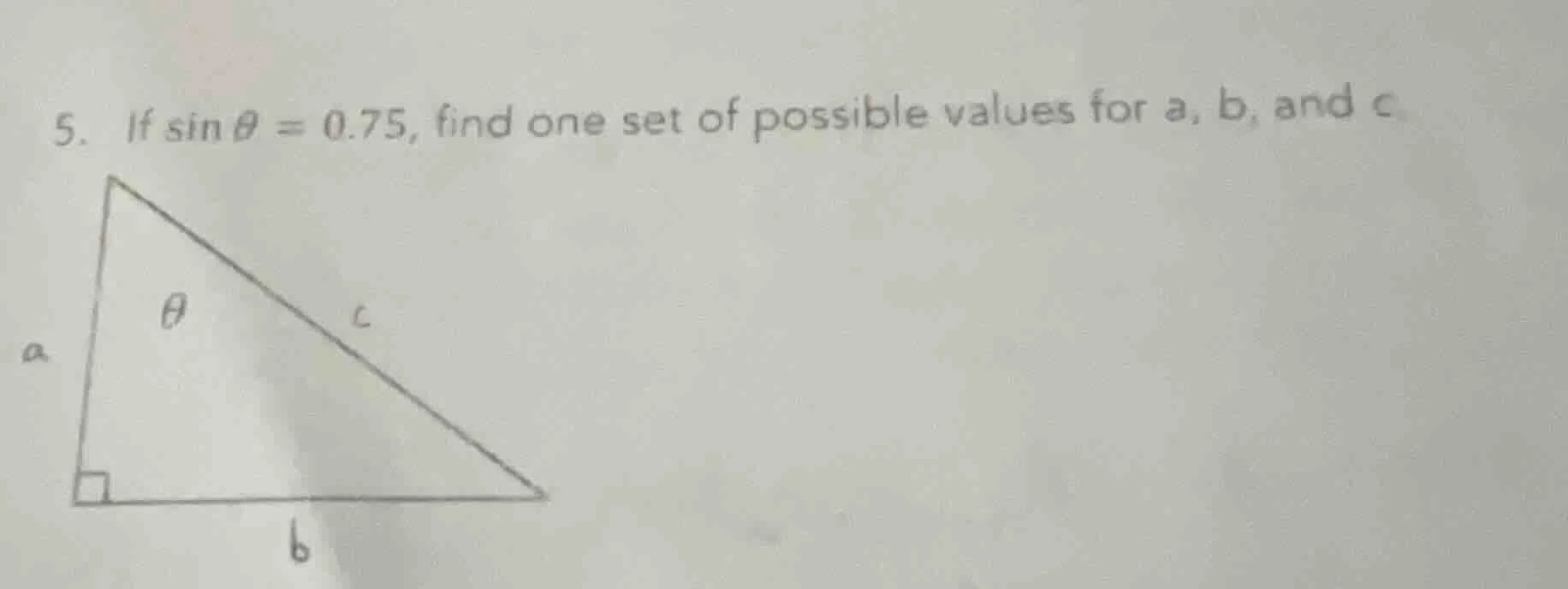
- if \\(\sin \theta = 0.75\\), find one set of possible values for \\(a\\), \\(b\\), and \\(c\\).
Step1: Recall sine definition
In a right triangle, $\sin\theta = \frac{\text{opposite}}{\text{hypotenuse}}$. For angle $\theta$, opposite side is $b$? Wait, no, wait: looking at the triangle, the right angle is at the bottom left, so angle $\theta$ is at the top? Wait, no, the sides: $a$ is vertical leg, $b$ is horizontal leg, $c$ is hypotenuse. Wait, angle $\theta$: let's see, the angle with $\sin\theta$: $\sin\theta = \frac{\text{opposite}}{\text{hypotenuse}}$. So if $\theta$ is at the top, then opposite side is $b$? Wait, no, maybe I got the labels wrong. Wait, the right angle is between $a$ and $b$, so $a$ and $b$ are legs, $c$ is hypotenuse. Let's assume $\theta$ is the angle opposite to side $b$? No, wait, the diagram: the vertical leg is $a$, horizontal leg is $b$, hypotenuse $c$. So angle $\theta$: let's say $\theta$ is the angle at the top, so the opposite side to $\theta$ is $b$, adjacent is $a$, hypotenuse $c$. Wait, no, $\sin\theta = \frac{\text{opposite}}{\text{hypotenuse}}$. Wait, maybe $\theta$ is the angle at the bottom right? No, the right angle is at bottom left. So the two acute angles: one at top, one at bottom right. Let's take $\theta$ as the angle at the bottom right. Then opposite side is $a$, adjacent is $b$, hypotenuse $c$. So $\sin\theta = \frac{a}{c} = 0.75 = \frac{3}{4}$. So we can set $a = 3k$, $c = 4k$ for some positive real number $k$. Then use Pythagorean theorem to find $b$.
Step2: Choose k=1
Let $k = 1$. Then $a = 3(1) = 3$, $c = 4(1) = 4$. Then by Pythagoras, $a^2 + b^2 = c^2$. So $3^2 + b^2 = 4^2$ → $9 + b^2 = 16$ → $b^2 = 7$ → $b = \sqrt{7} \approx 2.6458$. But maybe we want integer values? Wait, 0.75 is 3/4, so if we take $a = 3$, $c = 4$, then $b = \sqrt{4^2 - 3^2} = \sqrt{7}$. Alternatively, scale by a factor. Wait, but maybe the problem allows non-integer, or we can choose $k$ such that $b$ is integer? Wait, no, 3-4-5 triangle: but 3/5 is 0.6, not 0.75. Wait, 0.75 is 3/4, so the ratio of opposite to hypotenuse is 3/4. So let's take $a = 3$, $c = 4$, then $b = \sqrt{4^2 - 3^2} = \sqrt{7}$. Or take $a = 6$, $c = 8$, then $b = \sqrt{8^2 - 6^2} = \sqrt{64 - 36} = \sqrt{28} = 2\sqrt{7}$. But maybe the problem just wants one set, so let's take $k=1$: $a=3$, $b=\sqrt{7}$, $c=4$. Or if we want rational $b$, we can scale by a factor. Wait, no, 3/4 is the sine, so let's use $a=3$, $c=4$, then $b=\sqrt{7}$. Alternatively, maybe the angle $\theta$ is opposite to $b$? Wait, maybe I mixed up the sides. Let's re-examine: if $\theta$ is the angle at the top, then opposite side is $b$, hypotenuse $c$, so $\sin\theta = b/c = 0.75$. Then $b = 0.75c$. Let's take $c = 4$, then $b = 3$, then $a = \sqrt{c^2 - b^2} = \sqrt{16 - 9} = \sqrt{7}$. Ah, so regardless of which angle $\theta$ is, as long as we define opposite side correctly. So let's confirm: in the right triangle, $\sin\theta = \frac{\text{opposite}}{\text{hypotenuse}}$. So if $\theta$ is the angle with opposite side $a$, then $a/c = 0.75$; if opposite side $b$, then $b/c = 0.75$. Let's assume $\theta$ is the angle where opposite side is $a$, so $a = 0.75c$. Let's choose $c = 4$, then $a = 3$, then $b = \sqrt{c^2 - a^2} = \sqrt{16 - 9} = \sqrt{7}$. So one set is $a=3$, $b=\sqrt{7}$, $c=4$. Or if we take $c = 8$, then $a = 6$, $b = \sqrt{64 - 36} = \sqrt{28} = 2\sqrt{7}$, etc. But the simplest is $c=4$, $a=3$, $b=\sqrt{7}$.

Snap & solve any problem in the app
Get step-by-step solutions on Sovi AI
Photo-based solutions with guided steps
Explore more problems and detailed explanations
One set of possible values is \( a = 3 \), \( b = \sqrt{7} \), \( c = 4 \) (or other scaled versions, e.g., \( a = 6 \), \( b = 2\sqrt{7} \), \( c = 8 \), etc.).