QUESTION IMAGE
Question
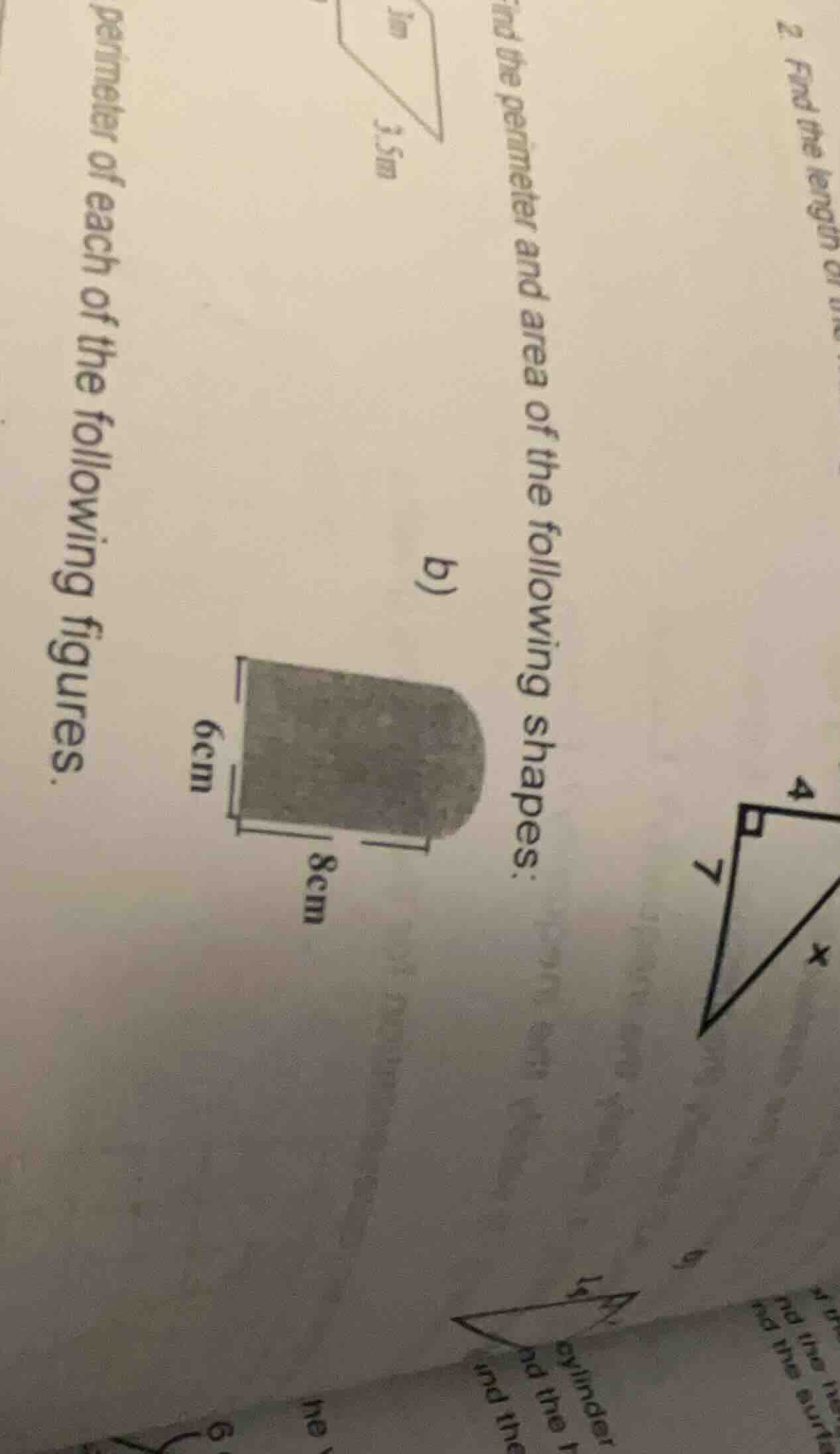
find the perimeter and area of the following shapes.
perimeter of each of the following figures.
b)
6cm
8cm
Part b) (Assuming the shape is a rectangle with a semicircle on one end)
Step 1: Analyze the shape components
The shape has a rectangle (length \( l = 8\,\text{cm} \), width \( w = 6\,\text{cm} \)) and a semicircle (diameter \( d = 6\,\text{cm} \), so radius \( r=\frac{d}{2}= 3\,\text{cm} \)). For perimeter, we consider three sides of the rectangle and the curved part (semicircle). For area, we consider the area of the rectangle and the area of the semicircle.
Step 2: Calculate the perimeter
- Perimeter of the three sides of the rectangle: \( 2\times l + w=2\times8 + 6=16 + 6 = 22\,\text{cm} \)
- Length of the semicircle: \( \frac{1}{2}\times\pi\times d=\frac{1}{2}\times\pi\times6 = 3\pi\approx3\times3.14 = 9.42\,\text{cm} \)
- Total perimeter: \( 22+9.42 = 31.42\,\text{cm} \)
Step 3: Calculate the area
- Area of the rectangle: \( l\times w=8\times6 = 48\,\text{cm}^2 \)
- Area of the semicircle: \( \frac{1}{2}\times\pi\times r^2=\frac{1}{2}\times\pi\times3^2=\frac{9\pi}{2}\approx\frac{9\times3.14}{2}=14.13\,\text{cm}^2 \)
- Total area: \( 48 + 14.13=62.13\,\text{cm}^2 \)
Step 1: Recall the formula for the perimeter of a parallelogram
Perimeter of a parallelogram \( P = 2\times(a + b) \), where \( a \) and \( b \) are the lengths of adjacent sides.
Step 2: Substitute the values
Here, \( a = 3.5\,\text{m} \), \( b = 1\,\text{m} \)
\( P=2\times(3.5 + 1)=2\times4.5 = 9\,\text{m} \)
(For area of parallelogram, if height \( h \) is given, but since it's not clear from the image, assuming we only need perimeter as per the initial "find the perimeter" text)

Snap & solve any problem in the app
Get step-by-step solutions on Sovi AI
Photo-based solutions with guided steps
Explore more problems and detailed explanations
- Perimeter: \( \boldsymbol{31.42\,\text{cm}} \) (or \( 22 + 3\pi\,\text{cm} \))
- Area: \( \boldsymbol{62.13\,\text{cm}^2} \) (or \( 48+\frac{9\pi}{2}\,\text{cm}^2 \))
(Note: If the first shape (a) is a parallelogram with sides \( 3.5\,\text{m} \) and \( 1\,\text{m} \)):